
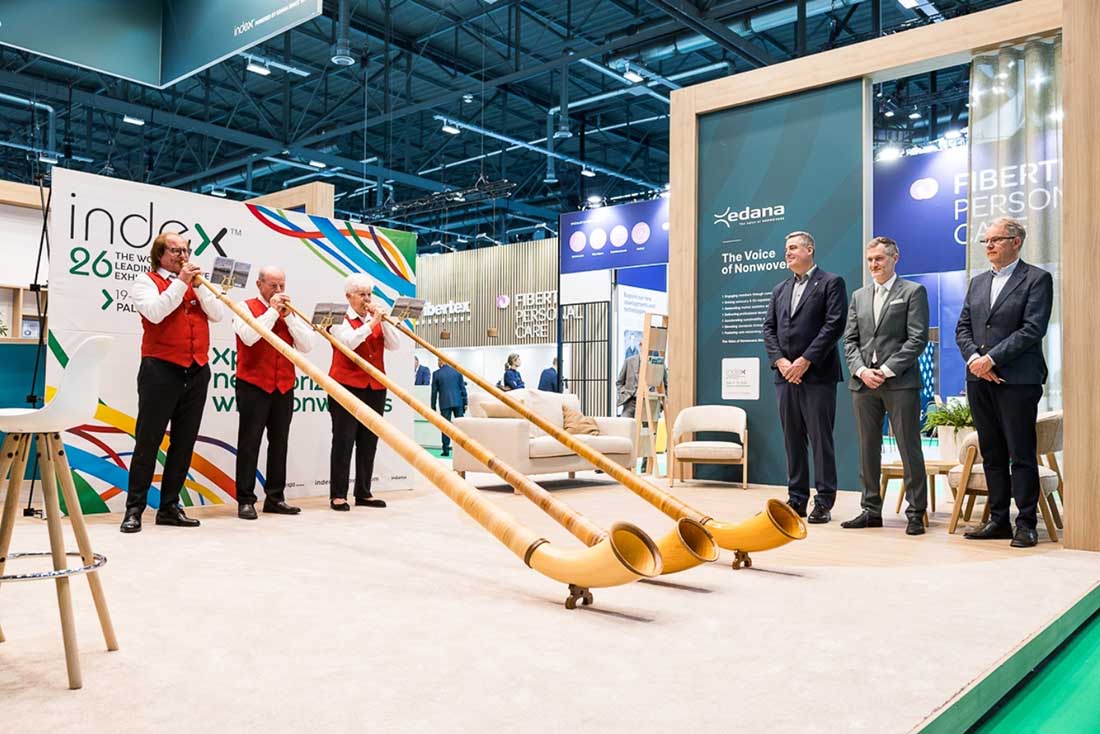
Attracting 625 exhibitors from 44 countries and 11,452 visitors over its four days, EDANA’s INDEX 26 trade fair for nonwovens, co-organized with Palexpo, successfully reinforced Geneva’s role as the go-to hub for the industry’s innovation every three years.
A defining theme of the latest edition was the integration of technical enhancements and environmental responsibility across the supply chain, with a major focus on circular design and carbon footprint reduction as primary performance indicators. The strong response to the specialized seminar program also highlighted how global collaboration and smart technologies are helping to shape a path for a circular manufacturing landscape.
“Despite the current geopolitical issues affecting travel conditions and budgets, the industry demonstrated a strong commitment to being in Geneva,” said INDEX Director Magali Fakhry Dufresne. “Our participants proved keen to meet in person, reconnect with their peers and advance discussions and INDEX is also a great opportunity for the younger generation to discover many innovations all under one roof. Exhibitors played a decisive role in the success of the edition, with stands that reflected the strength and ambition of the sector.”
Key Markets
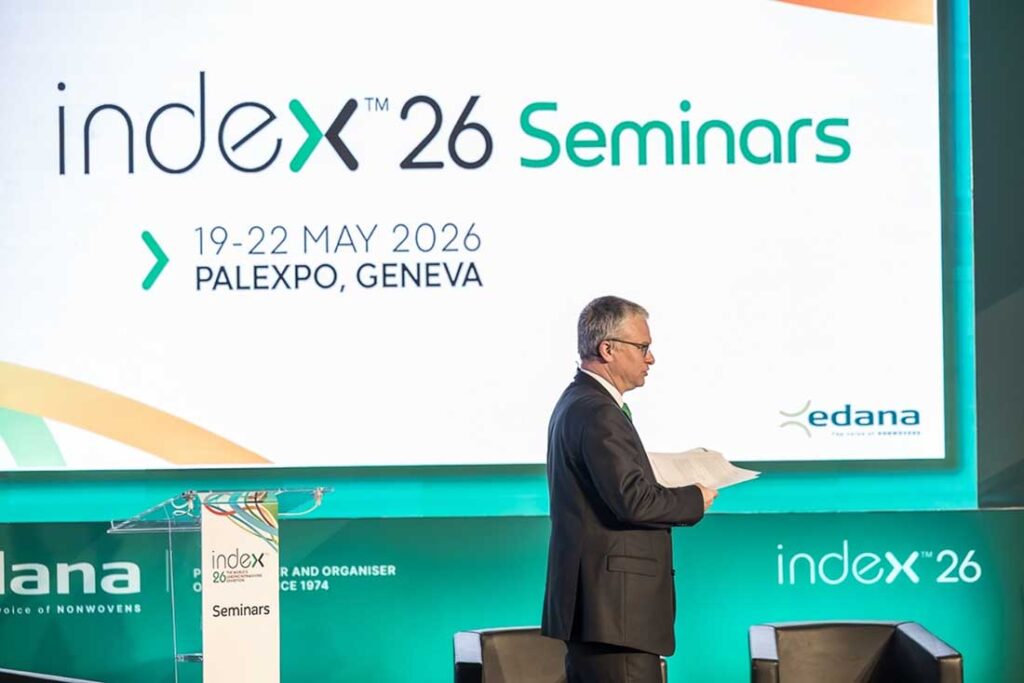
A major seminar in Geneva examined the performance of the main markets of North America, Greater Europe and Asia, with some telling distinctions between the three.
The five leading nonwovens production countries in Asia — China, India, Japan, South Korea and Taiwan — produced some 7.7 million tons of nonwovens in 2025, according to Kazuaki Baba, secretary general of ANFA, the Japan-headquartered Asia Nonwoven Fabrics Association, and China’s growth has been unprecedented.
China’s production climbed from 3,260,000 tons in 2016 to 6,090,000 tons in 2025, with hygiene and medical products accounting for 49 percent of 2025 output. Growth peaked at 25 percent in 2019 but actually fell to -1 percent in 2021 due to COVID-19, before climbing back to a healthy 6 percent in 2025.

Yet hindering this growth in capacity over the past few years has been a gradual fall in the profitability of China’s crucial exports. ANFA figures show that in 2023, exports from China amounted to 1.3 million tons with a value of $3.8 billion, equating to a value of $2.9 per kilo. A year later in 2024, exports climbed to 1.5 million tons with a value of over $4 billion, equating to $2.6 per kilo. In 2025, this value dropped further with 1.7 million tons of product netting roughly $4.3 billion with a value of $2.51 per kilo.
India’s Growth
Nonwovens production in India has meanwhile almost doubled since 2019, when production was 536,000 tons. It reached 934,000 tons in 2025 following some notable investments in high capacity spunmelt technology.
One unique feature of India’s market is that 26 percent of output is serving the packaging market, primarily nonwoven shopping bags which have become increasingly popular across the country over the past decade, driven by restrictions on single-use plastics, low production costs and the rapid expansion of organized retail. Made primarily from polypropylene spunbond nonwovens, these bags offer retailers an inexpensive alternative to conventional plastic carriers while providing consumers with products perceived as more durable and reusable. Their lightweight construction, printability and suitability for high-volume automated production have helped create a large domestic manufacturing sector, particularly in states such as Gujarat, Maharashtra and Tamil Nadu. Their sustainability credentials, however, remain debated — especially since reuse rates remain low and disposal infrastructure is limited.
Import Pressures
By comparison, nonwovens production in the United States and Europe has been comparatively stable.
North American production was 5.7 million tons in 2025, evenly split in terms of durable and disposable end markets. In presenting the figures, INDA, the Association of the Nonwoven Fabrics Industry’s President and CEO Tony Fragnito observed that operating rates at North American plants had fallen to 78 percent in 2025, largely as a result of the installation of a number of newer and faster machines, but imports are also growing — despite the Trump Administration’s imposition of corrective tariffs.
Overall nonwovens production in Europe fell by around 2.2 percent in 2025, reaching 2,919,000 tons, according to EDANA market analysis and economic affairs director Jacques Prigneaux. He put this down largely to a slowdown in demand across some key market segments, but also increasing competition from overseas.
Coinciding with INDEX 2026, EDANA welcomed the European Commission’s imposition of provisional anti-dumping duties of 45 to 50 percent on imports of certain polyethylene terephthalate (PET) spunbond fabrics from China, after eight months of investigation.
“It is encouraging to see the EU institutions are determined to support EU industries during these globally difficult times,” Prigneaux said. “EU production creates a lot of added value for our economy and it is essential for the stability and prosperity of our continent that industrial value chains are not exposed to unfair, state-supported market behavior on their home markets.”
Innovation Awards
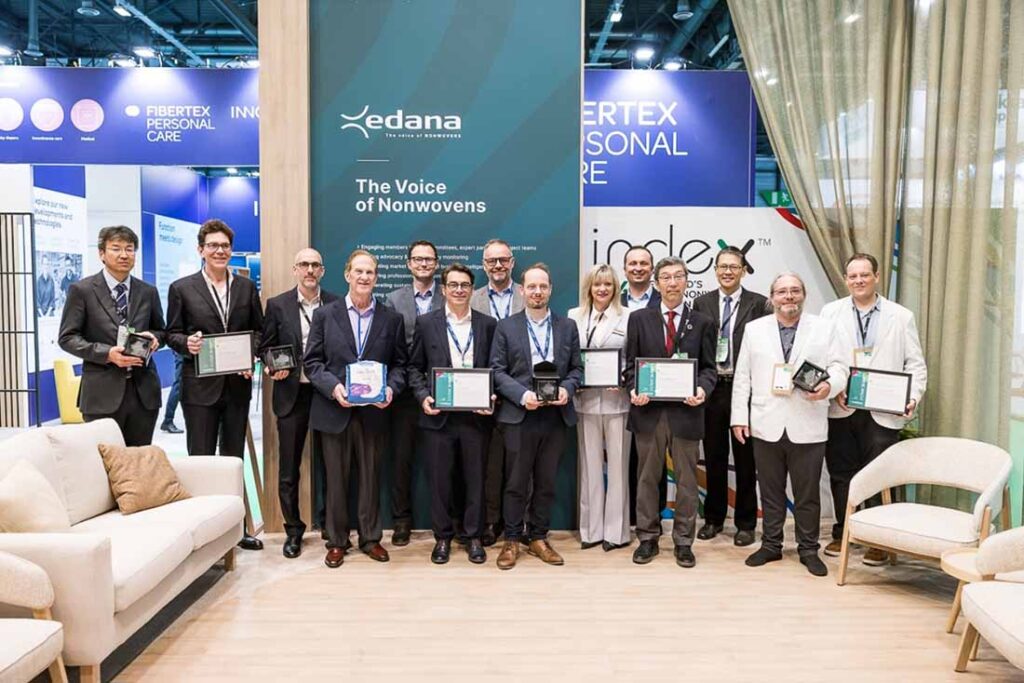
Technical excellence and innovation were recognized in Geneva with five companies receiving INDEX 2026 Awards.
Lenzing took the award in the nonwoven roll goods category for Dualwipe, a high-performance cleaning wipe produced from regenerated cellulose. Its dual-surface construction combines abrasion and absorbency within a single material, with one surface engineered to remove dirt, grease and residues through mechanical action and the reverse providing a softer, highly absorbent finish for liquid uptake and surface cleaning. The new material is designed to integrate with existing converting and processing infrastructure, supporting straightforward implementation.
Personalized Protection
Corman claimed the award in the single-use finished products category for its development of the Organyc Personalized Protection light incontinence pad.
The pad’s Smart-Cotton cover combined with a citric acid buffer helps maintain skin at a pH of 5.5 to reduce irritation. Meanwhile, a cotton-balanced core directs liquid towards superabsorbent polymers that retain moisture and expand towards the body to enhance leak protection. The pad also incorporates a natural odor control system that binds ammonia and slows odor formation rather than masking it. Clinically validated, the product addresses three key concerns associated with light incontinence — leakage, odor and skin comfort.
Washability
In the durable finished products category, Confitex Technology was recognized for its reusable nonwoven bed pads which introduce a new application area for nonwoven materials through machine washability and tumble drying.
The company’s proprietary fiber stabilization process enables absorbent nonwoven structures to maintain performance through more than 30 wash and drying cycles. The construction combines a fast-wicking top layer with a highly absorbent core capable of retaining more than two liters of liquid, while a bonded frame helps prevent leakage across the full surface, including at the edges.
Bostik meanwhile received the award in the raw materials and components category for Kizen Miles 9.0, an adhesive that introduces debonding on demand to disposables.
When exposed to a specific chemical trigger under controlled temperature and mechanical conditions, the adhesive enables rapid separation of plastic components while remaining attached to the substrate. The process supports cleaner recycling streams while maintaining reliable bonding performance during use. Containing up to 75 percent renewable content, the material performs across a broad range of substrates including polypropylene (PP), polyethylene (PE) and polylactic acid (PLA) and remains stable under wet conditions.
The machinery innovation award went to Zuiko for its reclosing baby diaper converting machine, developed to produce adjustable pull-on pant diapers that combine secure fit with softness and stretch.
Unlike conventional pant diapers, which are produced symmetrically, the machine’s design has an asymmetric construction and a precise adhesive-free attachment process during folding. At the center of the line is Zuiko’s “stretch re-pitch drum” technology, which regulates elastic tension and product spacing while allowing panel folding to remain aligned with machine flow. The system enables production speeds of more than 700 diapers per minute without the need for multiple folding units.
Strong Orders
A number of significant new contracts were concluded by major technology providers in Geneva, recognizing both the demand for nonwoven products in comparatively new regions and the drive for additional value, particularly by Chinese manufacturers.
Austria-based Andritz, for example, announced the sale of new lines to companies in both the Democratic Republic of Congo (DRC) and Uzbekistan.
Despite facing numerous issues — including regional conflicts, as well as the latest Ebola outbreak — DRC is an extraordinary country in terms of scale and resources, with huge rivers, vast farmland and some of the world’s richest deposits of copper, cobalt and other minerals.
Its population of 120 million is growing by roughly 3 to 4 million people per year and its capital Kinshasa alone, with a current population of 20 million, is seeing around 800,000 babies born each year — more, for example, than are conceived across the entire United Kingdom with its population of 70 million.
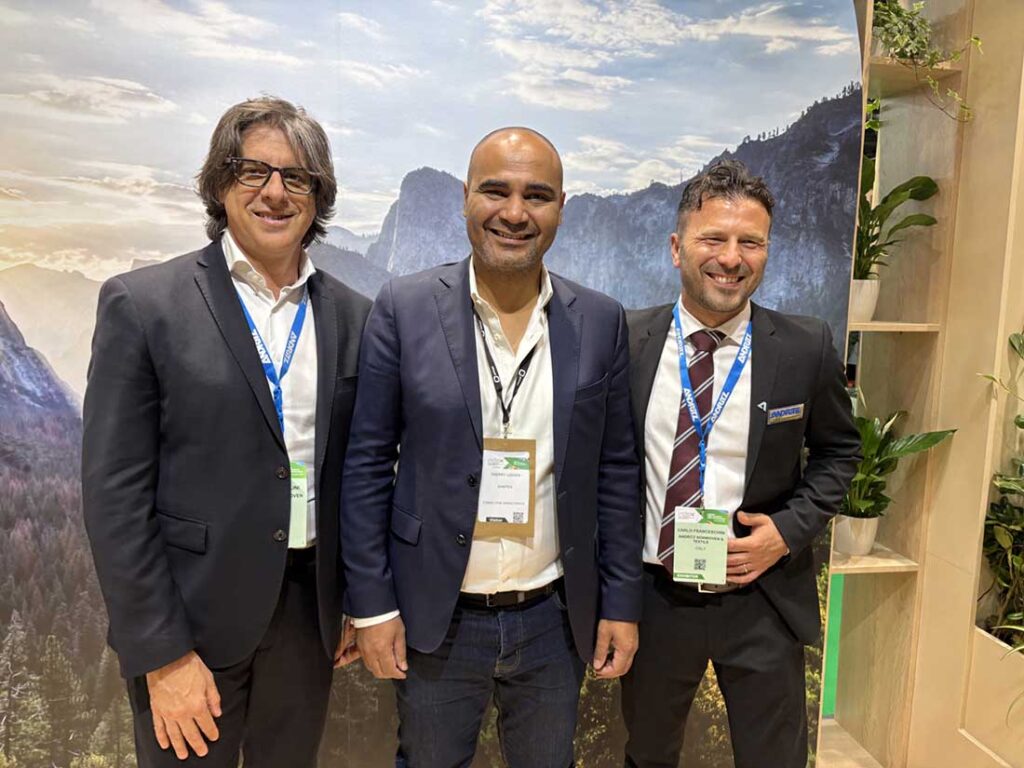
Andritz announced it is supplying a first of two baby diaper production lines and a sanitary napkin line to Sanitex, which is establishing a new plant in Maluku, Kinshasa.
“This investment is a major step in establishing reliable local production of modern absorbent hygiene products in DRC,” said Sanitex managing partner Thierry Lasoen in Geneva. “With this proven technology and the support of Andritz, we will provide local consumers with high-quality baby diapers and sanitary napkins faster and more efficiently. As part of our growth strategy, we will continue to strengthen our production capacity with additional investments in new production lines from Andritz.”
Andritz also announced a contract to supply a new baby diaper production line to ATCO Hygienics based in Tashkent, Uzbekistan.
A subsidiary of Türkiye-based Aim Global Consumer Goods, ATCO Hygienics is now one of the leading manufacturers of hygiene products in the Central Asian region.
“The demand for high-quality baby diapers is growing in Central Asia,” said Aim Global chairman Ali Akyuz. “Andritz impressed us with its advanced technology and expertise in hygiene products and we look forward to a successful cooperation.”
China Expansion
Both Andritz and Italy-based A.Celli also announced new supply contracts with Dalian Ruiguang in China — a company now operating some 18 advanced production lines, capable of producing more than 140,000 tons of various nonwoven fabrics annually.
Since 2014, Dalian Ruiguang has already installed two Andritz Wetlace lines and three of its semi-crosslapped spunlace lines. It is now installing a third Wetlace line to meet the demand for sustainable wipes and hygiene products that are pulp-based, biodegradable and disperse quickly in sewage systems.
As another long-term supplier to Dalian Ruiguang, A.Celli will meanwhile supply the company with an E-Wind Stream winder and an E-Wind Rapid rewinder both with working widths of 3.6 meters.
Trützschler Nonwovens, headquartered in Germany, also highlighted its growing strength in China by announcing three significant agreements with Fujian Liao Group, Wisdom-Greentech and Wangjin Holdings, reinforcing long-term partnerships and securing major investments across sustainable nonwovens production.
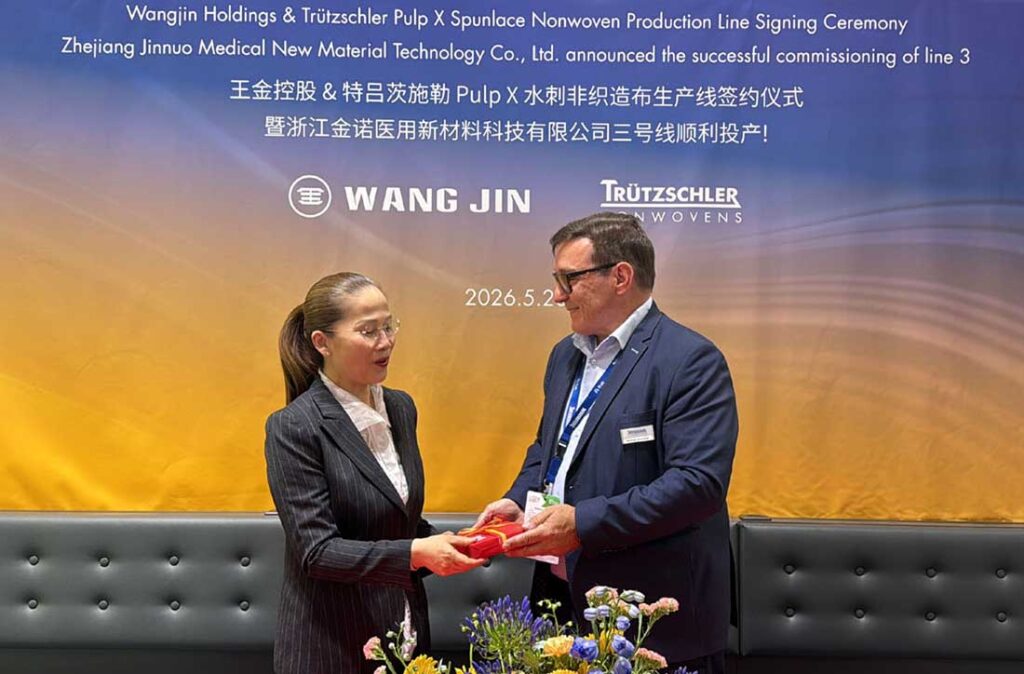
Wangjin Holdings has ordered a new Trützschler Pulp X spunlace production line while also commissioning a third production line at subsidiary Zhejiang Jinnuo Medical New Material Technology.
Both Fujian Liao Group and Wisdom-Greentech ordered new air-through bonding (ATB) lines and the significance of these orders — as China pushes to achieve more value from its nonwovens production — is detailed in a separate feature on page 37 in issue 4 of International Fiber Journal.