


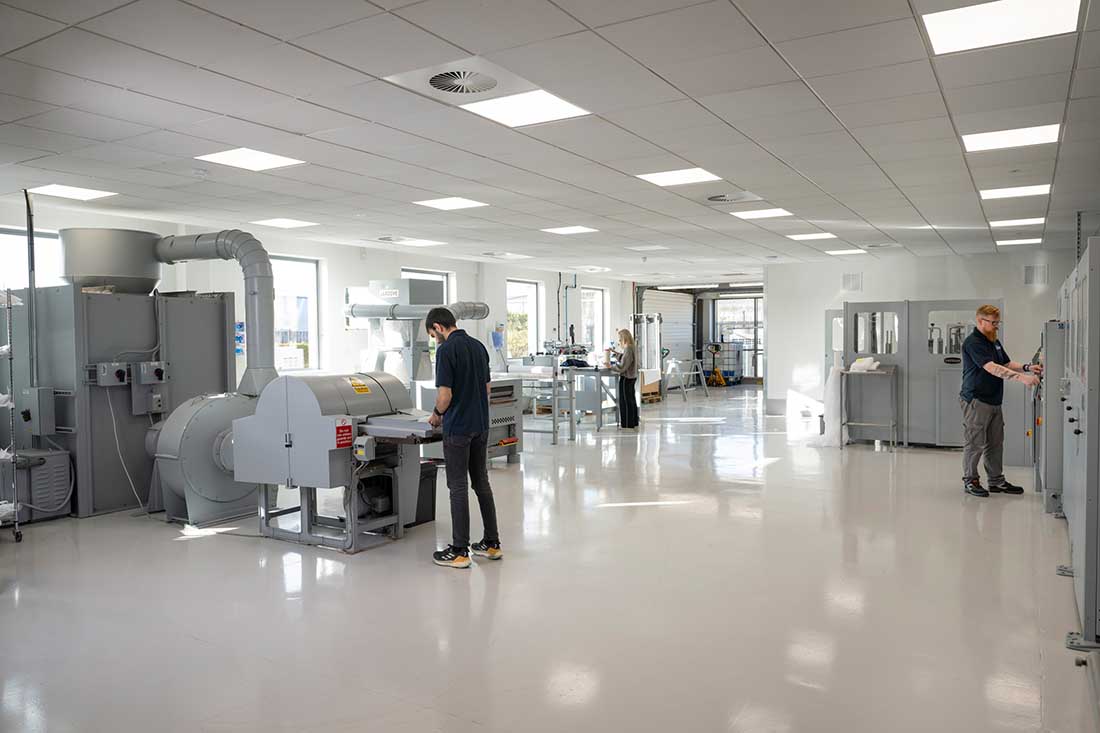
A collaborative approach to innovation can help manufacturers explore new opportunities while managing the technical and commercial risks.
In an uncertain economic climate, cost pressures, supply chain disruption and market volatility are changing the way manufacturers approach innovation. This is particularly true for established nonwovens businesses, where product development decisions must balance technical ambition, commercial risk, regulatory change, operational priorities and shareholder expectations. This article looks at how open innovation can support both continuous improvement and the controlled exploration of potentially disruptive opportunities.
Innovation across the nonwovens sector has never been more important. Manufacturers are under growing pressure to respond to evolving regulations, sustainability targets, material restrictions, changing customer requirements and end-user needs. From per- and polyfluoroalkyl substances (PFAS)-free finishes and biobased materials to recyclable constructions, lower-energy processing and new performance demands, the sector is being asked both to improve existing products and to create new forms of value.
Incremental innovation remains essential to progress. Continuous improvement in product performance, process efficiency, quality, cost and manufacturability will always be central to the development of nonwoven materials. However, as market and regulatory pressures accelerate, internal research and development (R&D) pipelines can become stretched. Companies may need to investigate unfamiliar materials, alternative processes, new applications or adjacent markets that sit outside their established development pathways.
The Value Of Open Innovation
This is where open innovation becomes increasingly valuable. By working with external partners, specialist facilities, research organizations, suppliers, startups and cross-sector experts, companies can extend their innovation capability without placing all of the risk on internal teams. Open innovation provides a practical route to test new ideas, access specialist knowledge, assess emerging opportunities and build technical confidence before committing to major investment. It can also create the conditions in which genuinely disruptive opportunities are identified and evaluated.
Disruptive opportunities do not always begin as fully formed breakthrough technologies. They can emerge from incremental solutions, lower-cost materials, more accessible manufacturing routes, new applications or existing technologies combined in a different way. For established manufacturers, open innovation can provide a controlled, evidence-led means of assessing such opportunities. For new entrants into the nonwovens sector, both models — open innovation and disruptive innovation — can accelerate progress from concept to market while reducing the risk that lower cost is achieved at the expense of quality or performance.
Disruptive Innovation: A Specific Market Process
The phrase “disruptive innovation” is widely used, but often too loosely. As Clayton Christensen, the originator of disruptive innovation theory, explained in his last interview in 2020: “Disruptive innovation describes a process by which a product or service powered by a technology enabler initially takes root in simple applications at the low end of a market — typically by being less expensive and more accessible — and then relentlessly moves upmarket, eventually displacing established competitors.”
Crucially, and where the theory is often misunderstood or misappropriated, disruption does not equate to breakthrough or incremental innovation. Instead, it can be defined as one of two approaches to innovation: low-end disruption, where a company takes a low-cost business approach to enter an existing market and undercut established businesses within that space; or new-market disruption, where a new entrant creates a market segment by serving a previously underserved or non-existent customer base.
When disruptive innovators enter a preexisting market, a major threat to established businesses stems from stakeholder expectations and customer demands. Continuous product improvement can take several forms. For example, improved sustainability requires the interrogation of materials and processes, but customers demand products that perform to at least the level they are accustomed to. Equally, regulatory demands may require comprehensive product review and redevelopment, as with the quest to establish PFAS-free alternatives in the more challenging sectors and applications. In the context of disruptive innovation, incumbents focus on their most demanding and profitable customer base, through incremental innovation, to ensure mid- to longer-term stability. This leaves a gap for disrupters who can focus on the “good enough” product, providing both a rationale for development of low-end products and/or creating a new consumer demographic.
This specific focus — on theory rather than product — offers an opportunity for companies at all scales and stages to explore less divisive, more collaborative approaches to innovation. England-based NIRI — an innovation consultancy involved in product development for fibers, nonwovens and advanced materials — sees this as another innovation paradox. The ubiquity of the application of disruptive innovation and the scope for exploration beyond its strict definition represent an opportunity through an open innovation approach to the challenges facing nonwovens today.
Not every radical R&D project will be disruptive, and not every disruptive business begins with advanced technology. The practical lesson is not that incumbents should abandon incremental innovation. Rather, they need a way to explore opportunities that do not fit the assumptions, customer priorities or investment criteria of the core business. Open innovation can provide that parallel pathway.
Collaborative Value Creation: Bridging The Gap Between Internal R&D And Radical Innovation
Henry Chesbrough introduced the term “open innovation” in 2003 to describe an externally focused approach that bridges the gap between business and academia. As Chesbrough explains: “Conceptually, it is a more distributed, more participatory, more decentralized approach to innovation, based on the observed fact that useful knowledge today is widely distributed, and no company, no matter how capable or how big, could innovate effectively on its own …
“For business, open innovation is a more profitable way to innovate, because it can reduce costs, accelerate time to market, increase differentiation in the market, and create new revenue streams for the company.”
As with disruptive innovation, there are two distinct approaches to open innovation, as defined by Chesbrough. The outside-in approach, whereby a business will bring external technologies, processes or developments into its own existing innovation pipeline, can increase a company’s own knowledge through the integration of suppliers, customers and external knowledge sourcing. The inside-out approach allows companies to offer external organizations underutilized or unexplored ideas that have not been developed internally. Here, the originator can earn profit by bringing ideas to market, selling intellectual property and multiplying technology by transferring ideas to the outside environment.

NIRI also sees a third option: the coupled process, founded on cocreation with complementary partners through alliances, cooperation and joint ventures during which give-and-take is crucial for success for all parties. Where incremental innovation represents the norm for corporate-scale R&D, innovation is internally focused to reinforce past successes, and the return on investment will generally be predictable. And a radical approach — such as disruptive innovation — introduces risk and high levels of uncertainty. In a volatile market, with the cost and value pressures manufacturers are facing today, collaborative open innovation offers a valuable alternative approach.
For established manufacturers, open innovation can be a particularly powerful concept when negotiating a competitive landscape where disrupters can seem to benefit from a more agile approach and one that allows for risk-taking that corporate stakeholders may reject. Disruptive projects are, by their very nature, resource-intensive, and a collaborative approach — harnessing the expertise of external partners and collaborators — can facilitate and accelerate experimentation, enabling incumbents to identify and exploit potentially disruptive opportunities that would otherwise be outside the scope of their own internal, closed R&D processes, thus enabling disruptive innovation to run in tandem with incremental innovation, but with shared risk and reward.
Equally, for small to mid-sized enterprises and startups, the bridge between open innovation and disruptive innovation — through collaboration with external organizations, harnessing the expertise of commercially focused research and development partners — can prove a valuable approach to product and materials innovation. Where smaller-scale businesses generally lack the resources for effective experimentation in R&D and the financial resources to commit to extended development timelines, collaborative and open innovation can allow for access to facilities and to new markets, meaning accelerated and more responsive ideation and product development than would be feasible when working in isolation.
NIRI’s Accelerator program is designed around this principle: to fast-track R&D, reduce commercial exposure, leverage shared
expertise and foster effective commercial collaboration. NIRI pairs each client with a senior consultant who facilitates access to the collective expertise of our entire innovation team and to our extensive laboratory and pilot-scale prototyping facilities, encouraging streamlined product development and rapid progress from inception to market entry.
Why An Open Approach Matters For Nonwovens Innovation
NIRI is aware of the immediate pressures facing manufacturers today, including:
- customer expectations;
- supply chain issues and rising material costs;
- inflation;
- the need to explore new materials without sacrificing performance; and
- the regulatory demands that require innovative solutions.
A closed approach can be too slow or too capital-intensive. For incumbents and disrupters alike, the financial barriers to innovation can be prohibitive, with significant capital costs for facilities for repeated experimentation with new materials or novel processing of existing fabrics. Even when companies have facilities in-house, testing new materials and processing treatments can risk damaging equipment or disrupting production.
Open innovation and a collaborative approach to R&D can help businesses to anticipate and adapt to disruptive market shifts that are beyond the reach of incremental innovation. External expertise and facilities enable companies to experiment at a more appropriate scale, benchmark alternatives, identify failure modes earlier and build an evidence base before committing capital. They can also help businesses detect market shifts that incremental product improvement alone may not address.
When open and potentially disruptive innovation are built into projects from the outset, through collaborative technical assessment, material development, benchmarking, market mapping, prototyping, testing and scale-up, manufacturers gain more options. In a competitive and volatile world, an open innovation strategy can turn uncertainty from a constraint into a source of commercial opportunity.
References