



Technical textile producers worldwide are upscaling plant, animal and mineral fibers into regulation‑ready, high‑performance yarns and composites — driven by carbon savings, circularity and original equipment manufacturer’s sustainability targets.
Sustainable fibers and yarns are among the fastest-growing segments in technical textiles. Producers worldwide are increasingly turning to natural and biobased solutions, driven by their performance, carbon dioxide savings, biodegradability, recyclability and independence from fossil resources.
Derived from plant, animal and mineral sources, natural fibers in particular are now being engineered into high‑performance technical textiles across the transport, construction, filtration and performance apparel systems and latterly in marine restoration. The latest developments show a shift from “eco‑friendly alternatives” to fully engineered, regulation‑ready materials with measurable performance gains.
Natural fibers are gaining ground in technical textiles for a number of reasons: regulatory pressure, such as the European Union Green Deal and microplastic restrictions; original equipment manufacturer (OEM) sustainability targets in the automotive, aerospace, construction and apparel sectors; improved performance through hybridization and fiber modification; economic viability as biobased materials upscale; and circularity and recyclability becoming commercial requirements — not optional extras
Potential Applications
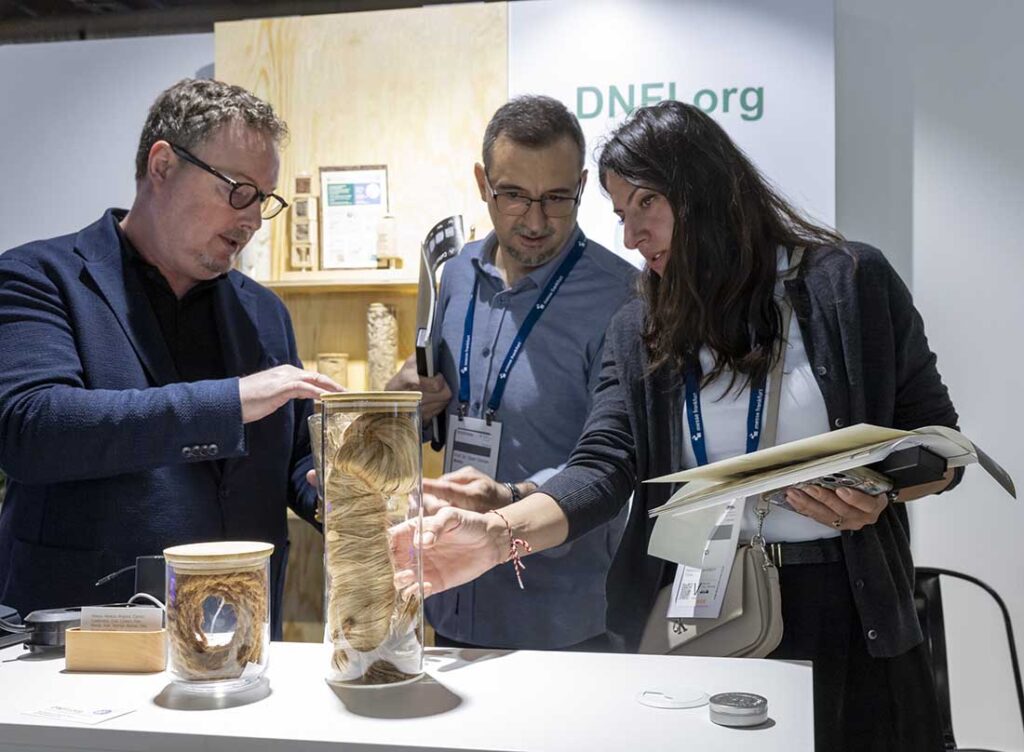
The Discover Natural Fibres Initiative represents an international alliance of more than 40 associations, organizations, natural fiber manufacturers and research institutes that aims to raise awareness of natural fibers and promote their application.
According to the alliance’s statistician, Dr. Terry Townsend, fibers such as jute with a volume of 3 million metric tons per year, coir at 1.2 million metric tons, short flax fibers at 200,000 metric tons, sisal at 300,000 metric tons, industrial hemp at 400,000 metric tons, kapok at 80,000 metric tons, and abaca at 50,000 metric tons are already being used in technical applications and have excellent prospects for expanded recovery and recycling.
“Potential applications for recycled natural fibers range from composites used in automobiles to reduce weight and improve sustainability, to insulation materials made from hollow fibers and to construction materials made with natural fibers as a binder,” Dr. Townsend said.
In the automotive and transportation sector, for example, natural fibers already feature in interior panels, trims and composites, in upholstery and acoustic insulation, and as hybrid yarns for durability and fire performance.
In the construction and geotechnical market, natural fibers can be used to make biodegradable geomats and erosion‑control textiles and also find use as fiber reinforcement in composite materials.
In the marine and environmental sector, seagrass restoration mats and biodegradable underwater substrates are now beginning to feature natural fibers, while in performance apparel, examples include technical wool base layers, engineered cotton for moisture and thermal control, and in hybrid natural/synthetic performance yarns.
Extraction And Fiber Modification
A 2026 review in RSC Advances, published by the England-based Royal Society of Chemistry, highlighted a number of recent breakthroughs for natural fibers in terms of advanced extraction and fiber‑modification technologies. These include the enzymatic and green‑chemical extraction of bast fibers, surface modification to improve bonding in composites, functionalization — such as antimicrobial, hydrophobic and flame retardant — and performance/sustainability optimization for natural‑fiber materials.
These developments will strengthen natural fibers’ competitiveness with synthetics in technical applications, explained the authors from the Department of Fabric Engineering, Barishal Textile Engineering College, Bangladesh.
Alternative Materials
This year’s Techtextil exhibition held in Frankfurt, Germany, highlighted the ongoing growth in biobased, recyclable and circular‑economy textile developments. Prominent among these was the increasing use of natural fibers, not just as “traditional” textile materials, but for use in high‑performance, regulation‑ready technical applications as biobased and recyclable alternatives to synthetic technical textiles.
Notably, more than 15 percent of the exhibitors already have natural fibers and materials in their product ranges, according to trade fair organizer Messe Frankfurt. This suggests that natural fibers are now central to the “alternative materials” segment highlighted at the exhibition, driven by sustainability regulations and OEM requirements for lower‑impact materials.
Curated Signpost
A major structural change at this year’s Techtextil show was the introduction of the Nature Performance label, which grouped together more than 119 exhibitors working with natural fibers, biobased materials and circular textile systems — a label that will likely become a long‑term platform for natural‑fiber innovation at future Techtextil editions.
This area showcased natural fibers and yarn, biobased polymers and composites, as well as recyclable and circular‑design materials. In addition, some 90 exhibitors focused on recycled or recyclable fibers and yarns. For example, the Dutch Circular Textile Pavilion featured SaXcell’s chemical fiber-to-fiber recycling process that converts discarded cotton waste into new cotton-like material, while Vodde presented a complete fiber-to-fiber supply chain using 100-percent textile waste, turning discarded textiles into yarns and socks.
Hemp-Based Nonwovens
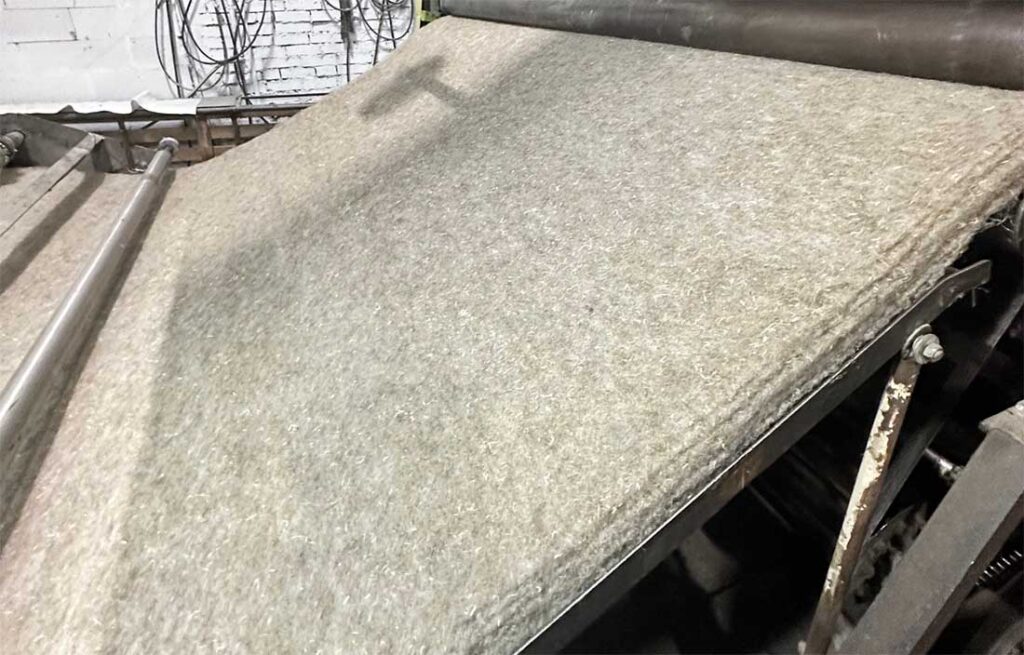
With more than 20 years of experience, K.Tex, a Ukraine-based manufacturer of nonwoven materials and a first-time Techtextil exhibitor, displayed technical textiles for various industries, made from hemp and other raw materials, including recycled polyethylene terephthalate (rPET), using advanced nonwoven technologies such as needlepunching/calendering, air-through bonding and airlaid.
Applications include construction such as insulation materials and acoustic panels, apparel for paddings and insole materials, fire-resistant insulation and geotextiles, agriculture in mulching materials and growbags, furniture such as hemp-based materials and filling materials, and automotive in prepreg and sound-absorbing materials.
In the agricultural segment, K.Tex presented solutions under the Greenery Land brand, designed for plant cultivation and landscaping. These materials are used to manage growing conditions, including moisture retention, soil protection and temperature stability. In addition to growbags and hemp-based mulching materials, the product range includes tree circles and other solutions for use in horticulture, greenhouse production and landscaping.
For the construction sector, the company showcased Novoisol — hemp-based nonwovens used for thermal and acoustic insulation. These materials can be applied in building structures where moisture regulation and indoor climate control are important as well as insulation performance; acoustic solutions were also presented.
Another key area was materials for the textile and apparel industry. K.Tex produces insulation materials under the Termoloft, Slimtex and Holosoft brands, which provide thermal performance, structural stability and comfort in use. The company also presented Embertex — a flame-retardant material designed for protective clothing and high-temperature environments.
With production facilities in Irpin, near Kyiv, and Kalush, and an annual capacity of 5,000 metric tons, K.Tex forms an integrated business ecosystem in Ukraine together with industrial hemp producer Ma’Rijany and textile recycling company Reinventex.
At the joint stand at Techtextil, Reinventex featured materials made from recycled textile fibers. These included acoustic panels, mattress fillings and other solutions where secondary raw materials are used to create new functional materials with defined properties, where the focus is not only on the origin of the material, but also on its performance in the final application.
Wool Felt
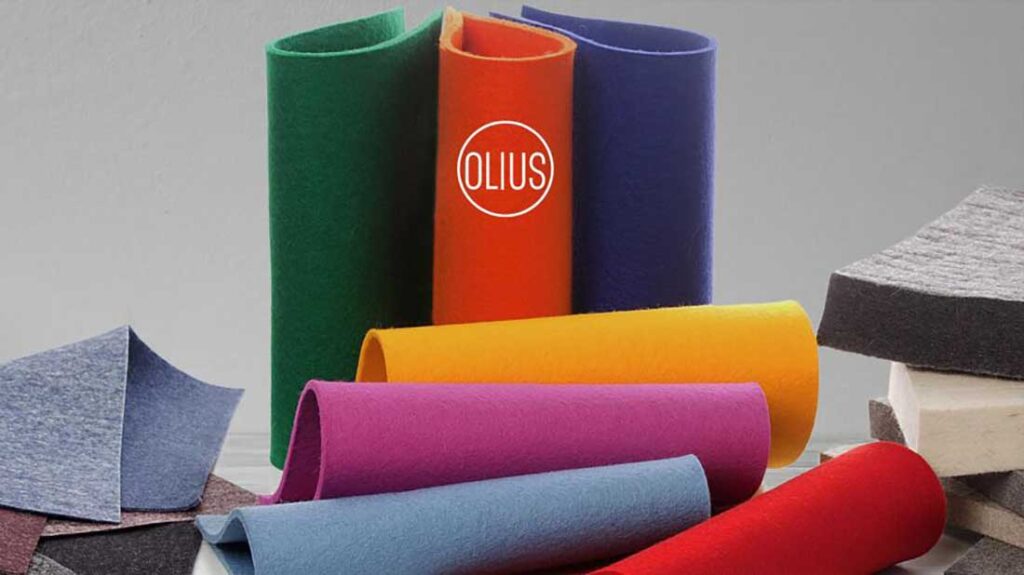
Spain-based company Textil Olius produces wool felts — nonwoven textiles that leverage the natural properties of wool and the technical characteristics of nonwovens. This combination allows the company to manufacture products for a wide range of end-uses in interior design and acoustic absorption, industrial applications and consumer goods, explained commercial director Virginie Tissot.
These technical and sustainable materials are ideal for industries and projects where durability, strength, acoustic insulation and liquid absorption properties are crucial. Various types of finishing can be applied to give the felts unique properties for specific applications, such as flame retardant, water repellent, anti-mold, anti-pilling, antistatic, anti-stain, mothproof and anti-slip.
Also in the wool sector, Germany-headquartered Südwolle Group, well known for its wool-based worsted yarns, showed technical yarn solutions together with its sister company Tenowo/Hoftex Group, for applications including safety and personal protection equipment, transportation, upholstery and interior textiles, and body and performance support for sportswear and activewear.
Biobased Marine Geomat
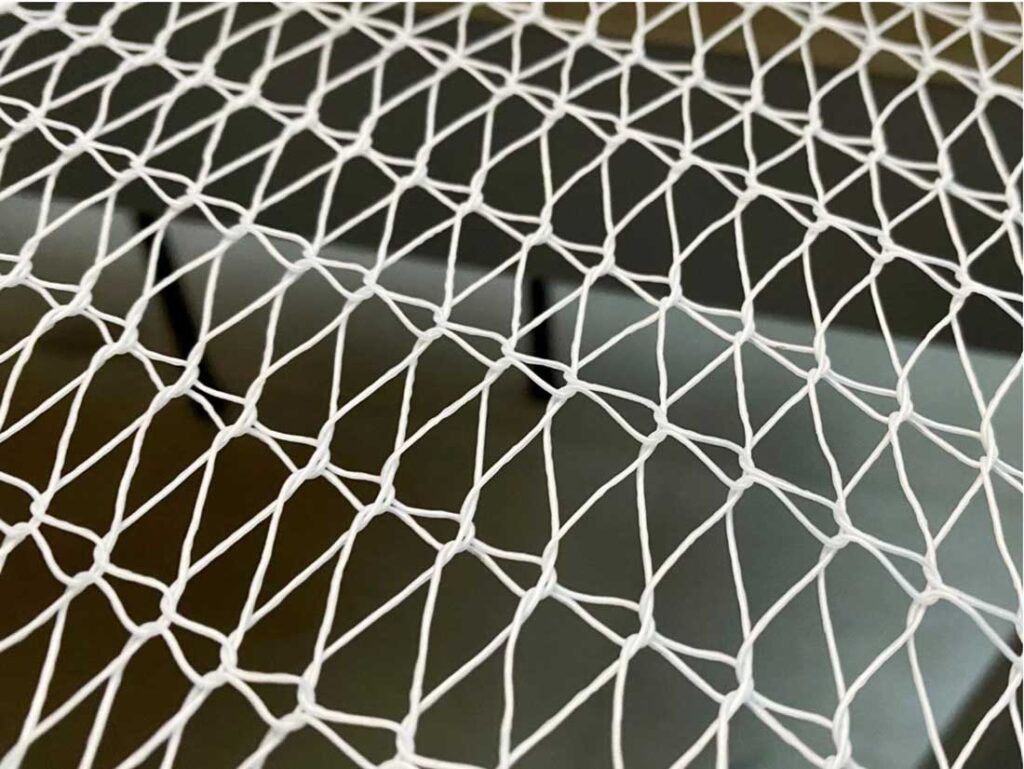
A major innovation this year saw the introduction of biobased geomats and underwater restoration textiles. These include biodegradable natural‑fiber geomats designed for seagrass meadow regeneration, erosion‑control mats using natural fibers instead of plastic and marine‑safe biodegradable substrates.
In Frankfurt, Italy-based Tex Tech presented a biobased marine geomat, a biodegradable underwater anchoring and restoration textile designed specifically for the regeneration of Posidonia oceanica seagrass meadows — one of the Mediterranean’s most ecologically important but threatened habitats.
Restoring P. oceanica requires planting cuttings on the seabed. Traditional anchoring systems often rely on plastics, synthetic nets and materials that risk becoming “ghost gear” or microplastic pollution.
Tex Tech’s solution eliminates these issues by using biobased, biodegradable polyester materials, such as polybutylene succinate-co-butylene adipate-based systems, and textile architecture that is optimized for underwater handling, anchoring and natural degradation within a controlled timeframe, usually within 12 to 24 months, depending on the thickness of the geomat.
The materials are selected on a case-by-case basis, including the use of high-tenacity and cut-resistant fibers, and validated through structured prototyping and laboratory characterization, explained CEO and COO Fabrizio Picariello.
The geomat is being evaluated with research partners including ISPRA (the Italian Institute for Environmental Protection and Research) and several universities through tank‑based pilot trials, including the Aquarium of Livorno, and open‑sea trials, with testing including biodegradation mechanisms, durability and ecotoxicity.
This represents one of the first fully biobased, textile‑engineered solutions aimed at large‑scale marine meadow restoration, the company explained. It added that it aligns with EU biodiversity restoration goals, the shift toward biobased technical textiles and the need for non‑plastic marine restoration tools.
Novel Copolyester
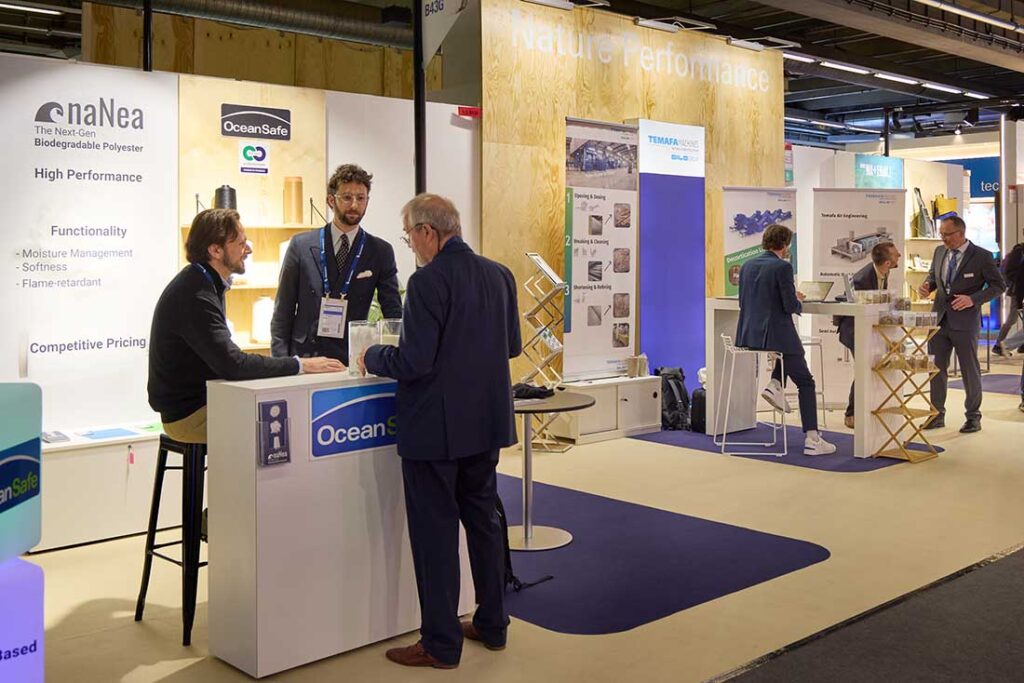
Switzerland-based polymer science company OceanSafe presented naNea, a novel copolyester designed for both biodegradability and recyclability. The material is made from biobased, recycled or virgin feedstocks, and its polymer structure enables rapid biodegradability in the open environment — more than 93 percent within 99 days, according to ASTM D6691-17 — without the use of additives or enzyme technology.
The company said naNea offers a range of built-in functional features, including higher hydrophilicity, faster water penetration and greater absorption capacity compared with conventional polyester. In addition, it has lower evaporative resistance and high-wicking properties, which enable a quicker drying rate, while maintaining moisture regain levels comparable to standard polyester.
naNea does not release persistent micro- or nano-plastics and is claimed to be the world’s only synthetic textile material to receive the Cradle to Cradle Certified Gold certificate.
The company reports naNea is compatible with existing textile machinery across the entire value chain with no equipment investment needed. It is suitable for weaving, knitting and regular dyeing and finishing processes, including low-temperature dyeing.
Gaining Traction
The halls of Messe Frankfurt demonstrated that natural fibers are moving into mainstream technical‑textile applications, supported by new processing technologies and performance enhancements. Biobased composites and recyclable fiber systems are also gaining traction with automotive, construction and interior materials buyers in particular. As one Techtextil exhibitor commented: “Circularity is now a commercial driver, not just a sustainability talking point.”