



The future for elastane and stretch fabrics is part of the ongoing mission to replace petroleum-based materials with plant-based alternatives.
Love it or hate it, elastane is an integral part of today’s fashion world. Consumers love it because it provides unrivaled levels of comfort and stretch; the recycling industry hates it because any material blended with elastane is difficult, if not impossible, to recycle.
Elastane has revolutionized the clothing industry owing to its stretch and comfort. The addition of just a few percent of elastane fiber makes denim jeans and leggings fit perfectly to the body and retain their shape; it gives sportswear, swimwear and activewear more comfort due to the resulting high stretch; and it provides compression wear with needed support.
Hidden Impact
Although a functional choice that offers excellent shape retention, elastane comes with a high environmental cost: it comprises a long-chain polymer — polyurethane — a chemically complex, non-renewable resource derived from fossil fuels that contributes to carbon emissions and non-renewable resource consumption.
Further, elastane is non-biodegradable, breaks down with heat and reportedly sheds more microfibers than other fibers, especially during domestic laundering, thereby adding to microplastic pollution.
While breakthrough technologies are emerging and the industry is clearly pushing toward solutions, there is no established, scalable infrastructure currently available for recycling elastane‑blend fabrics.
Intractable Problem
According to the Netherlands-based Fashion For Good, elastane is present in around 80 percent of all clothing, added in varying concentrations — typically 1 to 5 percent by weight in cotton or wool garments and up to 20 percent in polyester or polyamide garments — to provide the required stretch and comfort.
But in the context of circularity, even minimal concentrations of elastane “contaminate” textile recycling feedstocks, thereby compromising fiber-to-fiber recycling of high-volume fibers such as polyester and cotton. This gives the vast majority of clothing limited end-of-life options beyond downcycling or landfill.
“Elastane is one of the most overlooked blockers to true circularity in fashion: it’s everywhere and yet there is a significant challenge to recovering it at scale,” said Carrie Freiman Parry, senior director of sustainability at luxury womenswear label Reformation based in Vernon, Calif.
But in the context of circularity, even minimal concentrations of elastane “contaminate” textile recycling feedstocks, thereby compromising fiber-to-fiber recycling of high-volume fibers such as polyester and cotton.
Mixed‑fiber textiles, especially polyamide/elastane and polyester/elastane blends, are extremely difficult to separate, and there is currently no infrastructure for the recycling of elastane: recycling plants simply are not designed for handling this material.
In many countries’ textile recycling plans, which include automated sorting and fiber‑to‑fiber recycling, elastane remains one of the “innovation gaps” identified in the various road maps and pathways for hard‑to‑recycle materials: strategies for a fully operational elastane‑specific recycling stream remain elusive.
Recycling Elastane-Blend Fabrics
Danish researchers from the Interdisciplinary Nanoscience Center at Aarhus University have produced a technology that can separate out fibers in mixed fabrics so that they can be processed and reused. So far, the team has developed a method to remove elastane completely from polyamide.
Assistant Professor Steffan Kvist Kristensen explained: “The many links in the elastane chain are bound together by a small molecule called a diamine. By heating the clothes to 225°C and adding a specific alcohol, we have found a method to break down the bonds in elastane. When this happens, the chains fall apart and the materials separate.”
A potassium hydroxide base is added to the alcohol, which accelerates the process. It is thought that potassium hydroxide either increases the reactivity of the alcohol or breaks down the chemical bonds in elastane slightly, making it easier for the alcohol to break them completely.
The method is not quite there yet with cotton, because some of the cotton fibers are broken down in the process. However, the researchers believe that, with some minor adjustments, this problem can be solved.
Closed‑Loop Recycling Of Polyamide/Elastane
Italy-based RadiciGroup, The Lycra Co., Wilmington, Del., and Switzerland-based lingerie brand Triumph International recently collaborated to develop a closed-loop recycling process that recovers both polyamide and elastane from mixed-fiber textiles. The project has resulted in a prototype coordinated lingerie set, consisting of a bra and briefs, made entirely from recycled materials — Lycra® fiber and RadiciGroup’s Renycle® yarn.

The recycling process, developed by Radici InNova, the research and innovation division of RadiciGroup, uses selective dissolution technology to separate different fibers within a fabric, making it possible to recycle textile waste that contains multiple materials, such as polyamide and elastane blends.
The process uses non-toxic, non-flammable and environmentally compatible solvents, and can be applied to the main types of nylon, including nylon 6 and nylon 6,6. Importantly, both the fibers and the solvent can be recovered and reused, which supports both environmental goals and economic feasibility.
But putting it bluntly, the current infrastructure for recycling elastane-blend fabrics is fragmented, experimental and nowhere near being commercially viable: elastane is still considered a “killer fiber” for recycling.
Future-Forward Thinking
If recycling elastane-blend fabrics remains a difficult and uneconomic task, the future could belong to recycled elastane, biobased elastane or even biodegradable elastane.
Recycled elastane fibers can be produced from pre-consumer elastane manufacturing waste, pre-consumer materials, reclaimed production waste and recycled polyethylene terephthalate bottles.
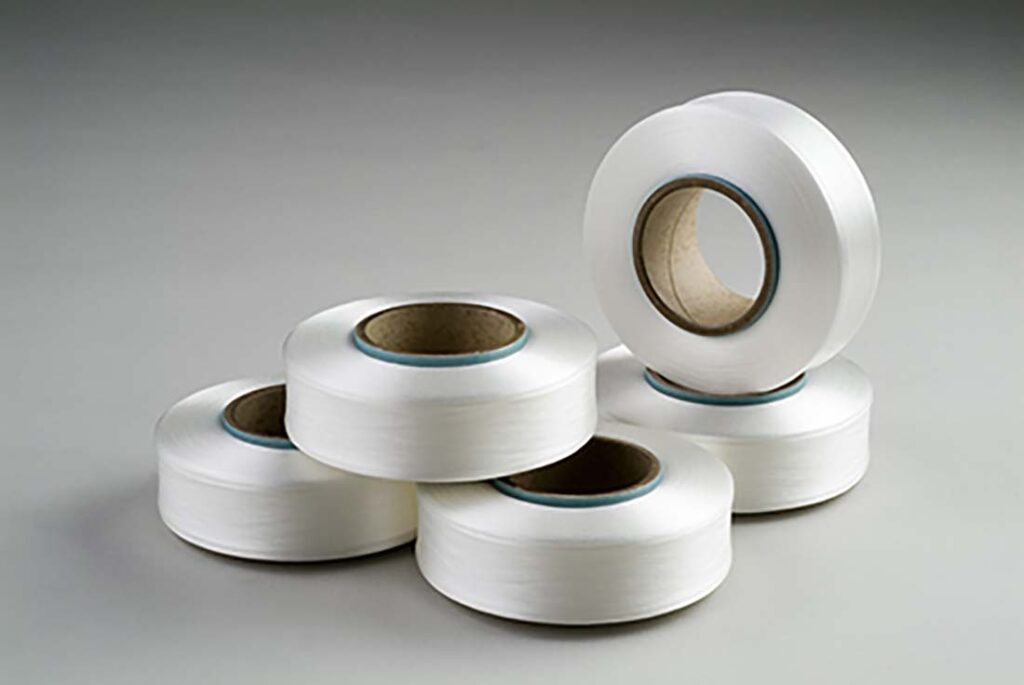
Recycled elastane products currently available on the markets include Creora™ Regen™ from South Korea-based Hyosung, made using reclaimed waste; Roica™ EF from Tokyo-based Asahi Kasei Corp., made using pre-consumer materials; and Lycra EcoMade fiber, made using 20 percent pre-consumer recycled materials.
If recycling elastane-blend fibers remains a difficult and uneconomic task, the future could belong to recycled elastane, biobased elastane or even biodegradable elastane.
Biobased elastane can be produced from renewable biomass, including plant-based materials and agricultural waste. For example, Hyosung supplies this as Creora bio-based, in which 30 percent of petroleum-based resources are replaced with biobased raw materials derived from industrial field corn known as dent corn.

Roica V550 is a stretch yarn from Asahi Kasei, which has been awarded a Cradle to Cradle Certified® Material Health certificate. However, it does not classify as being biodegradable because its degradation speed is too slow. For materials to qualify as biodegradable, they must completely break down and decompose into natural elements within a short time after disposal — typically within a year or less. Around 35 percent of the Roica V550 yarn is degraded within 270 days and 50 percent after 24 months.
Validating Biobased And Recycled Elastane
Earlier this year, a collaborative project — Stretching Circularity — was initiated by Fashion For Good to accelerate the adoption of lower-impact elastane alternatives that are compatible with circular textile systems. By validating biobased and recycled elastane solutions through pilot-scale testing and demonstrator garments, the initiative aims to remove one of the most significant technical barriers to a circular textile economy.
One aspect of the project focuses on testing next-generation elastane materials made from alternative inputs, including biobased materials and other feedstocks. This phase includes the creation of demonstrator garments, specifically a technical T-shirt with 10 percent elastane and a non-technical T-shirt with 2 percent elastane. The project will also focus on testing regenerated elastane made through emerging recycling innovations.
Biomass-Balanced Tetrahydrofuran
In 2023, BASF began supplying a biomass-balanced variant of tetrahydrofuran (THF BMB) to the Roica division of Asahi Kasei, which is integrating this solution to produce its mass balance-grade premium sustainable stretch fiber under the Roica brand. The collaboration aims to promote the launch of environmentally friendly apparel collections by Asahi Kasei’s customers.
Roica has introduced mass balance (MB) stretch fibers across most of its product range. It aims to establish itself in the market with new sustainable fibers and is currently in discussions with several apparel manufacturing corporations.
THF is used to produce polytetrahydrofuran, which is a raw material for the production of elastane fibers. BASF’s THF BMB is recognized for significantly reducing carbon footprints compared with traditional THF products owing to the substitution of a portion of fossil-based raw materials used in production with renewable resources.
Utilizing THF BMB in products can lead to a 25 percent decrease in carbon dioxide (CO2) emissions, according to Asahi Kasei. By further incorporating its own mass-balance approach and using renewable energy for production, the company hopes to manage an additional 25 percent reduction in CO2 emissions of its products.
Other Stretch Fibers
As an alternative to elastane, many manufacturers and fashion brands are now considering other stretch fibers that can be recycled and are less likely to cause microfiber pollution. For example, Newark, Del.-based Covation Biomaterials LLC, the former DuPont biomaterials business, has developed Sorona®, a 37 percent plant-based stretch fiber from propane-1,3-diol derived from corn glucose, while Italy-based Fulgar S.p.A. has produced Evo®, a biobased stretch fiber manufactured from a castor bean oil-derived biopolymer.
An alternative next‑generation moderate stretch system that avoids traditional elastane is S.Leisure™ from Taiwan-based Singtex® Group. This lightweight fabric is said to employ mechanical stretch, thermoplastic engineered polymers and bicomponent fibers, providing comfort, breathability, fast-drying properties,
ultraviolet protection, good recovery and recyclability with a lower carbon footprint than comparable elastane-based materials. It is also claimed to be at least 20 percent more energy‑efficient than
elastane-based fabrics.
Alternative For Athletic Apparel
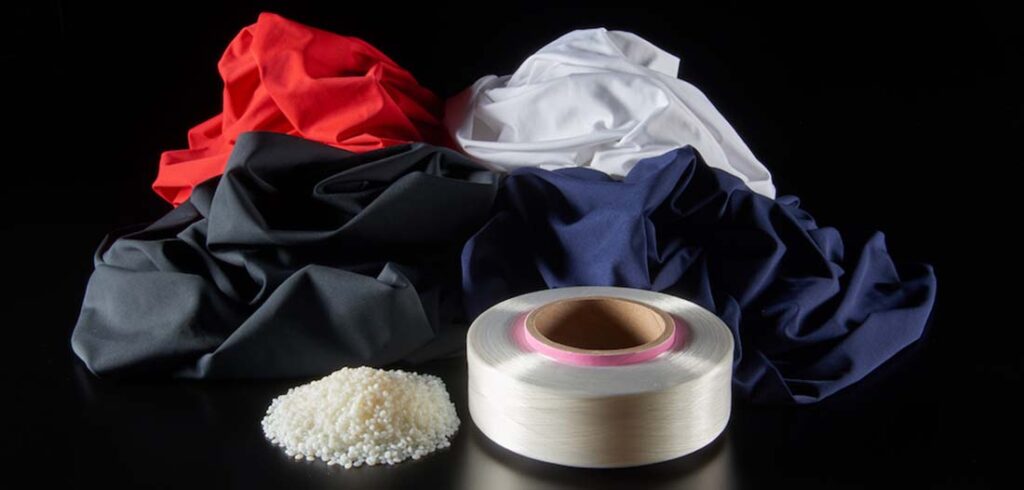
Specialty materials and chemicals company Celanese Corp., Irving, Texas, and athletic apparel and footwear producer Under Armour Inc., Baltimore, have announced the development of a new fiber for performance stretch fabric.
Neolast™ fibers feature the stretch, durability, comfort and improved wicking expected from performance fabrics yet are also designed to begin addressing sustainability challenges associated with elastane, including recyclability.
The fibers are produced using recyclable elastoester polymers and a proprietary solvent-free melt-extrusion process, eliminating potentially hazardous chemicals typically used to create stretch fabrics made with elastane.
Additional benefits of the Neolast fibers include enhanced production precision, allowing spinners to dial power-stretch levels up or down and engineer fibers to meet a wider range of fabric specifications.
Fossil-Free Material
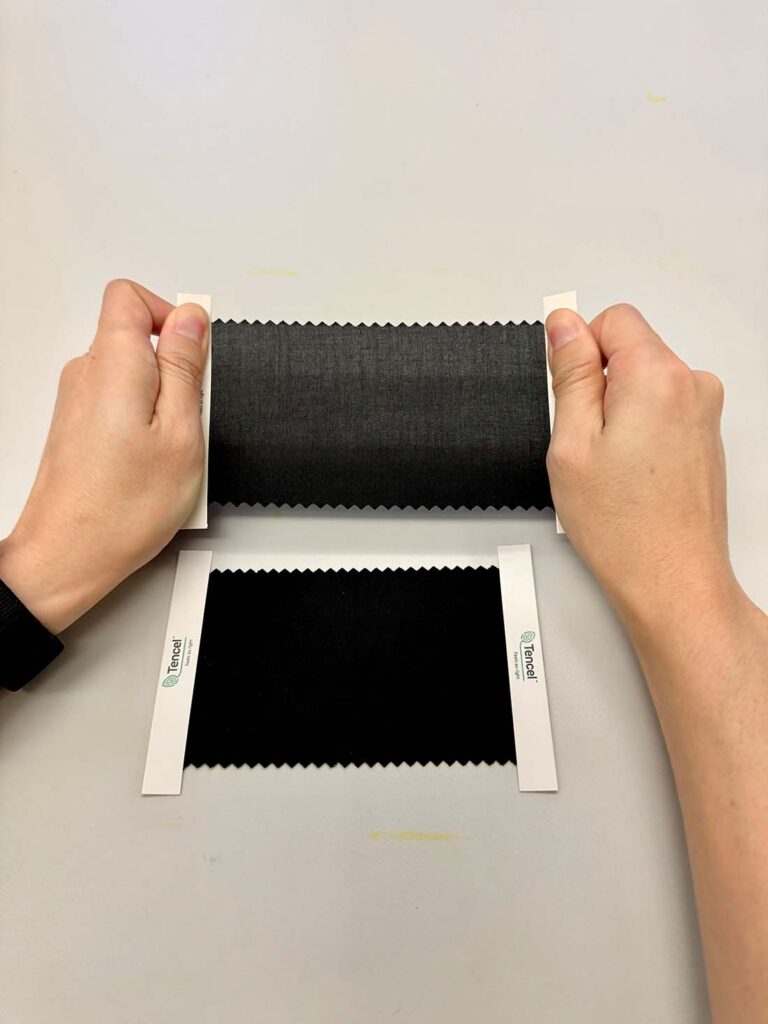
Austria-based cellulosic fiber producer Lenzing AG has developed a new processing technique for its Tencel™ Lyocell fiber that can transform it into a traceable and fossil-free alternative material for stretch fabrics, offering enhanced recovery properties and more design possibilities for lightweight apparel, alongside responsible production techniques.
The novel method comprises the reconfiguration of woven fabrics made of Tencel Lyocell fibers, followed by a fabric pre-treatment. During the wet process, lyocell fibers expand in diameter, which leads to an increase in yarn crimps widthwise. This results in a fabric that can stretch easily, with enhanced recovery and does not shrink or wrinkle easily, maintaining a smooth appearance even after home laundering, according to Lenzing.
The Tencel Lyocell fibers used in these stretch fabrics are extracted from certified wood sources and produced using a resource-saving closed-loop method. In addition, the fibers can be identified in end products and are traceable back to their sources, ensuring increased accountability and transparency throughout the supply chain.
Plant-Based Replacement — Nature’s First Elastomer
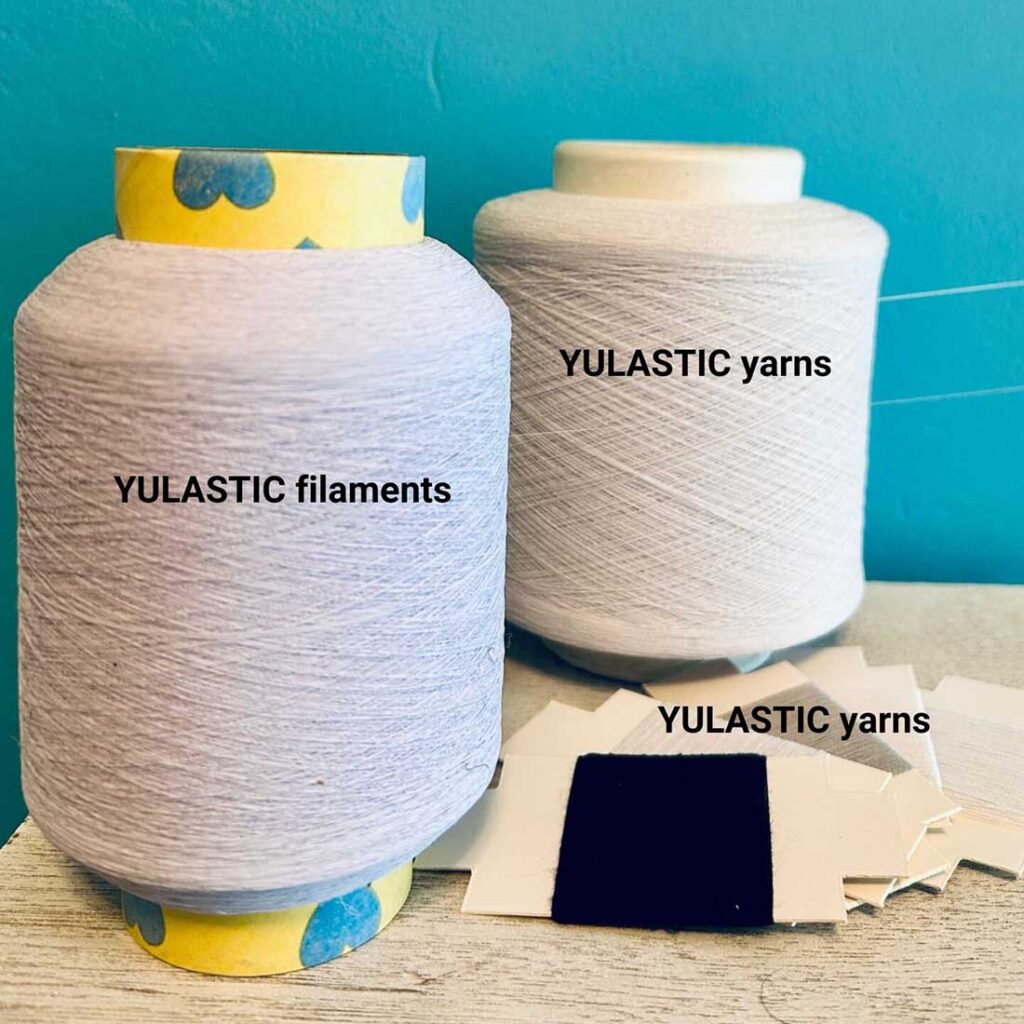
Meanwhile, Chandler, Ariz.-based Yulex LLC has launched Yulastic®, a “natural and sustainable alternative to elastane.” Made from natural rubber, the plant-based material is said to offer the same stretch and recovery performance as elastane, without the reliance on petrochemicals.
Yulastic is a fine, natural rubber filament harvested from Hevea brasiliensis, a species of rubber tree; and Yulex produces renewable products such as wetsuits, swimwear and bags using the filament.
CEO Liz Bui said: “Mother Nature has been making the best polymers since day one. But we’ve replaced natural fibers with non-biodegradable plastics that last forever and are impossible to recycle. And look where that got us.”
Yulastic natural rubber filaments are biodegradable in one to two years. The company added that several undisclosed “household-name” fashion brands are already on board, preparing to integrate Yulastic into their collections.