


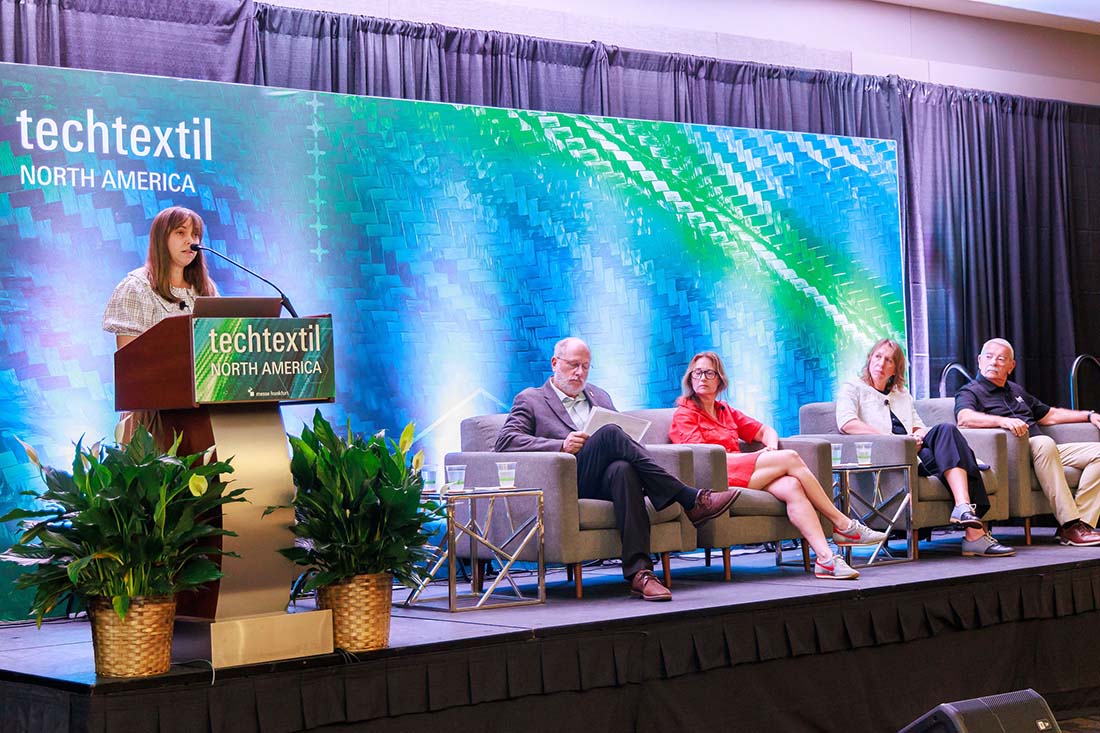
The Raleigh event combined exhibits, technical education and student research highlighting innovations across the textile value chain.
Techtextil North America (TTNA) returned to Raleigh, N.C., this summer, bringing a combination of trade show exhibits, student poster content and professional education. More than 140 exhibitors from all areas of the world presented their latest and greatest textile technologies. Exhibitors spanned the entire value chain of the textile industry from fibers, resins and modifying chemistries to processing, converting and end-use products and applications.
This year, show organizer Atlanta-based Messe Frankfurt Inc. partnered with the Sewn Products Equipment Suppliers of the Americas (SPESA) and the Alphabet Soup Collective to cohost the welcome reception, also known as the Shindig. The Alphabet Soup Collective is a collaborative network of approximately 15 associations and groups representing the global textile, sewn products and related industries that meets regularly to review event calendars to minimize overlapping events, identify common event and membership challenges and solutions, and find potential areas for collaboration.
TTNA Symposium
Educational programming at TTNA consisted of three parallel paths: the dedicated classroom-style symposium, show floor Tech Talks, and the Student Research Poster Program.
This year, symposium sessions included emerging technologies in nonwovens, transportation technical textiles, next-generation materials, military textiles and medical devices, among other topics.
The session, “Emerging Technologies: Nonwovens,” featured three speakers. Dr. Eunkyoung Shim, an associate professor and nonwoven minor coordinator in the department of Textile Engineering, Chemistry and Science at NC State, presented work on hybrid nonwovens for stormwater runoff remediation. This work has applications in a number of scenarios — agricultural runoff, industrial runoff and even urban runoff — in which both organic nutrients and particulate matter may be unintentionally entering bodies of water. This pollution may introduce heavy metals into the water, foster oxygen-depleting algal blooms, or even allow persistent per- and polyfluoroalkyl substances (PFAS), also known as “forever chemicals,” to contaminate water. The proposed solution combines meltblown nonwovens, already known for particulate capture, with various absorbents such as activated carbon, biochar and metal oxides to strip away chemical pollutants.
Dr. Hooman Tafreshi, also a professor at NC State, addressed the challenge of characterizing the structure of nonwovens, which by definition lack the geometric regularity of woven or knitted materials. His group has developed modeling techniques for the far more complex and random structures encountered in nonwovens. This in turn allows for predictive models of fluid flow through the fabrics, essentially modeling the void space or what’s not there as well as predicting the mechanical performance of the fabrics by modeling what is there.
Doctoral candidate Isabel Albelo concluded the nonwoven session as she presented her research on the valorization of textile waste. This is a topic area of increasing interest as more jurisdictions are enacting extended producer responsibility requirements or mandatory textile recycling. A general rule of thumb for both post-industrial and post-consumer recycling is that returning material to its original form — like recycling a yarn-based textile back to a yarn to make more textiles, for example — is likely to capture the greatest value of that material. During yarn, fabric and end-product manufacturing, and throughout recycling and reclaim, yarns and fibers may be degraded to such a point that they are no longer useful for yarn production. Albelo’s research instead considered such waste streams as inputs for other processes and material categories such as additive manufacturing and nonwovens.
The following session on “Technical Textiles for Transportation” began with Jennifer Rogers, Messe Frankfurt’s Conference and Program specialist, who established the rich history of textiles in transportation from nautical beginnings through coaches, carriages and balloons into the modern combustion era of motorized vehicles and aircraft. Stefanie Rodgers continued the transportation session with an eye on the future of textiles in transportation, including insights into the use of textiles in incredibly challenging physical aeronautical and astronautical environments.
This theme continued with the afternoon panel covering “Balancing Durability and Performance in Next-Generation Materials” and the second day’s session on “Advancements in Military and Protective Textiles.” Presented by NC State Research Scholar Dr. Marc Mathews and Madeline Poley-Bogan, a biomedical engineer at the U.S. Army Research Institute of Environmental Medicine, the military session highlighted the “science of survivability” and “tradespace” when considering the interlayered and often competing goals of material, composite, system, human, mission, threat and sustainment needs. The session included an in-depth dive into anticipating and managing thermal stress on materials, equipment and warfighters that gave a greater appreciation for the benefits fiber-based engineered fabrics provide.
The session on “Digital Design and Anthropometric Measurement” provided a real glimpse into the future of garments, apparel and personal protective equipment (PPE). Miranda Tidwell, an account executive with the Hohenstein Institute, set the tone with a discussion of digital avatars that go well beyond what’s possible with traditional mannequin-based design and size charts. Digital avatars allow for consideration of fit with respect to dynamic movement and motion of the wearer. The potential for reduction of sizing-driven returns is considerable. Dr. Susan Sokolowski and Dr. Linsey Griffin, professors from the University of Oregon and University of Minnesota, respectively, highlighted how such data can enable improved fit characteristics for products like PPE pants for women and gloves for all users. Frank Henderson’s talk on automation highlighted the potential for expanded fit design options via the “fastsewn” approach that entails automated cut-feed-sew. Henderson is the CEO of Henderson Sewing Machine Co.
While many of the earlier sessions highlighted advances that enable source reduction in material consumption, improved material utilization and other sustainability-related topics, the closing sessions of the symposium focused directly on sustainability and circularity. Amy Rauen, founder and principal of Circular Intention, highlighted the opportunities, challenges and realities of bringing apparel textiles full circle, which she illustrated with real branded apparel case studies in her session titled “Circularity: By Intent.”
During the final session, “Bringing Forward: Fibers and Composites,” Bear Fiber Inc. President Guy Carpenter highlighted the potential of hemp fibers as both a standalone material but also as a “collaborative fiber” with cotton in nonwovens. Eric Gardner, Fiber Processing Development Engineer with Cotton Incorporated, discussed a less familiar use for cotton — as a backbone material for nonwovens and a reinforcing phase of composites. Such applications leverage the unique and difficult-to-replicate, nature-designed attributes of cotton. Both hemp and cotton fibers are seeing a resurgence in use for longer life, durable applications such as composites.
Show Floor Tech Talks
In parallel to the symposium, TTNA also provided show floor Tech Talks that are open to all attendees. A few highlights included an overview of nonwoven technologies, the current state of digital product passports that are becoming increasingly prevalent and necessary to support textile recycling efforts, a look into performance cotton fabrics, an insightful look into the transition of textiles and nonwovens from conventional fabric products into medical devices and a new technology that can digitally quantify the softness of textile fabrics. The on-floor Tech Talk venue also hosted student presentations as well as the Techtextil North America Innovations Awards for 2026. PlasmaGear Inc. won the New Concept Award, Syniform Inc. received the New Production Award, the NC State Wilson College of Textiles won the New Product Award, and IND HEMP won the New Materials Award.
Student Posters
The final component of the educational content showcased at TTNA is the student posters. This year, there were about a dozen posters that showcased fundamental research as well as advancements that are ready for adoption by industrial partners. Topics ranged from sustainable materials in nonwovens and textiles — such as hemp, polylactic acid, polyhydroxyalkanoate, and wool-derived keratin — to end-of-life and environmental topics including microfiber shedding, biodegradation, PFAS alternatives and composting, enhanced performance of PPE, improved filter media charge retention, optimized extreme weather apparel, and improved testing of composting. Students and faculty were available to discuss their work throughout the event. Unsurprisingly, considering the location, NC State was well represented with researchers from the Wilson College of Textiles; Nonwovens Institute; Milliken Textile Protection and Comfort Center; Department of Textile Engineering, Chemistry and Science; and Forest Biomaterials.
The next installment of Techtextil North America will take place in Atlanta at the Georgia World Congress Center, May 11-13, 2027, collocated with Texprocess Americas.