


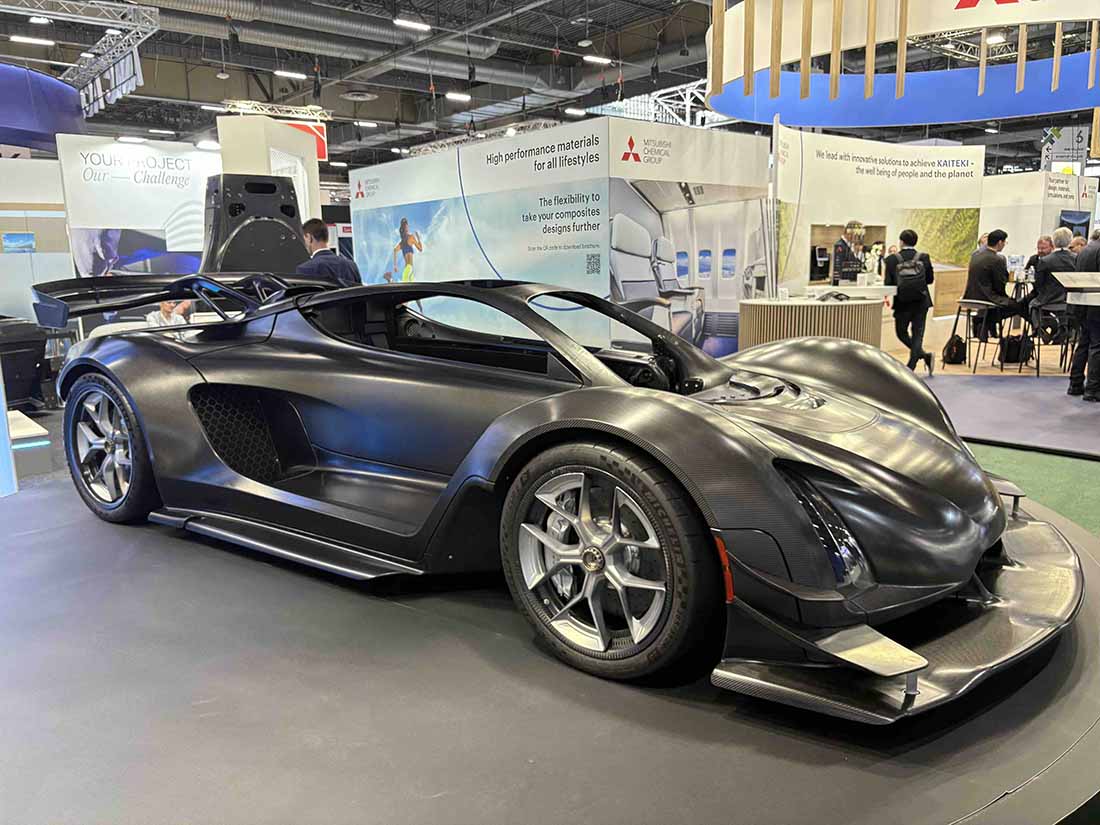
The global textile composites market is expected to reach US$14.2 billion by 2032, more than doubling in size over the next decade, according to a report by Allied Market Research. The projected growth is on track if JEC 2025 can be used as an indicator. The JEC Composite trade show is held over three days each year in Paris, attracting global exhibitors and visitors; this year, it recorded around 45,000 people passing through its doors from 94 countries.
With 1,350 exhibitors (including IFJ), a host of National Pavilions, conference, innovation, and start-up exhibition areas, and awards, the only shortage was time to see everything. This review focuses on some of the themes most relevant to the textile industry with key takeaways:
- Growth in biocomposites and hybrid biocomposites
- E-composites sees an increase in manufacturing solutions
- Futuristic cars, luxury items, and sports equipment capture the eye
Carbon fibers are perceived as dominant, and a cursory walk through JEC 2025 would confirm this, if one were to judge by the number of eye-arresting cars and acrobatic engineering forms using them. However, of the 13.5 million tons of composites produced in 2024, approximately 95% of them used glass fiber, according to Dr. Elmar Witten, Managing Director of AVK, the German industry association for reinforced plastics. Cost is one factor, with glass fiber a fraction of the cost of carbon fiber. Not all applications require the high specifications offered by carbon fiber. Coupled with the drive towards sustainability and strong R&D, natural fibers are growing in popularity. The global biocomposite market size was estimated at US$28.37 billion in 2024 and projected to reach US$79.35 billion by 2033, growing at a CAGR of 12.1%, a momentum driven by the strong global push towards sustainable materials in industrial applications, according to Grand View Research. North America dominates this market, accounting for just over 50% according to the report; however, the Asia Pacific industry is expected to grow at the fastest CAGR between 2025 and 2033. Here are indications of a step sideways from the goal of full circularity, with the hybrid biocomposite product segment expected to see the most significant growth over the forecast period at 12.9%.

One of the reasons for composites’ growing popularity is the acknowledgement of their ability to reduce environmental impacts, offer a good strength-to-weight ratio, and increasingly incorporate more natural fibers to produce biocomposites and hybrid biocomposites. Striving to move towards greater circularity, recycling has become a strong area of research and development. The JEC Innovation Planets exhibition showcased a number of these developments. Noticeable this year was the emphasis placed on the products made from recycled materials, demonstrating their continued value in the materials world. Teijin Carbon Europe GmbH, Spiral RTC, and Collins Aerospace exhibited their material developed from Airbus A350 production scrap carbon fiber clips, and were one of the Innovation Award Finalists.
The scrap material is sent from Collins Aerospace to Spiral, where it is compounded and co-consolidated with Teijin’s slit tape. The resulting material is used to make thermoplastic composite rods for the Multi-functional Fuselage Demonstrator (MFFD). The process offers a 20kg reduction in CO2 emissions per kg, achieved by minimizing the use of virgin raw materials while maintaining high mechanical performance and durability. ATA Mute developed and patented the Adaptive Acoustic Element, while CompositeEdge developed and patented the acoustic element itself. It is exceptionally thin, measuring just 1mm, and offers excellent sound absorption properties as well as vibration damping and thermal insulation. The material offers up to 95% sound absorption, is waterproof, fire- and chemical-resistant, and recyclable. Applications include wind turbine rotor blades, propellers for air and marine transport, as well as building technology and HVAC systems.

Flax, hemp, and jute were prominent in new developments in processing and manufacturing, combined with advances in resins (including bioresins), which offered improved performance characteristics, making them better suited to a broader range of product areas.
Oxeon AB has advanced its Textreme Spread Tow thin-ply technology, which combines both to produce thinner fabrics with material and composite weight savings. In addition to carbon fiber, the company is now applying the same process to a bio-based flax, as well as a woven carbon fiber and a carbon fiber/Zylon composite.
Manufactured by Toyobo, Zylon is a rigid-rod isotropic polymer spun through a dry-jet wet spinning process, exhibiting a high impact energy absorption level and a higher cross-sectional strength than carbon fiber. In an indication of industry confidence and market demand, EcoTechnilin, which manufactures biocomposites incorporating flax, hemp, jute, kenaf, or Dakkan hemp, has launched its fourth production line in Poland, thereby expanding its production capacity from 12,000 to 13,000 tonnes per annum.
Flax, hemp, and jute were prominent in new developments in processing and manufacturing, combined with advances in resins (including bioresins), which offered improved performance characteristics, making them better suited to a broader range of product areas.

Conductive, electromagnetic shielding, and E-composites were showcased at JEC 2025, featuring examples of finished products for the transportation and healthcare sectors. Cleveland, Utah, is home to Conductive Composites, specialists in conductive and shielding technology across a range of product types. NiFIBER is a nickel-coated fiber with a variety of core fibers, tailored to customer requirements, which can include aramid, cellulose, and carbon fibers.
Conductive Composites utilize a proprietary vapor-based process to apply an excellent coating to each fiber, resulting in a thin and ductile film of nickel. The fibers can be supplied in tow, braid, cloth and converted formats. The resulting product is well-suited for use in various manufacturing processes and offers significant advantages in terms of weight, stiffness, and tensile strength, making it ideal for applications requiring conductivity and electromagnetic shielding. The nonwoven form uses an ultrathin coating on substrates such as carbon fiber, aramid, and cellulose. It can be embedded in tapes or co-cured into composite surfaces, as well as being used as a stand-alone conductive sheet product.
Huntsman Advanced Materials showcased their electrically conductive adhesives. These are designed to offer benefits during manufacturing, including reduced energy requirements, time savings through a simplified process, and environmental and cost-saving benefits during transportation due to their lower weight. The products on offer include Miralon pulp, a carbon-based multipurpose adhesive that requires a low loading percentage compared to conventional fillers, preserving more of the base material’s properties, and is suited for bonding conductive elements. It is electrically conductive and flexible, placing it at the forefront of Huntsman’s new generation of carbon nanotube-based (CNT) materials. These are available in various forms, including sheets and yarn, in addition to the pulp adhesive. Miralon materials are made up of interconnected bundles of ultra-long, entangled nanotubes. It has strength and toughness at low density, with a conductivity that is almost equal to that of a single-walled CNT. The company envisions applications for its sheet form in composite embedded heaters or electrostatic discharge (ESD) protection for data cables, for example.
The scale of some of the products on display at JEC is always impressive, but this year’s show featured some very innovative manufacturing processes that utilized new technologies, clever design engineering, or both. The Swiss North Thin Ply Technology (NTPT) serves a very broad market range, spanning marine applications to the more unexpected field of luxury watches, in partnership with Richard Mille. Working in their clean room-controlled environment, Thin Ply prepregs are used to allow for a range of color and material innovations that enhance the distinctive aesthetic and performance of Richard Mille watches. The RM 011 was the first partnership in Carbon TPT, before going on to develop the Quartz TPT and Carbon TPT that is injected with graphene.


In a limited edition of just 75 timepieces, the Calibre RM50-03 weighs less than 40 grams, including the strap, making it, on release, the lightest mechanical chronograph ever made. Titanium, Carbon TPT are combined with graphene in the form of Graph TPT to achieve this. Carbon TPT uses multiple layers of 600 parallel carbon filaments to achieve a maximum thickness of 30 microns. These are impregnated with a matrix before being woven on a special machine that modifies the direction of the weft by 45° between layers. The woven material is then heated to a temperature of 120°C at a pressure of 6 bars. Carbon TPT is shown to improve the rate of occurrence of breaking stresses by 25% and of micro-cracks by 200% compared to other technically advanced forms of carbon material.