



Most carpets end up in landfills or incineration, locked out of the circular economy. In Europe, an estimated 1.6 million tonnes of carpet waste are sent to landfills each year. According to data from Deutsche Umwelthilfe from 2017, nearly 98% is either incinerated or sent to landfill. While the use of polyester has improved recycling rates, these improvements remain in the low single digits. In the United States, approximately 1.8 million tons of carpet waste are generated annually. Of this enormous amount, only 5% is recycled, and 6% is incinerated for energy recovery. The remaining 89% end up in landfills. These figures highlight a significant environmental problem, as most carpet materials are not biodegradable and therefore remain in landfills long-term. The low recycling rate indicates considerable potential for improving circular economy practices in the carpet industry1.
Although most carpet face fibers are technically recyclable, the way carpets are constructed has historically kept them out of the circular economy.
For decades, latex-based backings have been the standard in carpet production. While effective at binding fibers, latex creates a complex, inseparable composite. Once combined with pile fibers, the materials are permanently bound, resulting in carpets that perform well in use but are destined to become waste at the end of their life.
Hard Surface Growth Versus Carpet’s Staying Power
Luxury Vinyl Tile (LVT) dominates design trends, but carpets remain essential in homes, offices, and commercial spaces. Over the past two decades, carpets have steadily lost market share to hard surface alternatives, most notably LVT.
Once combined with pile fibers, the materials are permanently bound, resulting in carpets that perform well in use but are destined to become waste at the end of their life.
Yet carpets are far from obsolete. In residential markets, consumers continue to prefer carpets for their warmth, comfort, and acoustic properties. In commercial spaces, carpet tiles have become the dominant modular flooring option, accounting for about 44% of modular flooring revenue. Carpet’s resilience lies in its versatility and its ability to adapt to design trends. What has held the category back is its environmental baggage, and this is where innovation is beginning to change the story.
Hot-Melt Coating: 80% Less Energy, Zero Wastewater
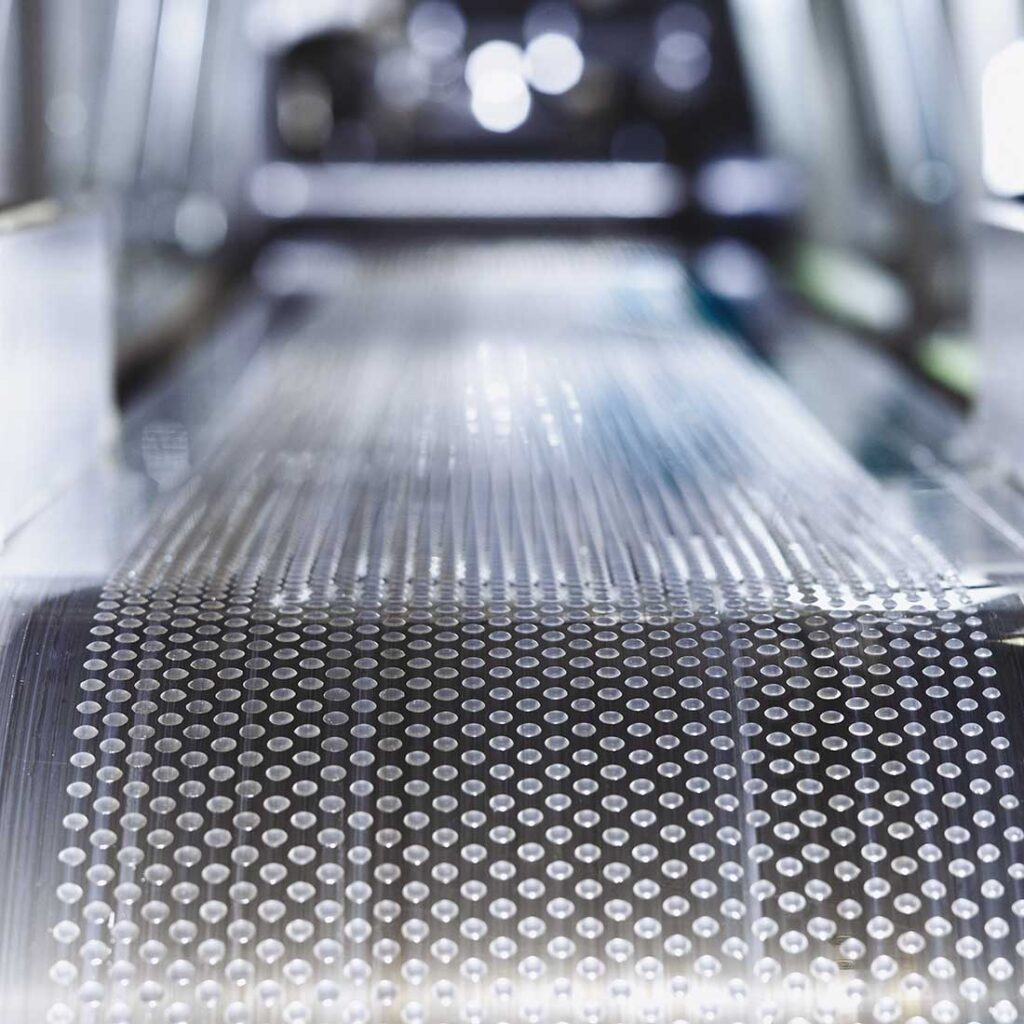
Compared to traditional latex coating, hot-melt technology offers significant benefits. The manufacturing process with hot-melt coatings consumes up to 80% less energy2 and generates no wastewater. This efficiency gain results from the fundamentally different coating process itself. Hot-melt coatings are applied in a molten state and harden through cooling, while latex systems require energy-intensive drying and curing processes with high water consumption. This shift to hot-melt technology represents a significant step toward reducing the ecological footprint of carpet production, regardless of the end product’s material composition.
Real-World Proof: Tiles, Turf, and Aviation
The potential for recyclable carpets is not confined to residential or office interiors. Mono-material design, specifically for PP and PET carpets, enables their downcycling into less performance-demanding items such as flowerpots or waste bins. This becomes more challenging when different raw materials are used in carpet construction. A particular advantage of PET-based carpets lies in the possibility to depolymerize and subsequently repolymerizing the material through chemical processes, achieving a closed material loop with virgin-quality material.
Carpet tiles, the workhorse of the commercial sector, are now being designed for cradle-to-cradle loops. For carpets with multiple components, such as those made with Polyamide 6 yarn or natural fibers like wool, the recycling process developed by Fraunhofer IVV and patented by Clariant for floor coverings ensures the pure recovery of the raw materials used, regardless of their composition.
In sports infrastructure, artificial turf is another major application. Modern turf systems typically combine polyethylene fibers with a primary backing based on either PP or PET. While latex and polyurethane are traditionally used as backing materials, polyolefin (PO) backing offers an alternative for better recyclability. Polypropylene-based solutions not only provide the necessary stability and tear resistance but are also fully recyclable.
Materials that Enable Circular Flooring
Carpet may never reclaim the dominance it once had, but it doesn’t have to. By aligning with circular economy principles, the industry can carve out a future where carpet is not just a flooring option of comfort and style, but also one of responsibility and resource efficiency.
New materials are leading the way. Licocene™ polymers, for example, are already enabling recyclable carpet systems by turning backings into polyolefin-based layers that can be reprocessed. And with the Licocene Terra line, which uses mass-balance certified renewable feedstocks, the industry now has an option that is both recyclable and renewable.
Carpets Redefined: From Waste to Resource
The image of carpets as bulky, unrecyclable waste could soon give way to something entirely different: a flooring solution designed to be used, recovered, and used again.
The carpet industry is rapidly moving toward circularity, and Clariant’s Licocene polymers have played a crucial role in enabling recyclable carpet systems. Now, Licocene Terra builds on this innovation, combining reliable performance with renewable feedstocks to reduce its environmental footprint.
Licocene Terra is produced using mass-balance-certified renewable feedstocks, has a lower CO2 footprint, and performs just like fossil-based versions with drop-in solutions. The result is the same bonding strength and process efficiency with a reduced carbon footprint.