


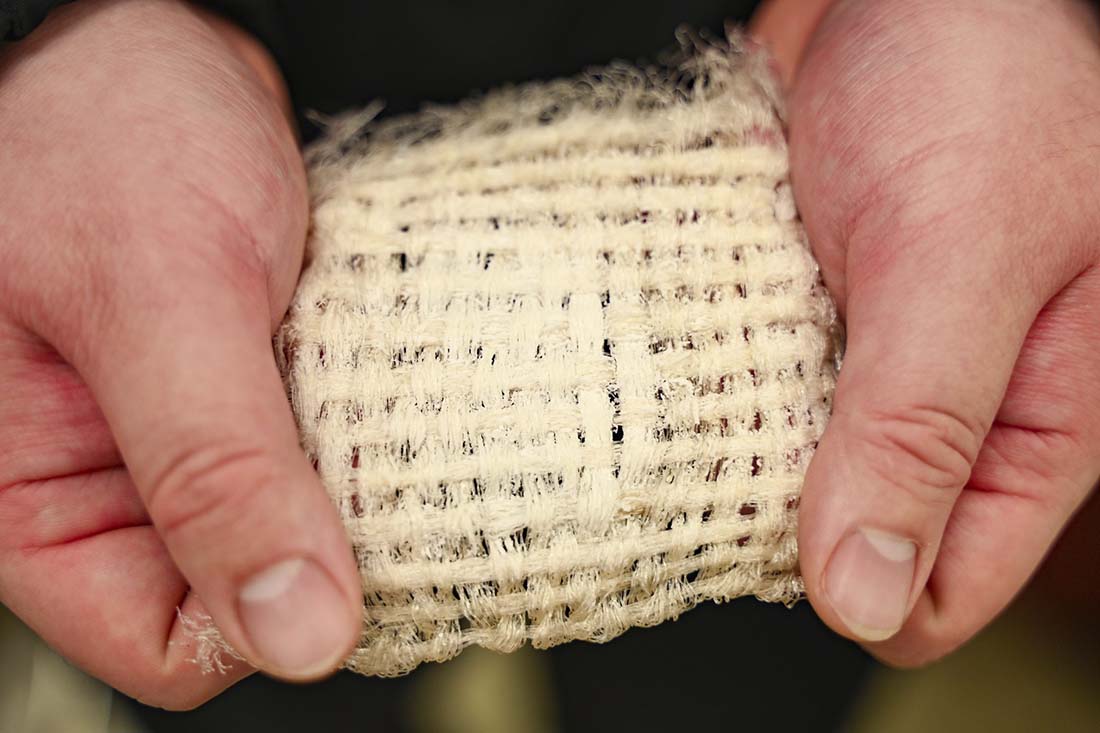
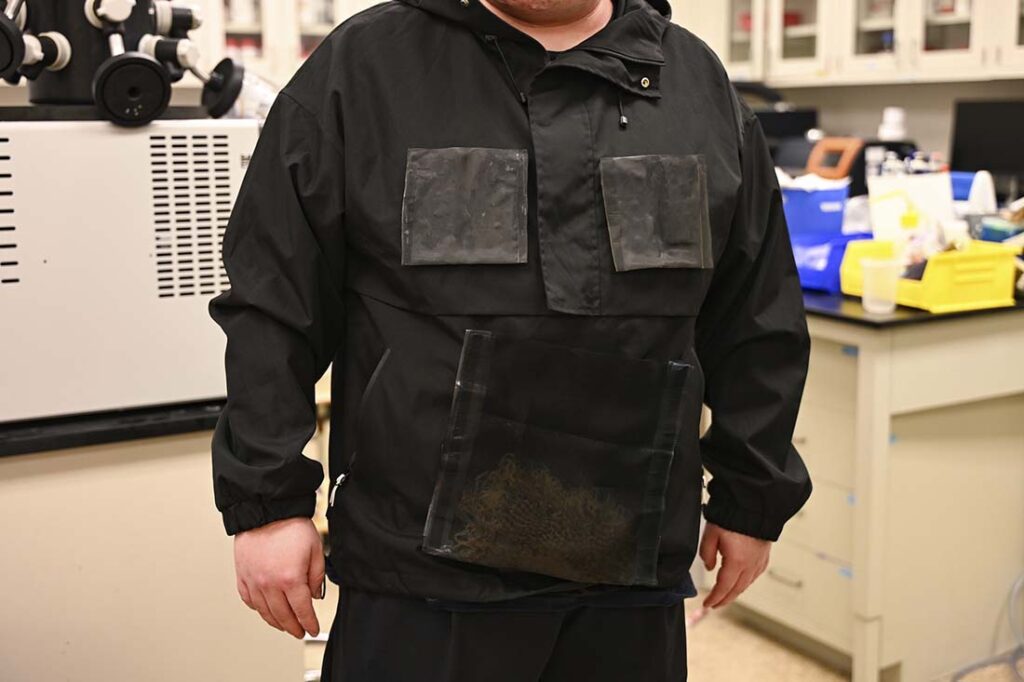
Engineers at The University of Texas at Austin have created a wearable jacket that harvests drinkable water directly from the atmosphere. The technology is an interesting innovation for anyone who spends extended time in areas with limited access to clean water — including hikers, campers, runners, agricultural workers, emergency responders and soldiers.
“Water harvesting from air is usually imagined as a stationary device such as a box, a panel or a large sorbent bed,” said lead researcher Guihua Yu, chair professor in the Cockrell School of Engineering’s Walker Department of Mechanical Engineering and Texas Materials Institute. “Here, we wanted to rethink the form of the technology. If the fabric itself can collect water from air, it opens a new direction for personal and portable water access.”
The jacket features a specially designed textile that captures moisture from the air and channels it to detachable harvesting units. These units sit in a foldable collector that is gently heated to release and condense the water into liquid form. Depending on humidity levels, the jacket can produce 400 to 900 milliliters — or about 14 to 30 ounces — of clean drinking water per day.
Compared to conventional water-harvesting materials, the new textile delivers a three- to 10-fold improvement in performance at scale. By engineering the fibers rather than adding a bulky device, the team solved a limitation in the field.
“The important advance here is that the team did not simply make another material that absorbs water,” said Keith Johnston, co-author and chair professor in the Cockrell School of Engineering’s McKetta Department of Chemical Engineering. “They designed a pathway for water to move quickly, from vapor in the air, to liquid on the fiber surface, and then into the textile. That transport design is what allows the material to work not just in a small lab test, but in a wearable system.”
Compared to conventional water-harvesting materials, the new textile delivers a three- to 10-fold improvement in performance at scale.
The researchers see broad potential beyond clothing. Applications may include backpacks, tents, emergency shelters and other everyday outdoor gear that could passively collect water. The team plans to expand testing for outdoor recreation, remote operations, disaster response, and water-scarce or infrastructure-limited regions. The university has already filed a patent application for the technology.
This textile builds on the same team’s earlier success with a separate portable device that set new records for pulling drinking water from the air. In field tests across the hot, arid Chihuahuan Desert in New Mexico and the more humid climate of Austin, that device consistently captured 1.3 liters of clean water per day — equivalent to 4.3 liters per kilogram of material — outperforming all previous research efforts.
“This is a big stride toward practical atmospheric water harvesting,” said Weixin Guan, lead author of the related paper in Nature Water. “This goal has been incubated over years of work, from molecular design to real-world operation, and it is especially meaningful to see those pieces finally come together in a field-ready system.”
For more information, visit the University of Texas at utexas.edu.