

With new capacity planned for 2027, Eximius Innovative is building a just-in-time supply chain model for India’s growing diaper and hygiene markets.
Eximius Innovative Pvt. Ltd. was founded in 2011 in Rajkot, India. Beginning with a single 1,600-ton spunbond line producing packaging fabrics, the company progressively advanced into high-specification hygiene and medical fabrics.
By 2025, Eximius had installed four production lines with production capacity totaling to 20,000 tons per year and is widely regarded as one of India’s top five hygiene fabric manufacturers. A key turning point came when Eximius successfully modified its double-beam production line to manufacture hygiene fabrics for diaper applications, despite hygiene fabrics traditionally being produced on triple-beam lines.
With a fifth spunbond-spunbond-spunbond (SSS) production line planned for 2027, Eximius aims to dedicate individual plants to specific diaper fabric variants, enabling just-in-time deliveries and reducing inventory costs for customers.
Overcoming Early Challenges And Earning Repeat Business
The name says it all. Eximius is a Latin word meaning “set apart” and describes something that stands out and is extraordinary. The company’s pivot to nonwovens came through family friends active in the plastics industry, with knowledge of the nonwovens sector, who initially joined Eximius as partners. The partnership helped Director Apurva Zalawadia place an order for a single-beam spunbond production line with a capacity of 1,600 tons per year. However, citing concerns about overcapacity in nonwoven packaging fabrics, the partners withdrew while the plant was under construction.
“Since we had already placed orders for the production line and the plant was under construction, we decided to go ahead on our own,” Zalawadia said.
It was a bold move for a team with limited industry knowledge. But Zalawadia and his team persevered, overcame early challenges, and began earning repeat orders — enough to give them the confidence to stay the course.
Building The Foundation: Packaging To Hygiene
The early years at Eximius centered on packaging fabrics, which typically require a weight of 40 grams per square meter (gsm) and above. By 2017, buoyed by growing confidence, the company expanded with a double-beam spunbond-spunbond (SS) plant at a new location, adding 3,600 tons per year of capacity.
Then came the turning point. A diaper manufacturer approached Eximius and encouraged them to produce 15 gsm hygiene fabrics — a very different technical proposition since the company had a SS production line.
“Normally, hygiene fabrics of this grade are produced on triple-beam (SSS) production lines, while the Eximius SS line had been designed entirely for packaging,” Zalawadia explained. “We undertook modifications on the SS production line. It took us two months to start commercial production, but we overcame every challenge. A diaper manufacturer has stringent quality control standards. The diaper assembly line runs at more than 750 pieces per minute, and if one fabric component is not of good quality, all diapers produced in that minute are rejected.”
Meeting those demanding standards, despite producing the diaper fabrics on a line not designed for hygiene applications was a landmark achievement. It set Eximius on a new trajectory. In those days, hygiene-grade nonwoven fabrics were predominantly imported into India, as domestic production capacity could not meet demand. Eximius’ success encouraged other double-beam line operators to begin experimenting with hygiene fabrics.
A Decade Of Capacity Expansion
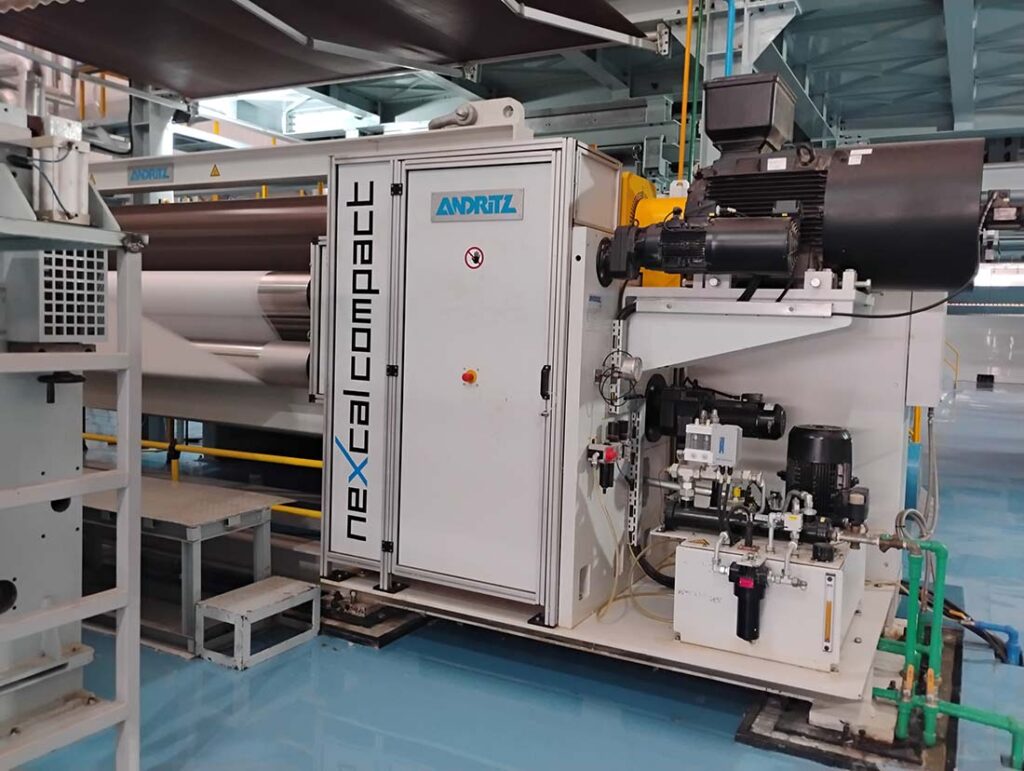
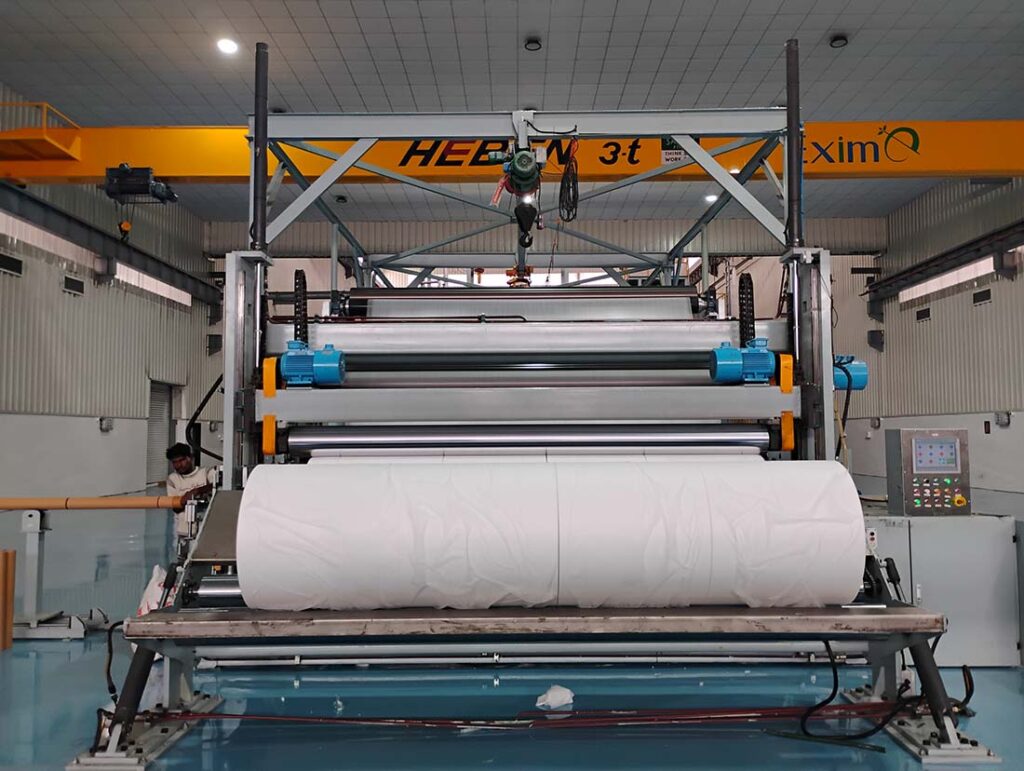
The first single-beam spunbond line was installed at Eximius in 2011, the plant’s double-beam SS line was set up in 2017, and its SSS line was brought online in 2020 with a capacity of 4,800 tons per year. According to the company, this line is the first SSS line installed in India with pre-delivery modifications for enhanced loft and softness in fabrics. A fourth machine, a spunbond-spunbond-meltblown-meltblown-spunbond (SSMMS) line, was installed in 2025 and has a capacity of 10,800 tons per year. Total capacity at Eximius now is 20,000 tons per year.
The first and second production lines are currently dedicated to nonwovens packaging fabrics, while the third and fourth production lines produce fabrics for only hygiene and medical applications. Weights range from 8 to 30 gsm for hygiene fabrics and up to 150 gsm for packaging fabrics. Eximius also provides 25 color options for packaging fabrics.
Differentiation: Volume, Quality And Scale With Consistency
When asked how Eximius differentiates itself in a market dominated by margin pressure and volume competition, Zalawadia is clear. “We may currently be the fifth largest hygiene fabrics manufacturer in India,” he said. “The nonwovens fabrics industry works on the game of volumes and there is constant pressure on margins. But we are able to offer volumes with quality.”
The diaper industry follows seasonal cycles and demands high volumes at peak times, driving the company’s ongoing capacity additions. Beyond volume, the company emphasizes consistency. Every batch is held to the same quality specification. “When we exhibit at trade shows, the story does not just end with the hand feel of the fabric or whether it is soft,” Zalawadia noted. “The customer also checks packaging quality, winding tension, labeling, data provided, material handling and many other parameters. Hygiene fabric is made to order — every diaper manufacturer has different parameters. We supply super soft, cotton soft, feather soft, baby soft and many other variants in hand feel alone.”
The Three Variants Of A Diaper
A modern diaper incorporates three distinct nonwoven fabric components — a hydrophilic fabric used in the top sheet, a spunmelt fabric for leg cuff applications, and a hydrophobic fabric for the waistband. Spunbond fabric accounts for 50 percent of the nonwovens used in a diaper, while 30 percent of the fabric components are hydrophobic or hydrophilic spunbonds, and the remaining 20 percent is spunmelt.
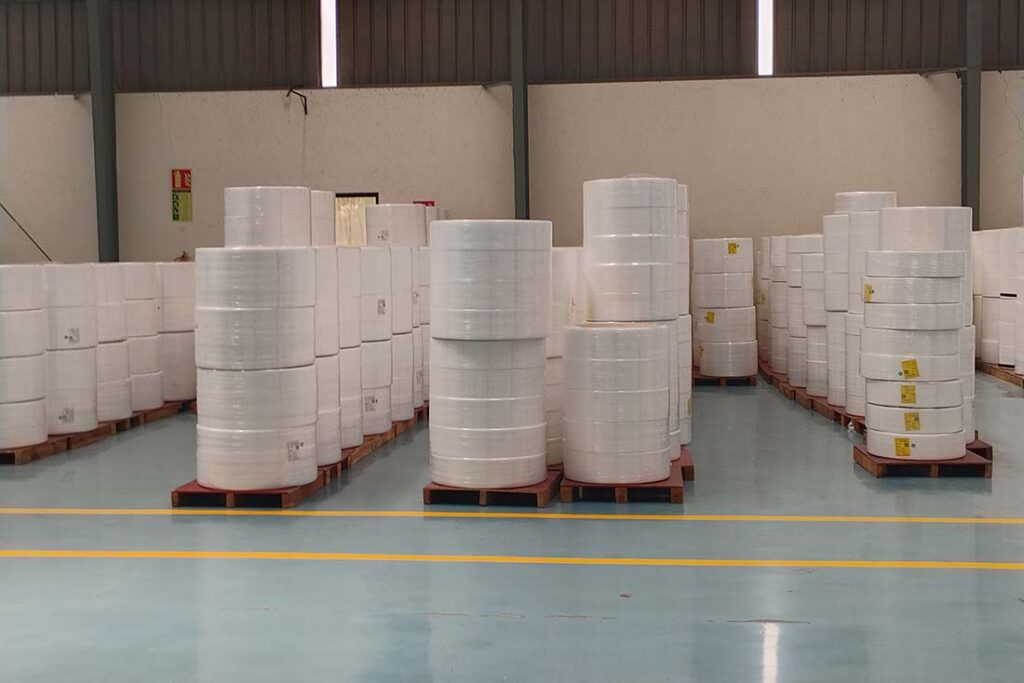
Today, Eximius produces each of these variants, but in batches of 10 to 20 tons per customer order. This means each customer must maintain approximately one month’s worth of inventory for each variant, which is a capital burden.
Just-In-Time: The 2027 Vision
Once the fifth production line becomes operational in 2027, Eximius plans to dedicate each line exclusively to one fabric variant — one plant for hydrophilic fabrics, another for spunmelt fabrics and the new 2027 equipment for hydrophobic fabrics.
“Currently, a customer buys one truckload of fabric for each variant,” Zalawadia said. “Once we dedicate each line to a variant, we will be able to provide all three fabric variants in one truckload. Secondly, we will be able to supply within 24 hours, compared to seven to 10 days currently.
“This will allow diaper manufacturers to cut raw material inventory dramatically, free up working capital, and order fabric on a just-in-time basis,” he added. “It will also give them unprecedented flexibility to plan production across diaper sizes and variants — something the current batch system does not permit.”
The Technical Edge: Quality Systems And Certifications
Quality at Eximius begins with technology choices. Key components of the nonwoven production lines including calenders, dies, pumps and winders have been sourced from established German, Japanese and American manufacturers.
Every production parameter is codified in a standard operating procedure, and the company has a deliberate staff retention policy to ensure key production personnel remain with the business over the long term. “This, in a small way, too helps maintain consistent quality,” Zalawadia said.
The company holds ISO 9001, ISO 14001, and ISO 45001 certifications. Its fabrics carry OEKO-TEX,® REACH and cytotoxicity certifications. Notably, Eximius applies these compliance standards to all production — domestic, as well as export.
“We believe in following ethics which we will never compromise,” Zalawadia said. “We produce fabrics meeting all compliance certifications irrespective of whether we sell in domestic or export markets.”
An in-house laboratory, equipped with technology sourced from Austria-based Lenzing Instruments GmbH & Co. KG, includes tensile strength testing machines, denier testing equipment and equipment for hydrophilic fabric runoff and strike-through testing. The plants producing hygiene and medical fabrics feature a closed-room facility with entry through an air shower — conditions necessary to ensure hygiene-grade output. An artificial intelligence-integrated online defect detection system is installed on the production lines, and all lines operate under programmable logic controller automation.
Eximius uses 100 percent polypropylene that is free of phthalates. Although phthalate-free polypropylene is required only for EU exports, the company applies this standard to all production, including domestic sales, a cost Zalawadia views as non-negotiable.
Sustainability: Solar EnergyAnd Biodegradable Products
Sustainability is not an afterthought at Eximius. The company has established a solar park and installed rooftop solar panels across its facilities, together accounting for 60 percent of its electricity requirements, which is the maximum threshold permitted under its state regulations.
Beyond nonwovens, Eximius operates a manufacturing plant producing solar films and components, and another plant making biodegradable tableware, reflecting a broader corporate commitment to environmental responsibility.
The Market Opportunity: India’s Diaper Boom
Zalawadia is unambiguous about where Eximius sees its greatest growth opportunity — hygiene fabrics for India’s domestic market. “Per capita income is on the rise in India and with increase in incomes, the growth in sales of diapers and sanitary pads is also assured,” he notes. “Until a few years ago, diapers were a want-based product. In current times they are need-based.”
He cited several structural drivers. The diaper industry in India is growing at a compound annual growth rate (CAGR) of around 18 percent, while the adult diaper segment is expanding even faster at 20 to 22 percent CAGR. Tier III and IV Indian towns represent a big, largely untapped market. Maternity hospitals are introducing mothers to disposable baby diapers, while other hospitals are introducing elderly patients to adult diapers. In both cases, usage continues after discharge.
“Ten years ago, there were just five or six Indian private label diapers or sanitary pad manufacturers. Now there are more than 50,” Zalawadia remarked.
Manufacturing technology has also leapt forward. Diaper production machinery that once ran at 300 to 400 pieces per minute now operates at up to 900 pieces per minute. Indian and multinational brands have significantly expanded capacity over the past decade. All of this underpins a long-term structural demand for high-quality nonwoven fabrics.
Exports: Going Global
Eximius began exporting in 2024 and exports now account for approximately 10 to 12 percent of revenue. Current markets include Nepal and several African countries. The company has plans to enter the United States and EU markets beginning in 2026.
The REACH and OEKO-TEX certifications, combined with phthalate-free production standards already applied domestically, position Eximius well for regulatory compliance in these markets.
CSR: Cafeteria, Cows and Community
Corporate social responsibility at Eximius is expressed through a range of initiatives. All employees have access to cafeteria facilities where food is provided at no cost. The company also maintains a facility housing roughly 250 cows and bulls — each with a physical impairment in some way. Across its production plants, which together span 25 acres and approximately one million square feet of built-up area, some 1,000 trees have been planted at each location.
Vision For The Next Five Years
Looking ahead, Zalawadia’s vision for Eximius is anchored in two pillars — customer convenience and capacity growth. “Our main vision is to provide convenience to our customers in terms of their inventory control,” he said. “We will keep increasing our capacity at regular intervals, thereby providing more employment opportunities.” The company also has plans to introduce hot-air-through nonwovens — a product used in premium diaper applications that commands higher value and more demanding technical specifications.
For Eximius, the next phase of growth is tied not only to added capacity, but to how that capacity is organized. By dedicating lines to specific hygiene fabric variants, the company aims to reduce lead times, simplify inventory planning for diaper manufacturers and strengthen its position in India’s expanding hygiene market.