



Biofabricated leather platforms based on mycelium, agricultural residues and microbial fermentation are reshaping the search for alternatives to animal-derived and synthetic leather.
This article is part one in a two-part series focused on biofabricated leather. Part one focuses on the reason for leather disruption, terminology and the major technologies and material development. Look for part two — which examines commercialization from manufacturing, scaling, regulation, adoption and future outlook — in Issue 5 of International Fiber Journal.
Global leather and leather-alternative markets collectively exceed $100 billion annually, making the search for sustainable alternatives not merely an environmental initiative but a significant industrial and economic opportunity. The global materials industry is entering a period of profound transition. Mounting environmental pressures, consumer demand for sustainable products, advances in biotechnology, and growing scrutiny of both animal-derived and fossil-fuel-based materials are reshaping how industries think about leather and flexible material systems. In response, a new generation of biofabricated leather platforms — derived from mycelium, agricultural residues, bacterial cellulose, engineered proteins and other biological feedstocks — is rapidly emerging. While these materials have generated considerable excitement across fashion, automotive and consumer goods sectors, their long-term success will ultimately depend not only on biological innovation but on industrial scalability, manufacturing integration, durability, economics and supply-chain maturity.
… a new generation of biofabricated leather platforms — derived from mycelium, agricultural residues, bacterial cellulose, engineered proteins and other biological feedstocks — is rapidly emerging.
Why Leather Is Being Disrupted
Few materials occupy as complex a position in modern manufacturing as leather. For centuries, animal-derived leather has been associated with durability, luxury, craftsmanship and status. Yet in recent years, growing environmental scrutiny, animal welfare concerns, regulatory pressures, and changing consumer preferences have accelerated the search for alternatives.
At the same time, conventional synthetic leather — primarily polyurethane (PU) and polyvinyl chloride (PVC)-based materials — faces increasing criticism due to fossil-fuel dependence, microplastic generation, difficult end-of-life disposal, and concerns over volatile organic compounds (VOCs) and toxic additives.
This convergence of sustainability pressures, biotechnology advances and investor enthusiasm has given rise to a rapidly expanding category broadly described as “biofabricated leather.”
Today, startups, luxury brands, material innovators and biotechnology companies are racing to commercialize alternatives derived from mycelium, pineapple leaves, cactus fibers, apple waste, bacterial cellulose, collagen fermentation and engineered biomaterials. Fashion brands eager to demonstrate environmental leadership have embraced these materials in limited-edition products, while investors have poured hundreds of millions of dollars into biomaterials ventures promising to redefine the future of textiles and consumer products.
Yet beneath the enthusiasm lies a more complicated industrial reality.
Despite impressive scientific advances and compelling sustainability narratives, many biofabricated leather platforms remain challenged by issues involving scalability, consistency, durability, economics, coatings chemistry, manufacturing integration and supply-chain readiness. In numerous cases, the gap between laboratory success and industrial-scale deployment remains substantial.
The future of leather alternatives may ultimately depend not only on biology itself, but on the industry’s ability to integrate biology into robust manufacturing systems capable of delivering consistent performance at competitive cost and scale.
What Is Biofabricated Leather?
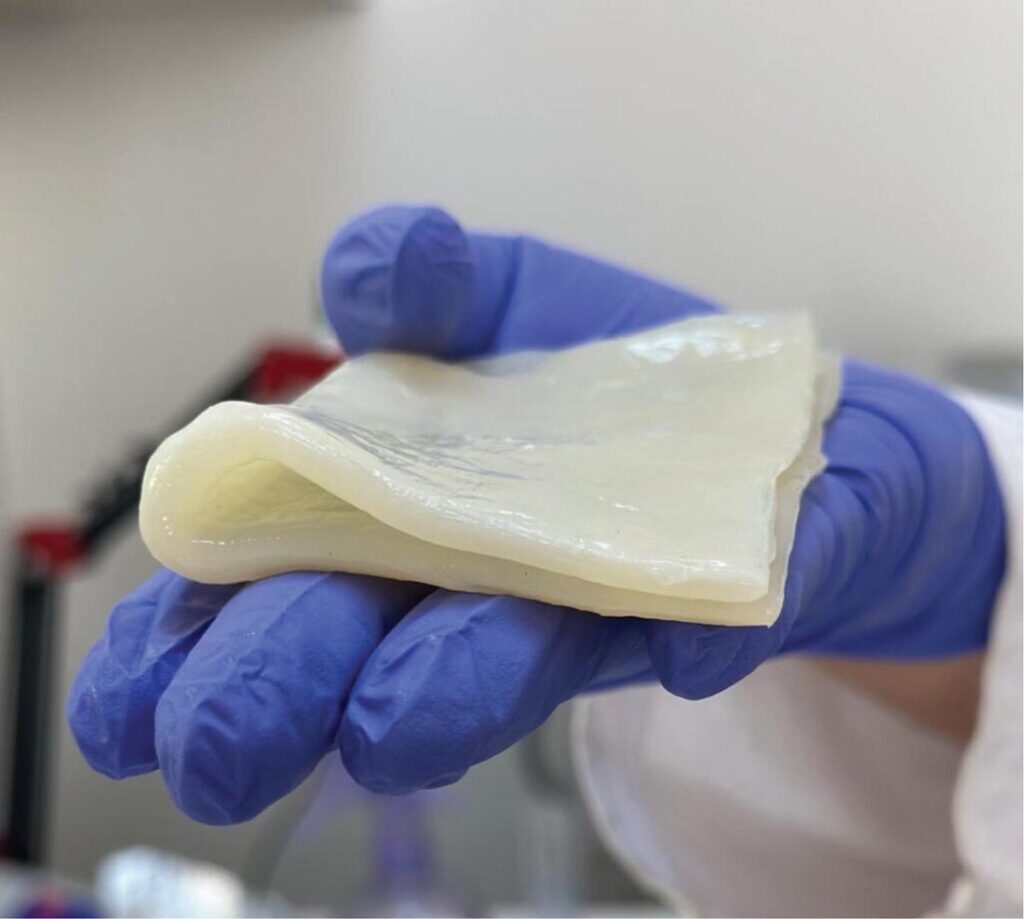
One of the first challenges facing the industry is terminology itself. Terms such as “biofabricated leather,” “vegan leather,” “biobased leather,” “next-generation leather,” and “lab-grown leather” are often used interchangeably despite representing fundamentally different technologies and material systems.
In practice, the category encompasses several distinct approaches:
• mycelium-based materials derived from fungal root structures;
• plant-fiber composites utilizing agricultural residues or natural fibers;
• bacterial cellulose systems grown through microbial fermentation;
• precision-fermented proteins and collagen; and
• hybrid biomaterial composites incorporating both biological and synthetic components.
Importantly, many so-called biofabricated leathers are not fully biological materials. Instead, they are often multilayer engineered composites involving nonwoven or textile substrates, polymer binders, coatings, reinforcement layers and chemical finishing systems.
This distinction matters because marketing narratives sometimes imply fully biodegradable or fully natural materials when the industrial reality may involve substantial synthetic content.
In many cases, the biological component functions primarily as a structural or aesthetic element within a broader engineered materials platform.
As the industry matures, clearer terminology and standardized definitions will become increasingly important for regulators, brands, investors and consumers alike.
Mycelium-Based Leather: Biology Meets Materials Engineering
Among all biofabricated leather technologies, mycelium-based materials have arguably generated the greatest excitement.
Mycelium — the root-like filamentous structure of fungi — can be cultivated under controlled environmental conditions to produce interconnected fibrous networks capable of forming sheet-like materials. Companies such as MycoWorks, Bolt Threads, and Ecovative have helped elevate mycelium from a niche biomaterials concept into a globally recognized innovation platform.
The appeal is understandable. Mycelium can grow rapidly using agricultural feedstocks, requires comparatively low land inputs relative to livestock systems, and offers the potential for tunable material architectures through controlled growth conditions.
However, the industrialization of mycelium leather is far more complex than simply growing leather.
In practice, most commercial mycelium materials require extensive downstream processing and finishing operations to achieve the durability, flexibility, abrasion resistance, water resistance and aesthetics expected by fashion and consumer goods markets.
Critical industrial challenges include achieving consistent morphology and density, controlling growth uniformity, preventing contamination, scaling bioreactor or tray-based systems, drying and stabilization, ensuring mechanical reinforcement, and developing suitable coating chemistries.
One of the least discussed realities is that many commercial mycelium leather systems rely heavily on polymeric coatings and finishing layers — often including PU formulations — to meet performance requirements. As a result, the overall sustainability profile may differ substantially from simplified public narratives.
This does not diminish the significance of the technology. Rather, it highlights an important truth: successful biofabricated materials are likely to emerge not as purely biological systems, but as highly engineered hybrid materials integrating biology with advanced manufacturing and materials science.
Luxury markets may continue to serve as an important early entry point for mycelium materials, where premium pricing can partially offset current production costs. However, broader penetration into automotive, footwear, upholstery, and mass-market consumer goods will require major advances in manufacturing efficiency, durability, reproducibility and cost reduction.
Plant-Based Leather Systems: Agricultural Waste As A Material Platform
A second major category of leather alternatives utilizes agricultural waste streams and plant-derived cellulosic fibers.
Prominent examples include:
- pineapple leaf fibers such as Piñatex from Ananas Anam;
- cactus-based materials such as Desserto® from Adriano Di Marti S.A. DE C.V. (See Figure 1);
- apple peel-based leather such as AppleSkin™ from VegaTex Biotech (HK) Ltd.;
- grape waste composites such as GrapeSkin® from VEGEA®;
- mango pulp and peel-based leather from Fruitleather Rotterdam and Aamati Green;
- cork-derived materials from HZCORK, Suberise and MB Cork;
- banana waste stem-derived fibers from Banofi; and
- walnut, almond, pecan, pistachio and peanut shells as well as seaweed-derived components such as NutLeather from Ecoatex.
These platforms are particularly attractive because they align strongly with circular economy narratives by valorizing agricultural residues that might otherwise be discarded or underutilized.
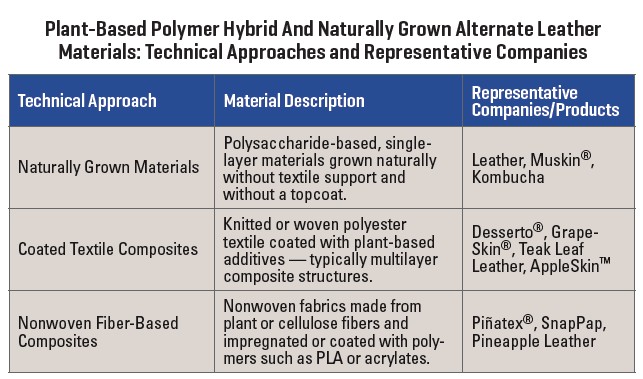
Piñatex, for example, utilizes fibers extracted from pineapple leaves, transforming an agricultural byproduct into a nonwoven substrate subsequently coated and finished for leather-like applications. Table 1 summarizes the technical approaches of representative companies manufacturing both plant-based polymer hybrids and naturally grown leather alternatives.
Yet here again, industrial nuance matters.
Most plant-based leather alternatives are not standalone biological materials. They typically involve fiber extraction, mechanical processing, nonwoven formation, resin impregnation, polymer binders, surface coatings, embossing and protective finishes.
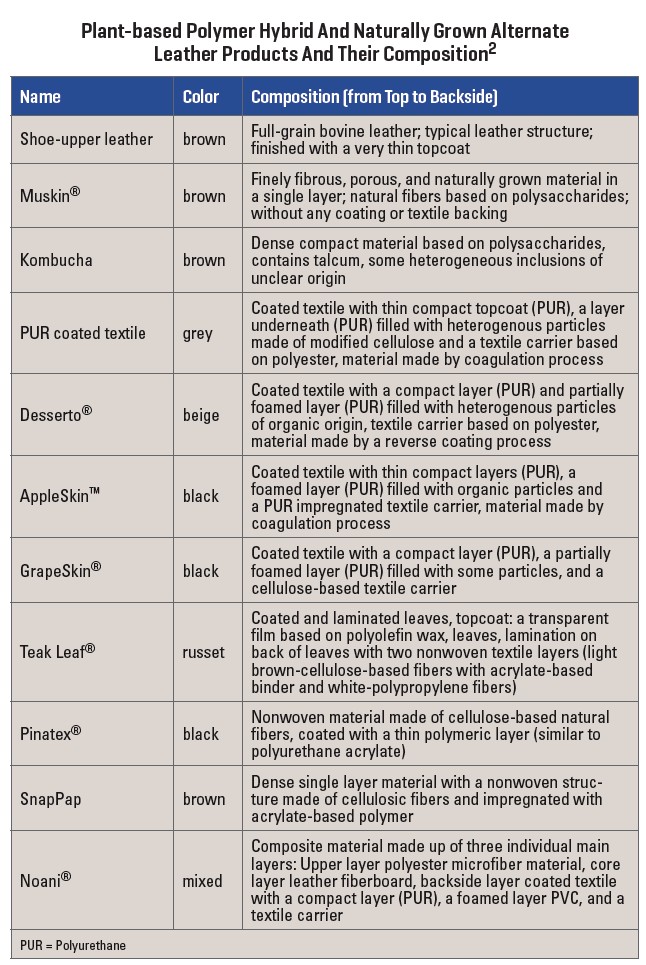
In many cases, synthetic polymers remain essential to achieving required mechanical performance and durability. Consequently, the overall renewable content may vary significantly across products. Thus, they are also referred to as plant-based plastic/polymer hybrids. Figure 2 compares the principal structure of natural leather and plant-plastic/polymer hybrid leather. Table 2 lists various plant-based/hybrid leather products and their composition.
Performance tradeoffs also remain important: flexibility versus stiffness, softness versus abrasion resistance, biodegradability versus durability, and aesthetics versus manufacturability.
Furthermore, agricultural feedstock variability presents ongoing supply-chain and quality-control challenges. Biological raw materials inherently vary according to climate, growing conditions, seasonality, harvesting methods and storage conditions. These variables complicate efforts to achieve consistent industrial-scale manufacturing. Nonetheless, plant-based systems may hold important advantages in terms of scalability and feedstock accessibility compared with more biologically complex fermentation platforms.
Bacterial Cellulose And Precision Microbial Fermentation: The Next Frontier
Beyond mycelium and plant fibers lies a more advanced frontier involving bacterial cellulose, synthetic biology, and precision fermentation.
Bacterial cellulose systems utilize microorganisms — often kombucha cultures or bacteria fed on nutrient-rich agricultural or food waste — capable of producing highly pure cellulose networks through controlled fermentation processes. These materials can exhibit remarkable structural properties such as high tensile strength and offer intriguing possibilities for engineered textiles and flexible biomaterials.
Meanwhile, advances in precision fermentation and cellular agriculture are enabling efforts to produce collagen and other structural proteins without animals. The scientific potential is enormous. Yet the industrial barriers are equally substantial.
Key challenges include bioreactor capital costs, fermentation yields, contamination control, downstream purification, drying and finishing energy requirements, water consumption, and scale economics.
One key manufacturer of fermented bacterial cellulose products is Mexico-based Polybion, which offers Celium. FABULOSE, an EU-funded biotech research project coordinated by the German Institutes of Textile and Fiber Research (DITF), is developing scalable manufacturing processes for fossil-free leather alternatives made from bacterial cellulose and cyanophycin.
The transition from laboratory-scale fermentation to industrial-scale continuous production remains one of the most difficult hurdles in biotechnology commercialization. In many cases, the bottleneck is no longer proof-of-concept science. Rather, it is the economics of manufacturing.
For these technologies to achieve meaningful commercial penetration, they must eventually compete not only against premium animal leather, but also against extremely low-cost, globally optimized synthetic materials supply chains.
References
- Grand View Research. Leather Goods Market Size, Share & Trends Analysis Report; and Synthetic Leather Market Size, Share & Trends Analysis Report. Market summaries accessed 2026.
- Huber, T., et al. (2024). Biofabricated Leather Alternatives: Current Status and Future Directions.
- Meyer, M., et al. (2021). Comparison of the Technical Performance of Leather, Artificial Leather, and Trendy Alternatives.
- Jones, M., Bhat, T., Wang, C.H., et al. (2021). Mycelium Composites: A Review of Engineering Characteristics and Growth Kinetics. Journal of Bionanoscience.
- Elsacker, E., Vandelook, S., Van Wylick, A., et al. (2020). A Comprehensive Framework for Mycelium-Based Materials. Journal of Cleaner Production.
- Huber, T., et al. (2022). Alternative Leather Materials Based on Fungal and Plant Biomass. Materials Today Sustainability.
- Appels, F.V.W., et al. (2019). Fabrication Factors Influencing Mechanical Properties of Mycelium-Based Composites. Materials & Design.
- Montalvo-Navarrete, J.I., et al. (2023). Plant-Based Leather Alternatives: Materials, Processing and Sustainability. Sustainability.
- Spierling, S., et al. (2018). Bio-Based Plastics and Fiber-Based Composites: Environmental Assessment and Market Outlook. Journal of Cleaner Production.
- Gorgieva, S., Trček, J. (2019). Bacterial Cellulose: Production, Modification and Applications. Nanomaterials.
- Jozala, A.F., et al. (2016). Bacterial Cellulose Production and Industrial Applications. Applied Microbiology and Biotechnology.

