


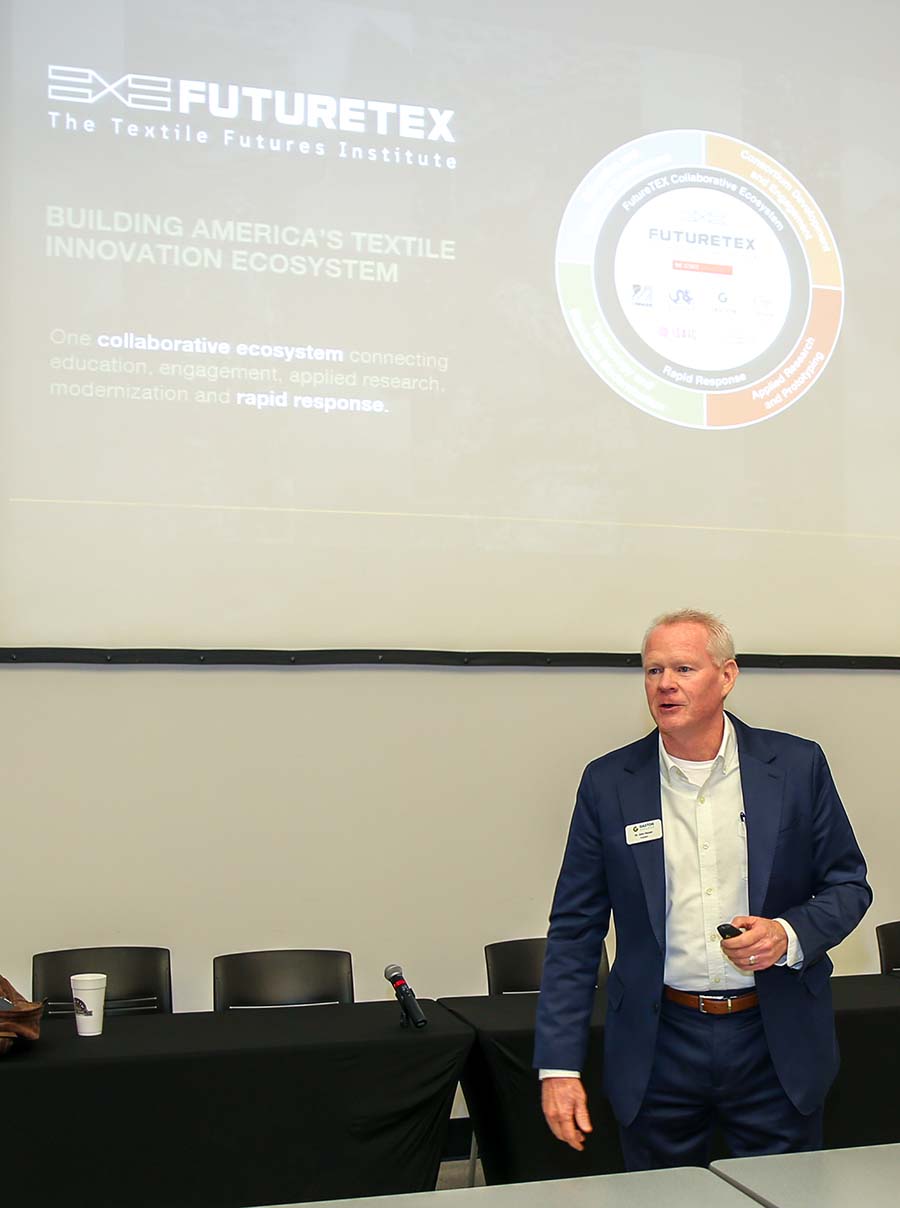
The 10-year initiative will unite industry, academia and government to advance defense textiles, commercial applications and workforce development.
FutureTEX is a new national Manufacturing Innovation Institute focused on fibers, textiles and advanced materials. The 10-year Department of War initiative is intended to modernize U.S. textile manufacturing, strengthen domestic supply chains and support the defense industrial base. The FutureTEX award includes $36 million in first-year funding and has a ceiling of $480 million over 10 years.
Raleigh, N.C.-based NC State was selected to lead the initiative. Core partners include Belmont, N.C.-based Gaston College, Philadelphia-based Drexel University, Atlanta-based Georgia Institute of Technology, the Detroit-based Industrial Sewing and Innovation Center (ISAIC), and the Lowell, Mass.-based University of Massachusetts Lowell. In addition to its headquarters at
Gaston College’s Kimbrell Campus in Belmont, FutureTEX will have hubs in Raleigh, Philadelphia, Atlanta and Lowell.
Gaston College President Dr. John Hauser, who has been appointed FutureTEX’s inaugural CEO, shared some details about the vision for the institute during the Southern Textile Association’s Summer Marketing Forum.
“We are building an innovation ecosystem that is focused on connecting industry and associations, engaging in applied research and modernizing the equipment and facilities that are in the U.S. now,” Dr. Hauser said.
FutureTEX plans to bring together manufacturers, brands, retailers, federal agencies, universities, trade associations and nonprofit organizations. Its work will focus on accelerating innovation, reducing the risks associated with scaling up new technologies and moving applied research toward commercial production.
While the institute has a national defense mission, Dr. Hauser emphasized that its work will also serve commercial textile markets. Materials, manufacturing technologies and workforce capabilities developed for military applications can often be transferred to automotive, aerospace, medical, protective apparel and other commercial sectors.
The initiative will address multiple stages of textile manufacturing, from fibers and yarns to finished products. Planned areas of activity include automation, digital infrastructure, advanced materials, product development, testing, production scale-up and workforce training.
Gaston College and NC State will initially work together to establish an independent nonprofit organization that will assume administrative oversight of FutureTEX.
The institute will build on Gaston College’s existing textile facilities and workforce programs. Its Kimbrell Campus is home to the Textile Technology Center as well as the 39,000-square-foot Fiber Innovation Center, which opened in 2025. The center houses a polymer development lab, extrusion, yarn and filament processing, product development and analytical testing capabilities.
Workforce development is also a central part of FutureTEX’s mission. Dr. Hauser said manufacturers consistently identify the availability of trained employees as one of their most significant challenges. The consortium plans to promote textile careers nationally while creating educational pathways extending from K-12 outreach and industry-recognized credentials to associate, bachelor’s and graduate degree programs.
“People don’t realize that textiles and advanced materials are in everything that we touch every day,” Dr. Hauser said. “Part of the mission of FutureTEX is to change and rebrand what people think about textiles, advanced materials and fibers.”
FutureTEX’s broader objective is to make the domestic textile network more resilient while helping manufacturers access research expertise, modern equipment, technical assistance and trained workers. Dr. Hauser invited companies and industry associations to help determine the consortium’s priorities and participate in projects as the institute develops.
“We’re looking to innovate, really looking to collaborate across the consortium,” Dr. Hauser noted. “Our focus is strengthening U.S. manufacturing, accelerating technology development and building that workforce. Let’s go build this thing together.”