


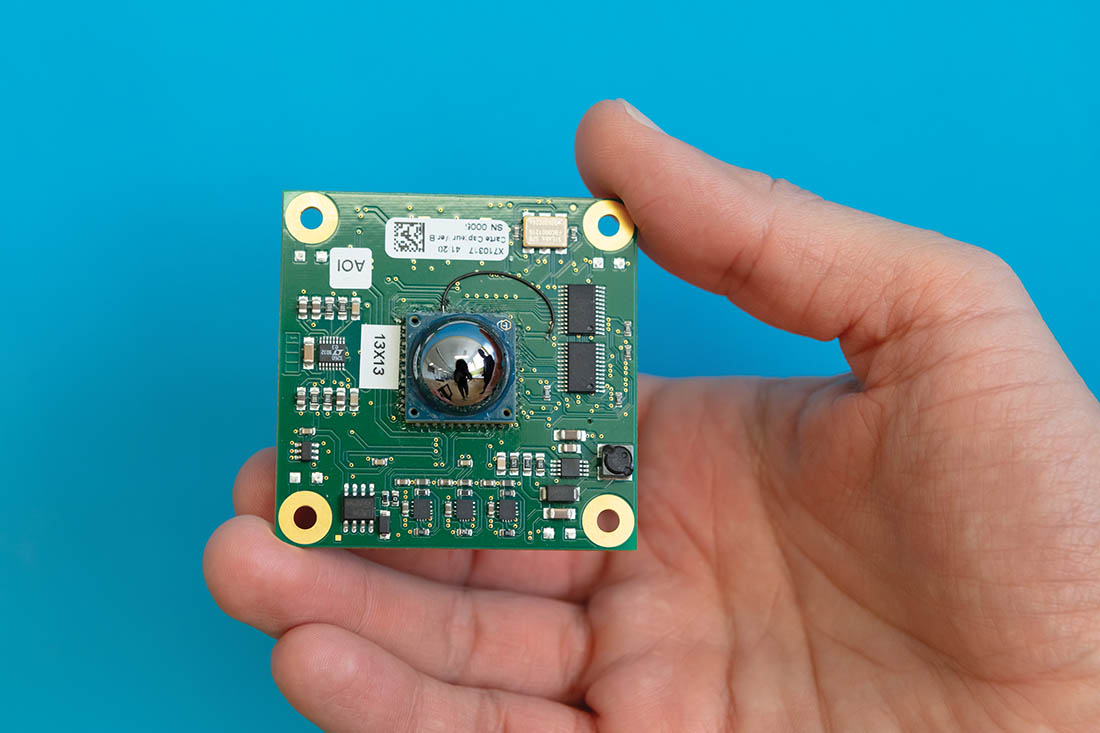
SAPScan is a non-destructive terahertz laboratory scanner designed to reveal and quantify internal product characteristics without cutting or altering the sample. Developed by France-based TiHive, the solution turns lengthy laboratory analysis into actionable results in 90 seconds. It gives research and development and quality teams faster access to internal data that was previously difficult or time-consuming to obtain, helping accelerate product development and testing cycles.
Developed initially for the absorbent hygiene industry, SAPScan’s optics, calibration and measurements can be tailored to different materials and use cases across nonwovens, medical devices, packaging and textiles. Depending on the application, the technology provides insights into characteristics such as moisture, density, material distribution and internal defects.
In absorbent hygiene, the system maps the quantity and distribution of superabsorbent polymer (SAP) inside finished diapers, adult incontinence products and period pads. According to the company, SAPScan delivers results within a few minutes — up to 15 times faster than many traditional methods — while leaving the sample intact for later destructive tests such as rewet or absorption-before-leakage measurements.
SAP can absorb up to 300 times its own weight in aqueous fluids and is a primary driver of core performance. Both the total amount and its placement matter. A product can appear acceptable from the outside yet contain overdosed zones, underdosed areas or material that has shifted during manufacturing. Whole-product weight and surface vision cannot reveal these internal patterns. Teardown analysis is destructive and time-consuming; delayed lab feedback slows troubleshooting.
SAPScan closes that gap. Non-ionizing terahertz waves penetrate non-metallic multilayer structures — such as fluff, nonwovens, films and adhesives — and produce contrast linked to SAP. TiHive’s software and product-specific calibration convert the raw signals into estimated SAP quantity in the full sample or selected zones, distribution heatmaps, zonal and profile plots that highlight peaks, valleys and asymmetry, sample-to-sample comparisons, and 3D core topography.
The same physical sample can then be archived or used in complementary performance tests, linking internal structure directly to functional results.
Industrial teams gain concrete advantages. Quality groups can verify internal profiles, compare batches, and document deviations with visual evidence rather than relying solely on aggregate weight or subjective teardown. R&D and product-development teams shorten prototype comparison cycles, explore zoning strategies, and perform rapid competitive benchmarking of market products. Production and process engineers receive faster feedback that helps localize variation and support root-cause analysis.
One cited economic and environmental illustration is that saving a single gram of raw material per product can translate into up to $1 million in annual savings per production line while also reducing associated carbon dioxide emissions, according to the company. A customer survey referenced by TiHive indicated that process improvement frees several hours of technician time per day.
The underlying technology sits between infrared and microwave on the electromagnetic spectrum. Terahertz radiation is non-ionizing; it can penetrate many materials opaque to visible or near-infrared light and reveal internal structure or compositional differences. TiHive’s full-stack approach combines custom terahertz hardware, proprietary CMOS semiconductor, application-specific optics, and AI-powered analytics that turn complex signals into actionable data. The same platform underpins TiHive’s complementary inline solution, SAPMonit, which targets continuous production monitoring.
TiHive was founded in Grenoble in 2017 by Hani Sherry and Carlos Prada. It received European Innovation Council Accelerator support in 2020, won the INDA RISE Innovation Award in 2023 for SAPMonit, announced an 8 million euro funding round in October 2025, and was selected for France’s French Tech 2030 program in 2025.
In short, SAPScan transforms previously difficult-to-access internal product characteristics into visual, quantitative and repeatable data without destroying the sample. In absorbent hygiene, this means measuring SAP quantity and distribution in 90 seconds. More broadly, the combination of speed, non-destructive inspection and digital output provides a new way to understand materials, compare products and make data-driven decisions.
For more information, visit tihive.com