


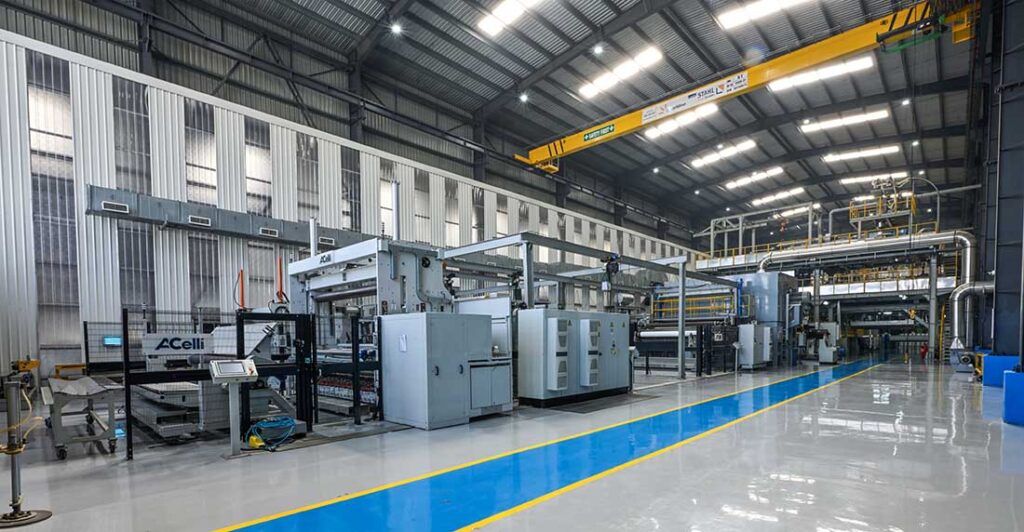
India-based Alpha Foam Ltd., which operates five production lines, has dedicated nonwoven lines for the production of performance fabrics for hygiene and medical applications. The company believes its fabrics perform better because it has lines designed specifically for certain applications. Its medical line focuses more on better hydrostatic head, air permeability and microbial penetration. The hygiene line is designed for larger volumes, fine denier, less elongation and lower GSM.
It also has an SMS line that produces performance fabrics in niche colors and high-performance meltblown fabrics. It produces spunlace for niche industrial markets and also for health and hygiene. It is probably India’s most diversified nonwoven company. Additionally, in meltblown technology, the holes per inch in a die are very crucial and are standardized by the production line supplier. With nearly 20 years of experience, Alpha Foam has developed its own dies and optimized the number of holes per inch in each die.
International Fiber Journal: Kindly provide a history of your company, like when it was started, who started it, etc. Please share details about the manufacturing infrastructure and annual capacity.

Apurva Ranka: Alpha Foam began its journey as a manufacturer of automotive foam for seats, and then we ventured into producing seats and other automobile components, and we continue to be in this business. In 2005, we forayed into the production of nonwoven fabrics and were among the first in India to start a spunbond nonwoven fabric manufacturing line. In 2007, we installed a spunlace line and in 2009, we put up an SMS production line, and in 2011, we began laminating our nonwoven fabrics.
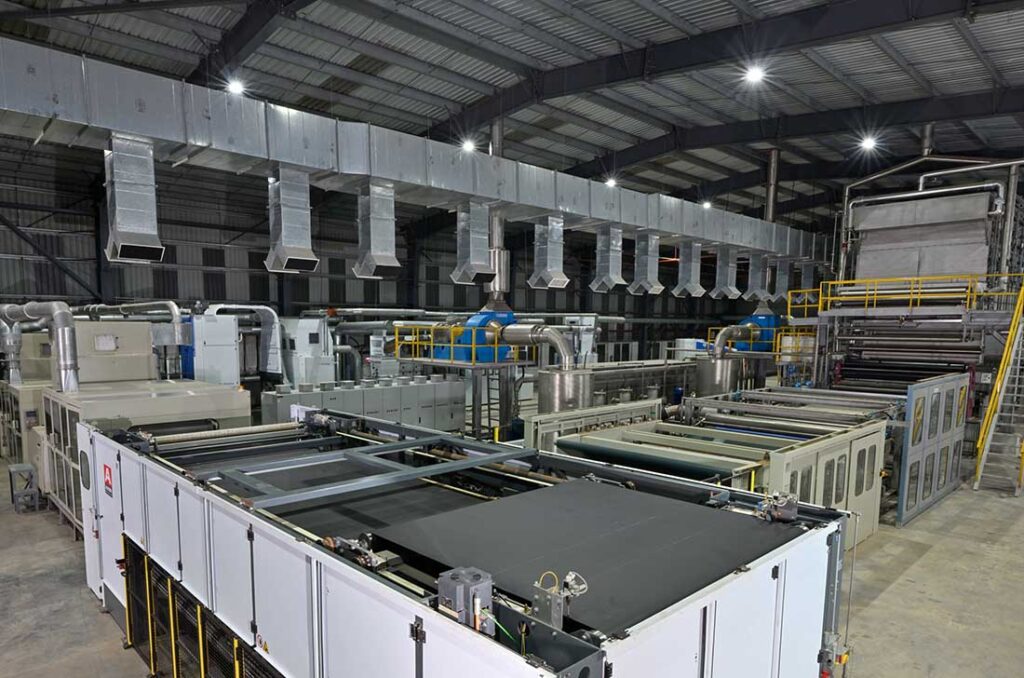
In 2014, we installed an SMMS line designed specifically for producing medical fabrics. In 2022, we installed an SSMMS line, and in 2024, we installed another spunlace line dedicated to producing high-quality cotton fabrics. Currently, we have three spunmelt lines and two spunlace lines and two lamination lines. During this period, we have also diversified further into coated, anti-static, and alcohol-repellent fabrics.
Now we are probably the only company in India that manufactures both spunlace and spunbond fabrics on a large-scale production base and has dedicated production lines for specific products. Our production capacity is 2,200 metric tons per month for spunmelt fabrics and 500 metric tons per month for spunlace fabrics, for a total of 2,700 metric tons per month. Our key raw materials include polypropylene, polyester, viscose and cotton. We also have a very active R&D lab focused on developing new nonwoven fabrics.
IFJ: Which are the core company products and solutions you offer to the market?
Ranka: The GSM range for our spunbond nonwoven fabric is 6 to 120, and for spunlace fabrics, it is 30 to 250. On our SMS line, we offer customized fabrics for orders as small as five tons. In spunbond fabrics, we can supply all the needs of the hygiene or medical fabrics market, from laminates to AAMI LEVEL 4 fabric. Within spunlace, we offer proprietary, customer-specific fabrics for industrial applications, including laminates.
We also manufacture filtration fabrics in spunlace and higher-GSM, higher-strength materials, used for rexine backing and automotive scrim. We have been able to provide an alternative to woven fabrics in industrial applications. We also offer printed fabrics. The newly set-up cotton spunlace crosslapped line applications include covers for tampons, wipes, gauzes, and bandages.
Since we have so many lines in different configurations and speeds, we can supply to tight or short delivery deadlines. Our customer base extends from a small buyer to a large multinational corporation. We also collaborate with reputable institutes to develop new technologies for fabrics.
IFJ: What are the advantages of the products that you offer vis-à-vis those offered by the competition?
Ranka: We do not use fillers, which help maintain the fabric’s quality, and we are still able to supply at competitive prices. The strength and quality of our 90 GSM fabric will be comparable to the 120 GSM fabric used by the competition, as we do not use fillers. The thickness of our fabric is also better when considering GSM, since we have done the fabric engineering ourselves. We have dedicated our various lines to the production of specific products, whether medical, hygiene or industrial. The Indian government is developing standards that will be better for players like us, since we already manufacture to international standards. In the meltblown technology, the holes per inch in a die are very crucial and are standardized by the production line supplier. With nearly 20 years of experience, we have developed our own dies and optimized the holes-per-inch in a die.
IFJ: Does your nonwovens plant follow good manufacturing practices?
Ranka: We follow good manufacturing practices, and all our plants are GMP compliant. Our plants are sealed from the outside environment, as we have installed double doors, and the plants are hygienically maintained. Timely pest control is carried out to ensure there is no microbial contamination. Our bacterial loads meet world standards. We also have pressurized air handling units, while the floor is epoxy, which resists bacterial and fungal growth, crucial for sterile environments. We have also put up HEPA filters at certain locations in the plant. Proper sanitization is maintained at every level. Our products can pass the bioburden and cytotoxicity tests. Since we supply to multinational brands, it’s imperative that we follow best practices.
IFJ: What sustainable products or solutions do you offer to your customers?
Ranka: We foresee demand for more sustainable products, and that is where cotton fibres will come in, which is why we have installed a spunlace dedicated to producing fabrics from only cotton. We also recycle all side trims of fabrics where the raw material is polypropylene and constitutes 10% of the polypropylene that is used in our production.
IFJ: What hiccups did your company face in its 20-year-old journey?
Ranka: Our journey was never smooth, as we had a self-integrated plant, so it took us longer to achieve the highest efficiency and customer trust. For example, in our first SMS line, the beams came from China, the meltblown system came from Japan and we integrated it here. Buyers believe in the brand of the technology rather than the nonwoven fabric’s parameters and quality. But we proved we can provide the highest-quality nonwoven fabrics, even though our technology has not been sourced from well-known suppliers. Customers used to audit our facilities to ensure the quality of our products. We had to struggle to create a name for ourselves.
IFJ: Please share details of your presence in the Indian domestic and export markets.
Ranka: We supply about 80% in the Indian domestic and the rest is directly exported. A major portion of the nonwoven fabrics sold in the Indian domestic market is converted and then exported by the converters. Hygiene and medical fabrics share almost equally in our sales. In medical fabrics, we sell to converters who then export the final product. However, we also directly export a few niche products.
IFJ: How have you seen the conversion industry evolving in the last few years?
Ranka: The conversion industry has grown phenomenally when concerning of hygiene and medical fabrics. Ever since the advent of COVID-19, awareness has grown among Indian hospital surgeons who now demand blood barrier disposable gowns as against the cloth gowns. COVID-19 has phenomenally expanded the medical fabrics market in India, while the hygiene market is growing consistently.
Hospitals have also started using disposable bedsheets and operating table sheets. As disposable income increases and awareness of hygiene increases, sales of hygiene fabrics will increase faster. The conversion industry is growing in Asian countries like China, Bangladesh, India and Vietnam since conversion is cheaper, and so directly exporting nonwoven fabrics to the EU or the U.S. is now becoming a challenge.
IFJ: Please share your plans for the future?
Ranka: We have continuously expanded in the last decade, and now it is time to consolidate. But we would surely like to expand our lamination and also spunlace capacity. We are also looking at spinning fibres from bio-degradable material, which, although a challenge, we will try to meet this challenge head-on. There has always been a tussle between cost and sustainability. PLA is an alternative, but it is biocompostable and not biodegradable. But we are of the firm opinion that the world will move to one-time-use products that contain biodegradable elements. By biodegradable products, we mean converting them into carbon dioxide, biomass and water and not into micro-plastics.
IFJ: Your expectations for the future growth and opportunities in the Indian as well as overseas markets?
Ranka: The nonwovens market has become highly adaptable, and we are in a consolidation phase. It has become very important to develop new varieties of nonwoven fabrics to survive. But we expect sales of medical fabrics to grow faster than those of hygiene fabrics in the near future. We expect that in the near future the Indian market will grow much faster compared to markets in other countries like the USA or countries of the EU, as the markets in those countries are already saturated.
Reasons include the large Indian consumer population, the rise in dual-income families leading to higher disposable incomes, and increasing awareness of hygiene products, healthcare, and medical disposables. The increase of Indian women from rural households in the workforce will also lead to growth. Baby diapers have also now started penetrating the construction industry workforce. India has a very big potential which needs to be exploited.
IFJ: Can you let us know the key trends in consumer demand and the growth trajectory of the nonwoven fabrics market?
Ranka: As the per capita income in India increases, we will see a multifold increase in disposable products made from nonwovens. This should continue until per capita income increases from the current $2,700 to $10,000. We are saying this based on increased consumption obsrved in China following higher per capita income.
Secondly, as consumer awareness of sustainable products increases, we are seeing more customers enquire about biodegradable and reusable products. The nonwoven industry will undergo major technological changes as the push for biodegradable nonwoven products intensifies. Thus, our ability to keep learning and our readiness to invest will help us with changing market conditions.