


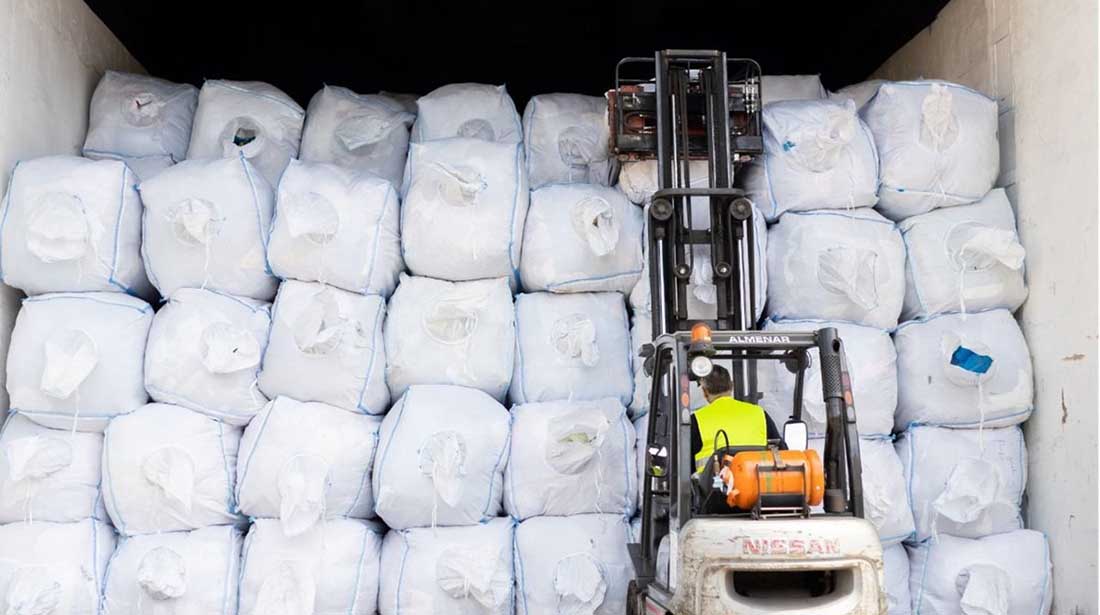
ReHubs is connecting technologies, infrastructure and industry partners to move European textile recycling from individual projects toward industrial reality.
Europe has no shortage of technologies capable of turning textile waste back into useful fibers — the considerably harder task is connecting them into an economically viable industrial system.
This challenge is increasingly defining the work of Brussels-based textile recycling alliance ReHubs, which is pursuing an ambitious target of establishing the conditions for 2.7 million tons of textile waste to be recycled annually in Europe by 2035.
Its membership stretches across the textile recycling value chain, encompassing collectors and sorters, recyclers, technology providers, manufacturers, brands, producer responsibility organizations and other industry stakeholders.
Rather than viewing recycling technology in isolation, ReHubs is attempting to break what it describes as the “supply-demand deadlock” between recycled fiber supply, market demand, infrastructure and investment.
Getting To Scale
“Despite growing momentum across Europe, textile-to-textile recycling remains far from at industrial scale,” said ReHubs board advisor Béatrice Moureaux. “The reason is not a lack of innovation or commitment, but that today’s economics simply do not support a circular system at the scale Europe needs.”

Moureaux, who joined ReHubs at the end of 2025, has recently taken over as managing director of the Dornbirn Global Fiber Congress (GFC), following a career spanning more than two decades with DuPont and subsequent senior positions with Jacob Holm, Glatfelter and Magnera.
The overlap between her two roles was evident at the 65th Dornbirn GFC in Austria, where ReHubs members presented practical experience from projects exploring textile-to-textile recycling, with a particular emphasis on workwear.
Controlled Environment
Workwear is increasingly being viewed as an important proving ground because many of the difficulties associated with postconsumer fashion are reduced.
Uniforms, protective clothing and textiles supplied through industrial laundries frequently have documented fiber compositions and manufacturing histories, while collection can be organized through established business relationships. In rental systems, individual garments may already be tracked throughout their working lives using QR codes or radio frequency identification.
The result is a more controlled environment in which collection, sorting, preparation and recycling technologies can be connected to a defined demand for the resulting fibers.
This does not make recycling straightforward, however, as the two-year Workwear 2 Workwear (W2W) project carried out by Spain-based ReHubs member Texlimca with industrial supplier Prolians Metalco demonstrated.
Practical Requirements
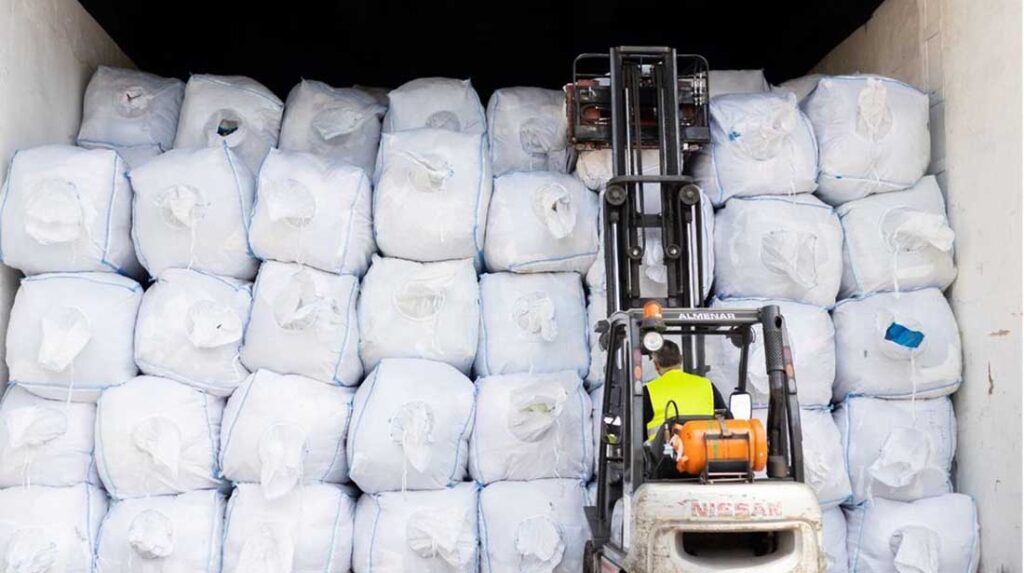
Founded in 1945, Texlimca is one of Spain’s longest-established textile recovery companies and handles postconsumer clothing, commercial textiles and pre-consumer manufacturing waste.
Its W2W project was designed to explore the practical requirements for establishing an end-to-end textile recycling ecosystem.
Some 5,370 kilograms (kg) of waste workwear was collected, but only around 60 percent, or 3,216 kg, was considered suitable for preparation for recycling. The removal of trims and other non-textile elements subsequently reduced this to 2,523 kg.
The resulting fibers were used to manufacture 480 meters of a 270 grams per square meter fabric containing 15 percent recycled polyester and 15 percent recycled cotton, suitable for new workwear applications, including protective aprons. A further 160 5-kilogram packs of cleaning cloths were produced.
The significant finding, however, was economic.
Additional Costs
Collection and sorting added approximately 80 euro cents (90 cents) per kilogram to the process and preparation another 0.50 euro cents (0.57 cents), while the eventual fabric cost around 11 euros ($12.63) per meter compared with approximately 4 to 6 euros ($4.60 to $6.98) for equivalent material manufactured from virgin fibers in Asia.
The project consequently highlighted that recycling technology itself is only one element of the cost equation. Customer engagement, reverse logistics, storage, transportation, sorting, contamination and removing unwanted components can collectively become a significant burden before recycling even starts.
For ReHubs, this is precisely the type of information that needs to emerge from demonstration projects if industrial recycling is to develop beyond technically successful but economically unsustainable trials.
The Texlimca experience also points to the importance of volume commitments, clearly defined responsibilities and accurate cost mapping throughout the chain, alongside policy mechanisms such as extended producer responsibility (EPR) and public procurement to help close the gap with virgin materials.
Building Infrastructure
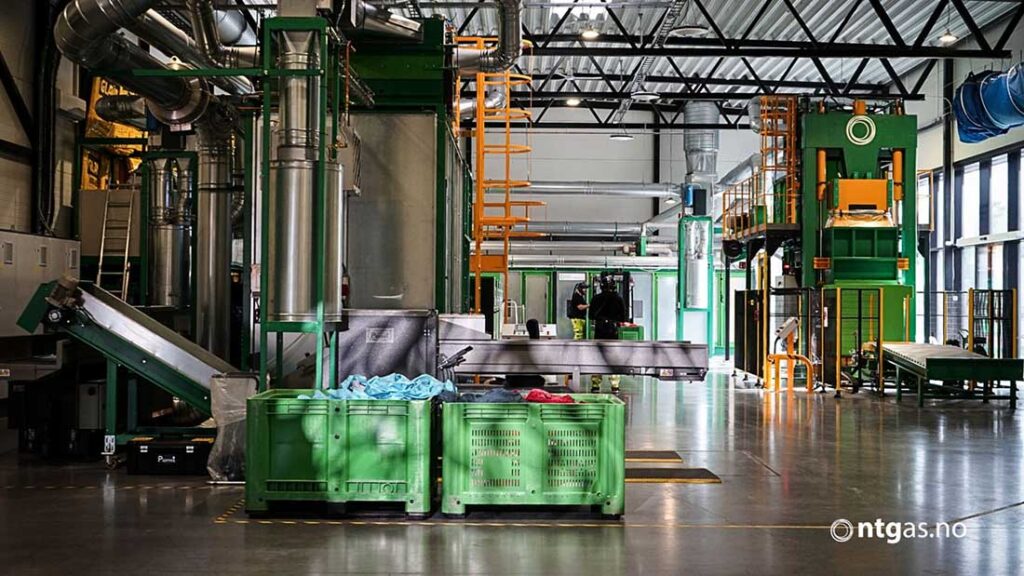
In Norway, fellow ReHubs member Norsk Tekstilgjenvinning (NTG) is demonstrating how quickly the necessary infrastructure can develop when reliable waste streams and technology are brought together.
Founded in 2021 by Pål Erik Haraldsen, owner of health care workwear supplier Health Workers, NTG initially set out to provide hospital workers with a means of managing textile waste.
After securing public and private funding in 2023, it established a recycling plant and subsequently expanded its preprocessing capabilities.
Today, rather than receiving bags of discarded garments from individual health care workers, the company is taking a full truckload of textile waste almost every day from Norway, Sweden and Denmark.
Much originates from health care and hospitality industrial laundries and includes workwear, bed linen and towels. The known composition and concentrated nature of these materials results in a much higher proportion of usable feedstock than is typically available from mixed postconsumer collections.
Increasing Sophistication
NTG has simultaneously invested in increasingly sophisticated preparation. Its Norwegian-developed sorting system combines hyperspectral cameras and artificial intelligence to classify textiles according to fiber content, color and features such as logos, buttons and zippers. It’s possible to separate the material into as many as 100 categories.
The company has also spent more than two years working with an Italian machinery manufacturer on equipment designed to remove hard components and other impurities while minimizing the loss of surrounding textile material.
This matters, because conventional preparation systems can sacrifice substantial quantities of usable fabric when removing zippers, buttons and similar components. Preserving as much material as possible, and maintaining fiber length during subsequent recycling, has a direct bearing on both yield and the quality of the final recycled fiber.
With the new preparation technology incorporated, NTG expects its integrated mechanical recycling operation to be capable of producing between 600 and 1,000 kg of regenerated fiber per hour.
Designing Out The Problem
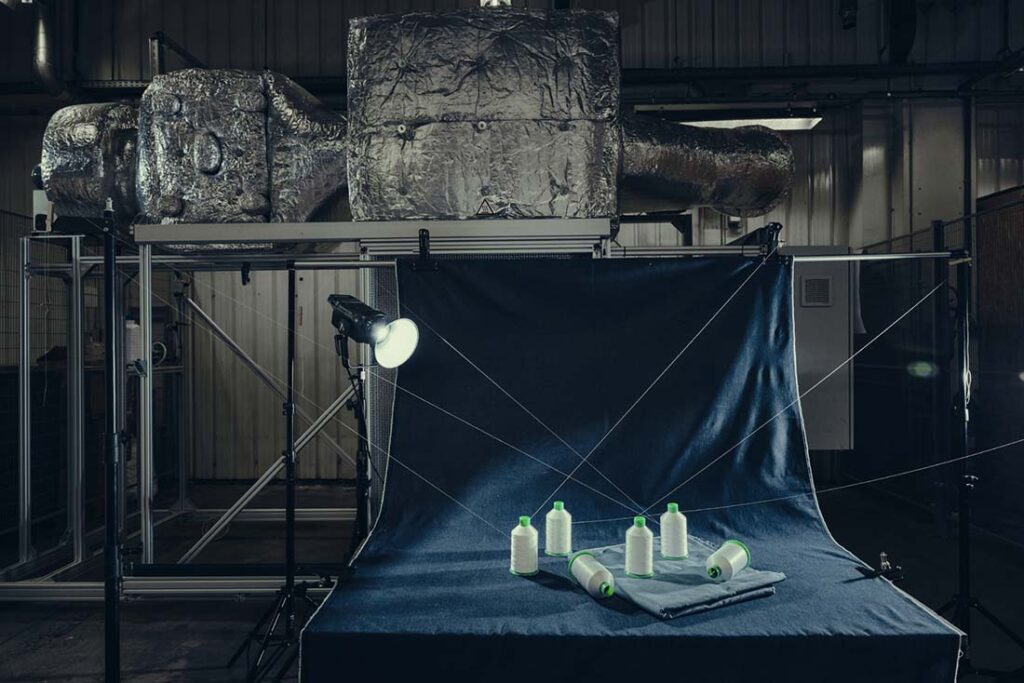
Another ReHubs member, Resortecs, is approaching the preparation challenge further upstream by asking whether garments can be designed from the outset to make disassembly easier.
Its Smart Stitch technology is a heat-activated sewing thread developed for applications ranging from consumer apparel to workwear. Compatible with conventional sewing machinery, the thread is engineered to dissolve at selected temperatures between 150°C and 190°C without affecting normal garment washing, ironing or laundering.
Combined with the company’s industrial Smart Disassembly system, which has a capacity of up to 13 tons per day, the technology enables components to be separated more rapidly into cleaner textile fractions.
The potential benefits extend beyond recycling. Garments can be delabeled, repaired or stripped of valuable components, while unsold or grade B production can potentially be redirected before entering conventional waste streams.
Resortecs is already working with workwear manufacturer Sioen Industries and has been involved in projects with the Belgian Red Cross and Brussels Airlines, as well as industrial laundries and workwear rental companies.
The wider implication is that decisions made during garment manufacture can have a considerable impact on recycling economics years later. Designing for disassembly can reduce the cost and complexity that projects such as Texlimca’s have encountered when dealing with products never intended to be taken apart.
Preserving Value
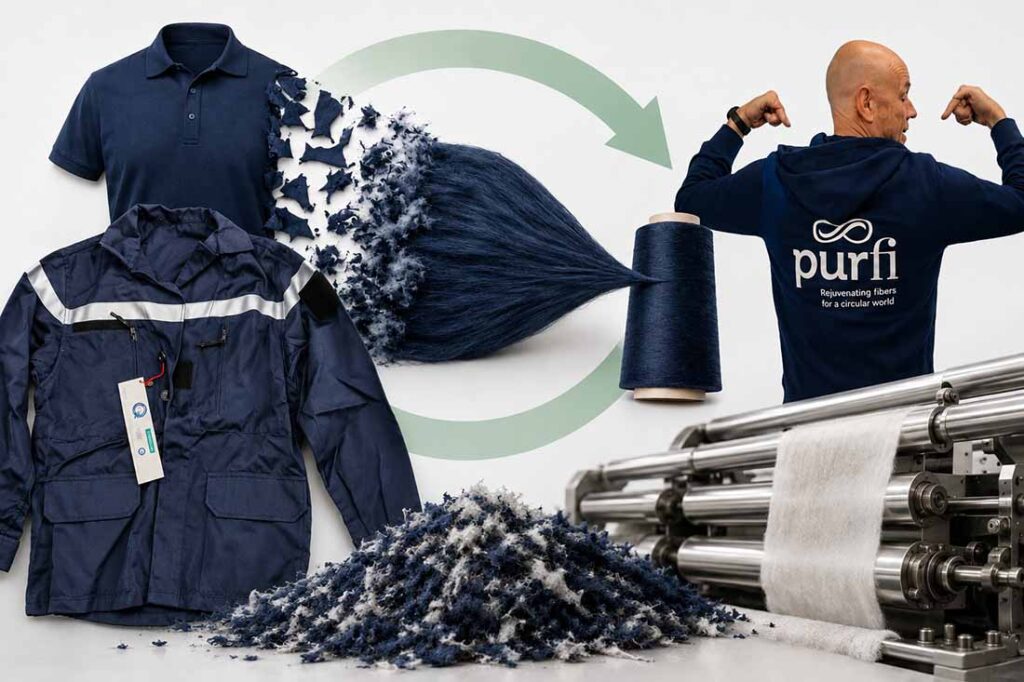
Once material has been collected, identified and prepared, retaining sufficient fiber quality for textile-to-textile recycling presents the next challenge.
Belgium-based Purfi is tackling this through what it describes as “soft mechanical recycling,” employing a patented reverse-spinning process intended to preserve much more of the original fiber length and strength than conventional shredding.
Its system is producing recycled cotton and polycotton fibers between 22 and 32 millimeters (mm), compared with around 10 to 16 mm through conventional mechanical recycling. With higher-value para-aramids, lengths of 38 to 48 mm are being achieved compared with 18 to 25 mm from shredding.
Similar results are being obtained with cashmere, wool and silk.
This ability to preserve value is particularly relevant to workwear and other controlled supply chains, where the input materials can themselves be relatively valuable and their composition is known.
Purfi’s pilot line in Waregem, Belgium, has a capacity of 300 kg per day and has been operating at full demand, while its industrial-scale Cookie Monster line has a projected annual capacity of approximately 3,000 tons.
Connecting The Pieces
Taken individually, the projects being pursued by ReHubs members address very different stages of textile recycling. Together, however, they illustrate why no single technological breakthrough will create a circular textile industry.
Texlimca has exposed the real costs associated with getting discarded textiles to a recycler in usable condition. NTG is developing the sorting, preparation and recycling infrastructure needed to handle material at industrial volumes. Resortecs is attempting to eliminate costly disassembly problems through decisions made when garments are first manufactured, while Purfi is demonstrating how greater fiber value can be retained during mechanical recycling.
Workwear provides a particularly useful environment in which to connect these elements, but ReHubs ultimately sees the lessons being applicable much more widely.
“Reaching the target of 2.7 million tons will require the whole system to move together,” Moureaux said. “This means more efficient collection, sorting and preprocessing, industrial-scale recycling infrastructure, common standards for feedstock and recycled fibers, predictable demand from manufacturers and brands and crucially, investment capable of bridging the remaining cost gap.”
The sessions at Dornbirn GFC 2026 provided a useful snapshot of how some of those pieces are now coming together, while also highlighting how much remains to be done.
Europe increasingly has the technologies required to recycle textiles. The next phase is about connecting them, providing sufficient feedstock, creating markets for their output and establishing an economic model that allows each participant in the chain to operate profitably.
“For ReHubs, that transition from individual recycling projects to a functioning industrial ecosystem is now the real measure of progress,” Moureaux concluded.