



Promix Solutions has partnered with STC Spinnzwirn to develop a new spinning process for more voluminous artificial grass blades.
Artificial grass is a product in ever-increasing demand. It has long been used not only on soccer fields but also in hotel complexes and recreational areas. The advantages over natural grass in the age of climate change are obvious. Artificial grass conserves water resources and is low maintenance. But can artificial grass grow even denser?
Switzerland-based Promix Solutions AG and Germany-based STC Spinnzwirn GmbH have collaborated to develop a process that enables the production of more voluminous artificial grass blades.
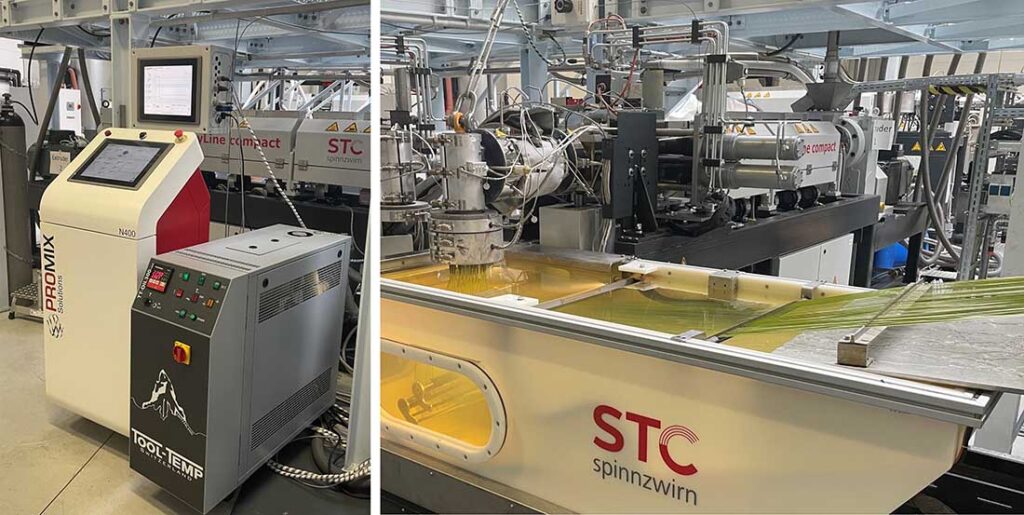
The filaments and tapes used to produce the grass blades can be manufactured on special fiber extrusion lines from STC. In this process, monofilaments or tapes made of polyolefins are produced. These are cooled in a water bath and then mechanically stretched, heat-treated and finally wound onto spools. In a subsequent process step, the fibers are tufted together with a backing fabric to form an artificial grass mat. The more blades and the thicker the individual blades are, the denser the grass becomes. This is precisely where the new patent-pending process comes into play.
STC’s fiber extrusion line has been equipped with Promix Microcell technology. This addition allows a very precise amount of benign gases such as carbon dioxide or nitrogen to be added to the melt during the extrusion process. The gas-laden melt is homogenized using a special cooling mixing technique, and the gas is completely dissolved in the melt. The melt temperature is further lowered and stabilized, and as the melt exits the spinneret, extremely fine microcellular bubbles form within the fibers. The challenge lies in precisely controlling cell formation to achieve the finest possible and highly uniform cell structure. This filaments must then be drawn by a factor of four to 10 without any fiber breaks.
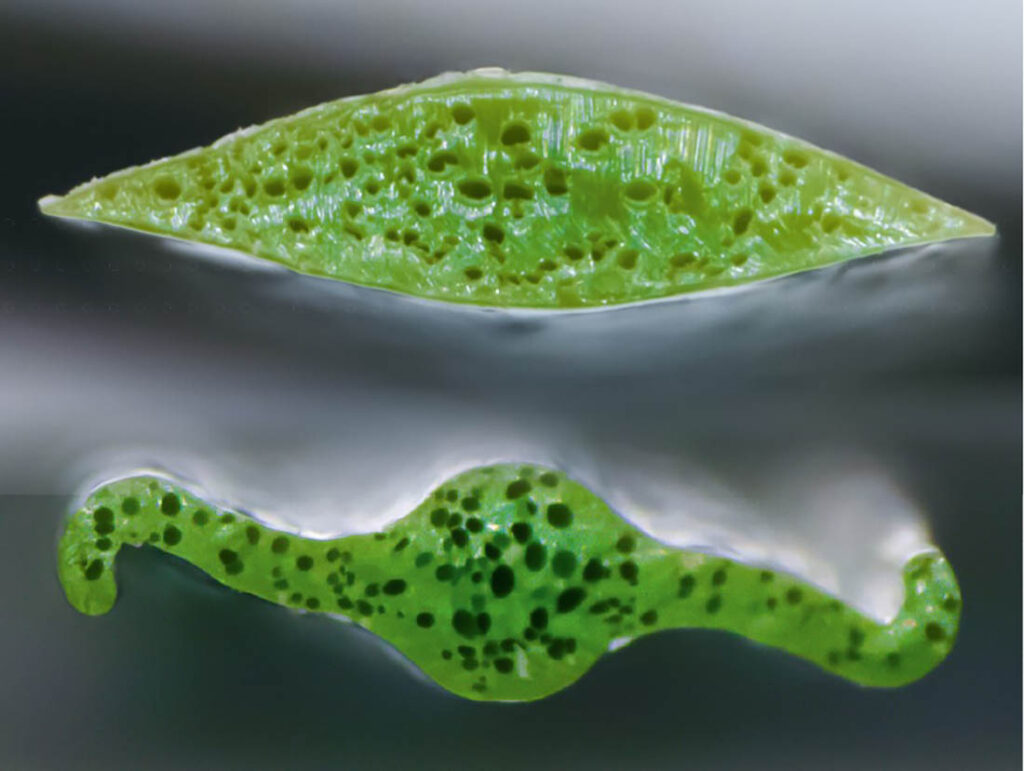
Tests have shown that Promix Microcell technology integrates well into STC fiber extrusion systems, allowing the systems to operate reliably at the same throughput. Depending on the size, the system produces between 100 and 600 kilograms of fiber per hour. However, the grass blades produced in this way are 10 to 20 percent thicker than conventional artificial grass fibers. During tufting, this results in a denser grass carpet, or, at the same grass density, a 10 to 20 percent reduction in raw material usage. The process also gives the artificial grass blades a more natural appearance. The cells on the surface create a textured and slightly rougher feel. The green color of the blades shimmers and appears to be several different shades, giving the artificial grass a very natural appearance. If desired, this effect can be specifically prevented by using an outer skin without a cellular structure.
Surprisingly, it has been shown that the mechanical properties of the microcellular fibers differ only slightly from those of conventional fibers. The tensile strength and elongation at break of the fibers are at a very similar, or only slightly lower level. For a fiber manufactured from linear low-density polyethylene (LLDPE) using the monofilament process with approximate dimensions of 1.5 x 0.25 millimeters, the values were as follows:
However, microcell fibers are not expected to be used on soccer fields quite yet because they do not fully meet the high wear requirements. To improve wear resistance, encapsulation of the microcell structure with a conventionally manufactured outer layer is being tested.
Further potential applications of Promix Microcell technology in the field of fiber processing are currently being evaluated. As a result, carpets and clothing made from polyester, polypropylene or nylon fibers could become denser or lighter in the near future.
For more information: www.promix-solutions.com.