



Five key industry events taking place in the first few months of 2026 will provide diverse and informative perspectives on how effectively technical textiles and nonwovens perform when converted into finished products, components, and systems.
Taken together, the 2025 editions of JEC World, Converters Expo, Techtextil and Texprocess Frankfurt, INDEX, and CIDPEX will illustrate how today’s technical fabrics and nonwovens are converted at scale and ultimately deliver value in demanding end-use environments.
JEC World 2025
Long established as the world’s leading composites exhibition, JEC World, which takes place at the Paris Nord Villepinte exhibition center from March 10-12, has evolved into a global reference point for fiber-reinforced materials and hybrid structures.
While carbon fiber and glass fiber remain central, natural fiber alternatives are increasingly gaining importance, and the roles of textile engineering, nonwoven architecture, and advanced fibrous preforms have moved firmly into the spotlight.
For fiber producers and technical textile manufacturers, this shift reflects changing expectations among composite end-users. The automotive, aerospace, and energy sectors are no longer seeking fibers and fabrics in isolation but integrated reinforcement solutions offering predictable mechanical behavior, efficient resin impregnation, and compatibility with automated manufacturing processes. Nonwoven mats, multiaxial fabrics, stitched reinforcements, and three-dimensional textile structures are now highly valued as functional components that influence weight, durability, and recyclability.
At JEC World 2025, this will be reflected in strong interest in tailored fiber orientations, hybrid reinforcements combining different fiber types and textile solutions optimized for both thermoset and thermoplastic matrices. The growing emphasis on sustainable composites further underscores the importance of textile-based reinforcements that reduce waste, enable faster cycle times and support end-of-life recovery strategies.
Converters Expo
A month later, at the Converters Expo, which takes place in Green Bay, Wisconsin, from April 15-16, the focus will be on the processes that turn engineered materials into application-ready products.
Conversion is often the point at which material advantages are either realized or compromised. Slitting, coating, laminating, calendaring, and rewinding define dimensional stability, surface functionality, and downstream processability. As nonwovens and technical fabrics become lighter, more complex, and more application-specific, converters are under increasing pressure to maintain quality while improving efficiency and flexibility.
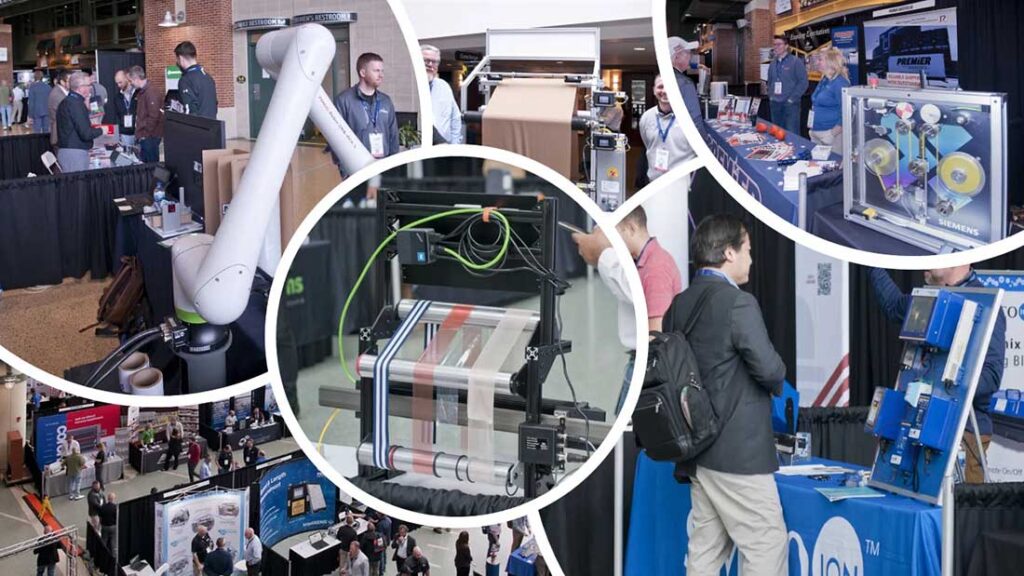
Converters Expo will reflect these realities through a strong focus on machinery, automation, and process control. For suppliers serving filtration, hygiene, medical, and industrial markets, the ability to customize roll formats, apply functional coatings, or integrate barriers and adhesive layers has become essential. The same pressures apply to composite reinforcement suppliers, who are increasingly expected to deliver pre-processed textile solutions that simplify molding and assembly for their customers.
Importantly, the relevance of conversion technologies extends upstream. Fiber and fabric developers are now required to consider how their materials behave during conversion, ensuring compatibility with high-speed processes and minimizing fiber damage or distortion. Conversion has therefore become not merely a downstream activity but a design consideration that shapes material development itself.
Techtextil & Texprocess
This integration of materials and manufacturing will reach its fullest expression at Techtextil and Texprocess 2026, at Messe Frankfurt in Germany from April 21-24.
As the world’s leading platform for technical textiles and processing technologies, this event provides a comprehensive overview of how fiber-based materials are being adapted for industrial-scale applications.
Techtextil will bring together fibers, yarns, nonwovens, and textile structures for markets ranging from construction and mobility to protective clothing and medical technology. Increasing attention is being paid to multifunctional materials that combine mechanical strength with filtration performance, thermal management, electrical conductivity, or sensor integration. These developments underscore the expanding role of technical textiles as engineered systems rather than passive substrates.
Running alongside Techtextil, Texprocess will showcase the manufacturing technologies that transform materials into finished products through processes such as cutting, joining, sewing, and automated assembly. The parallel staging of the two events highlights a critical industry reality—innovation does not stop at the fabric stage, but continues through conversion and fabrication, where productivity, repeatability, and digital integration determine commercial success.
A recurring theme in Frankfurt will be the industrialization of customization. Shorter product lifecycles and increasingly specific application requirements are driving demand for flexible production systems that can handle diverse materials without extensive retooling. For fiber and nonwoven producers, this
reinforces the need to supply materials that are not only high-performing but also consistent and predictable in processing environments.
INDEX and CIDPEX
INDEX 2026—the world’s leading nonwovens exhibition—will also bring together raw material suppliers, machinery manufacturers, converters, and brand owners and place end-use applications firmly at the center of the conversation.
Across the hygiene, medical, filtration, automotive, and building sectors, nonwovens are increasingly selected as engineered solutions offering specific functional advantages. Controlled porosity, lightweight structures, tailored absorbency, and compatibility with circular economy principles are now core drivers of product development.
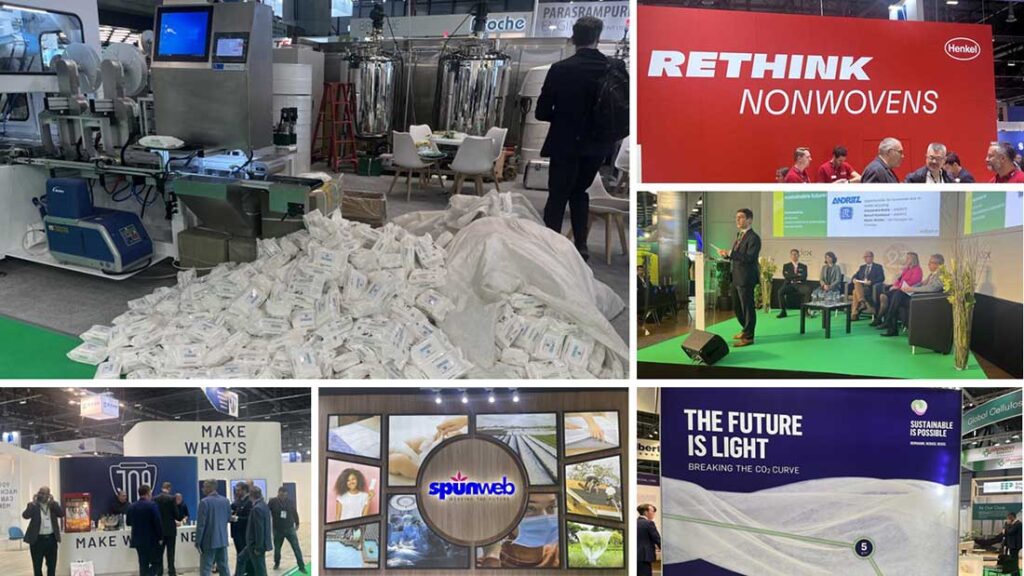
INDEX, which takes place from May 19-22 at Geneva Palexpo in Switzerland, will provide a forum for examining how these requirements are shaping nonwoven production technologies, from spunbond and meltblown extrusion to carded, airlaid, and wetlaid processes.
Sustainability remains a defining theme, not as a marketing exercise but as a technical and regulatory challenge. Bio-based fibers, recyclable composites, and mono-material nonwoven structures are gaining prominence, particularly where legislative pressures and brand commitments intersect. Conversion technologies are increasingly recognized as a critical enabler, allowing manufacturers to reduce material usage, eliminate incompatible layers, and design products with end-of-life considerations in mind.
For companies operating in the nonwovens field primarily in Asia, CIDPEX, which takes place at the Nanjing International Expo Convention Center in Jiangsu, China, will have a similar focus.
Viewed together, these early-2026 events will reinforce the reality that, for manufacturers across the value chain, competitive advantage lies in understanding not only how materials are made, but also how they are transformed into functional products that meet the evolving expectations of diverse global markets.