



In recent years, the fibers and nonwovens industry has received a steady stream of pitches for sustainable or circular materials. For biopolymers, these include proposals from long-established suppliers; from new, low-cost entrants; and from the latest startups using diverse feedstocks including alginates and protein-derived materials. All proposals seek rapid adoption and scale-up in fiber and nonwoven applications.
It’s no surprise then that when decision-makers in the fibers and nonwovens industry look at the biopolymers supplier industry, it can seem a little bewildering. Some may describe it without pejorative intent, as the Wild West — young, innovative, and structurally unsettled. It’s an industry that’s going through numerous growing pains, with associated wild swings for some materials, such as polylactic acid (PLA), which experienced a recent undersupply — understandably resulting in reluctance to commit to a new material in the fibers/nonwovens channel — to now oversupply, with new players in China rapidly building out considerable over-capacity for PLA as well as poly (butylene adipate-co- terephthalate) (PBAT).
With those changes in supply can come associated big swings in pricing and ensuing concerns about commercial viability.
While consolidation, rationalization, ownership changes, and new entrants and exits are to be expected for a still nascent, relatively young industry like biopolymers, the uncertainty that can accompany it provides yet another barrier to entry for fibers and nonwovens players interested in new materials characteristics.
Figure 1, from the European Bioplastics Industry, provides a capacity snapshot for the currently commercialized biopolymers. Updated annually, it is a valuable resource from a consistent perspective. What this big-picture, static view does not provide, however, is a ringside view of the fast-moving industry dynamics that underpin this annual summary, or of the latest advances that make this capacity increasingly relevant for fibers and nonwovens developers.
This article provides a systematic overview — from a fibers and nonwovens vantage point — of the current state of play in the global biopolymers industry. The goal is to provide the nonwovens audience with a simple, structured overview of the biopolymers space that can be used as an anchoring reference for work, clarifying the state-of-play in fibers and nonwovens for the various biopolymers, and illustrating where the nonwovens-relevant advances are being made.
Biopolymers Defined
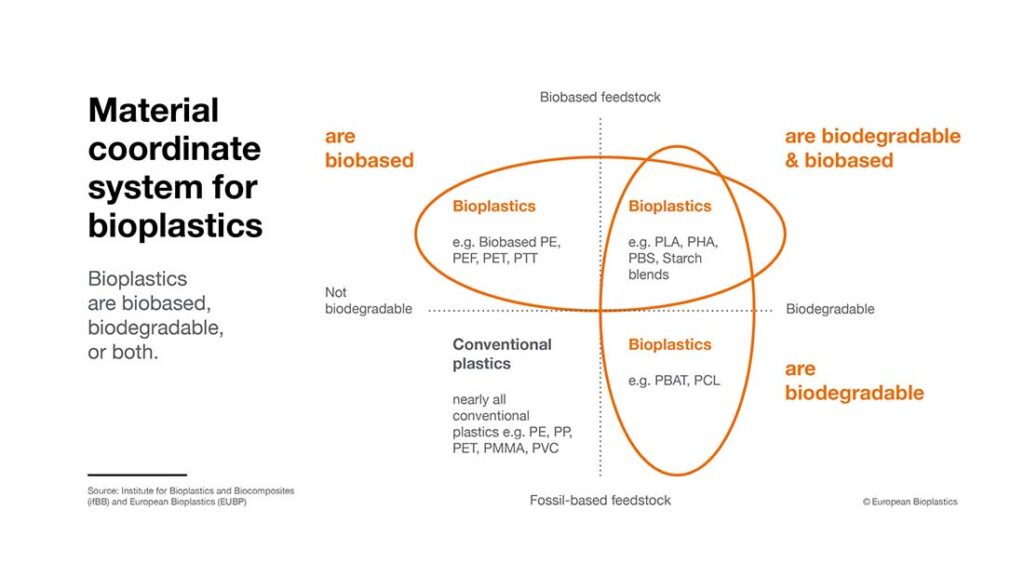
In this article, use of the word “biopolymer” refers to polymers that are biobased, biodegradable, or both. The four-quadrant format shown in Figure 2 is a long-standing, generally accepted industry definition, yet this remains a topic ripe for discussion and disagreement. Indeed, perhaps it’s precisely because of the explicit either/or construct of the definition — the biobased and biodegradable camps each have their ardent champions, and often each would prefer a definition that excludes the other.
Furthermore, adding fuel to the ongoing passionate discussions is the intentional use of the broad term “biodegradable” in this definition. It’s a term that is only useful with further definition of what the user means when they say biodegradable, and that requires a further careful specification of the biodegradation time scale and environment including temperature and moisture, for example.
Definitions aside, the focus here is less on sourcing or end-of-life pathways and more on performance in processing and in use — specifically, whether these materials deliver fibers or nonwovens relevant characteristics at the right price. For too long, the supplier discussion has focused on the former — biobased, and/or biodegradable — and not on getting the right price/performance balance, which has stymied the growth of these innovative new materials.
In this article, the discussion focuses on the two right-hand quadrants — materials that are biodegradable under defined conditions, no matter what they’re sourced from. While partially or fully renewably sourced versions of conventional polymers such as polyethylene (PE), polypropylene (PP), and polyethylene terephthalate (PET) may provide interesting options for those interested in making carbon footprint claims or avoiding reliance on fossil resources, the polymers themselves are well understood in the fibers and nonwovens industry and typically fall outside of the wild west observation noted above.
The Biopolymers Degradability Landscape
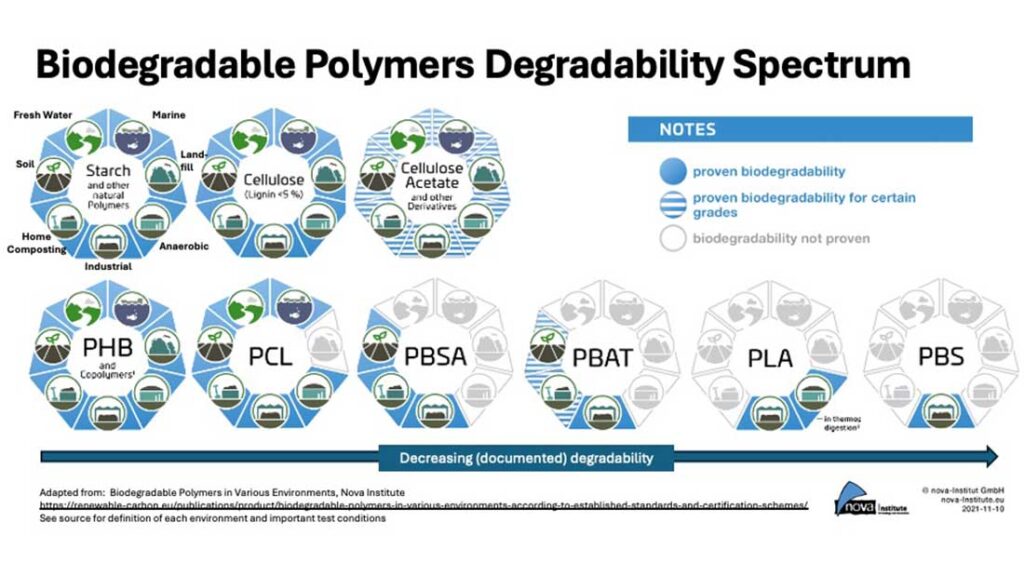
Commercial biopolymers span wide ranges in biobased content, biodegradability, physical properties, commercial scale, and of course, cost. Figure 3, based on an excellent summary of biodegradability claims provided by the Germany-based nova-Institute, organizes the most common commercially available polymeric materials across a broad degradability spectrum.
For a fiber/nonwovens applications developer, the Nova Institute construct makes clear the criticality of specifying the exact biodegradation conditions that are of interest. The seven degradability environments captured — industrial and home compost, soil, freshwater, marine, landfill, and anaerobic systems — span dramatically different conditions of temperature, moisture and microbiology.
For developers concerned with microplastics or microfiber persistence, clarity about the relevant exposure environment is essential. The anaerobic degradation environment provides an example: materials designed to perform well in a dry, hot or thermophilic anaerobic digester — such as a stacked solids system, for example — may be entirely inappropriate for a wet, cold anaerobic digestion system such as a water treatment system. The intent here is simply to highlight some of the excellent resources that are available to fibers and nonwovens developers on the topic of degradability, testing, certification and claims.
It is worth noting that biodegradable is inherently context specific. The rate and extent of degradation depend heavily on environmental conditions, and outcomes relevant to microfiber persistence will vary accordingly. For fibers and nonwovens developers, clarity around the intended exposure environment helps ensure that sustainability objectives and performance expectations remain aligned.
While understanding the exact degradability characteristics of a material of interest is critical, it must be understood that degradability is but one piece of the puzzle, and that more attention must be given by both biopolymers suppliers and users in also getting the right processing and fiber performance attributes at the right price. It’s a theme that the biopolymers industry is beginning to recognize and call out — addressed explicitly for example, by new biopolymer supplier South Korea-based SK Leaveo in the presentation “Degradability in Adsorbent Hygiene Products — Necessary but not Sufficient,” given at the last Hygienix™ conference.
What Figure 3 does not capture, with its focus on comparing degradability, is the tremendous physical property range that the currently commercial biodegradable polymers encompass spanning from the hard and rigid, PET-like, biopolymers like PLA to the soft/flexible biopolymers like PBAT, the polyhydroxyalkanoates (PHAs), or polybutylene succinate (PBS).
The biopolymers industry is beginning to awaken to the possibilities and innovation afforded by cleverly combining biopolymers from this portfolio. With ample supplies of the neat resins now commercially available, there is real opportunity for the fibers and nonwovens industry to achieve the right price/performance balance by combining these materials.
Biopolymers In An Industry Life Cycle Context
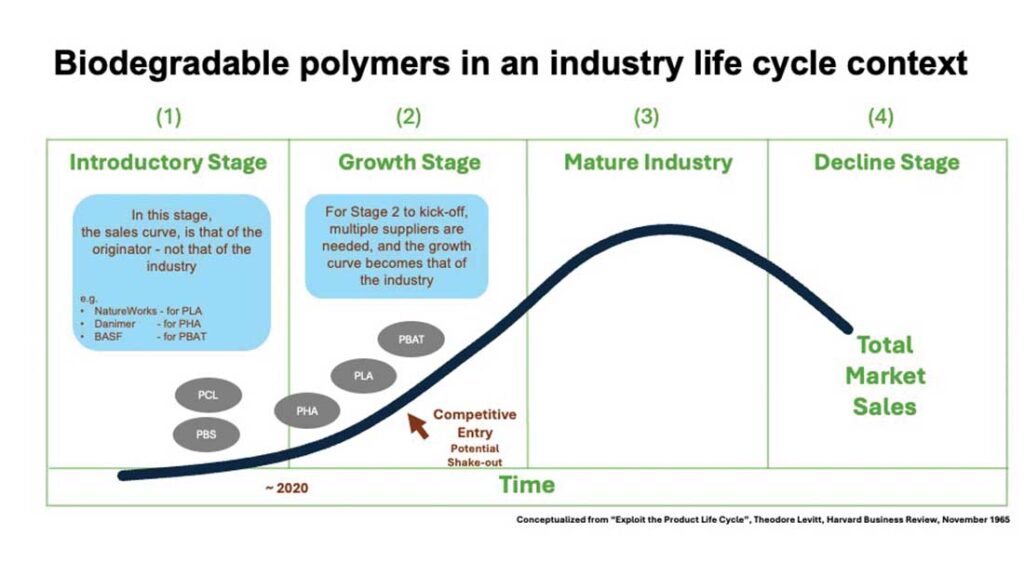
Theodore Levitt’s classic 1965 “Product Life Cycle” provides a useful macro lens for understanding where biodegradable biopolymers sit along the industry spectrum — from introduction to growth and maturity (see Figure 4).
The more mature biopolymers, PLA and PBAT, now in their third decade of commercial production, and the not too-far-behind PHA, are firmly in the growth stage marked by competitive entry, pricing competition and the need for differentiation.
To varying degrees, all these biopolymers face the same challenge — the substantial capital investment required to build polymer facilities at an economic scale. Purely biobased variants such as PLA, face the additional capital expenditures (CAPEX) challenge of having to simultaneously build out the requisite monomer capacity. By contrast, biodegradable materials such as PBAT that can use existing fossil-based monomers have been able to scale more rapidly from existing petro-based monomer capacity already available at an economic scale. This lower CAPEX barrier to entry for PBAT, along with the existence of a relatively large, legislated compostable bag market, has resulted in global PBAT capacities estimated in the 1-million to 2-million ton range.1 Note that the smaller PBAT capacities shown in Figure 1 represent only the PBAT which is both biobased and biodegradable. While little of that capacity until today has been applicable to fibers and nonwovens markets, recent advances in fiber-specific grades that bring compelling, more polyolefin-like performance to nonwovens are encouraging to see.
In the PLA space, the considerable CAPEX barriers to entry initially constrained industry expansion, resulting in a period of undersupply relative to market demand. More recently, rapid capacity additions — particularly in Asia — have shifted the market into a period of relative oversupply and pricing pressure. This recalibration has prompted some established and prospective producers to pause or reassess previously announced expansion plans.
Longer term, however, this period of capacity rationalization may ultimately benefit fiber and nonwovens players by increasing pricing competitiveness and incentivizing differentiation through fiber-specific grades and application-aligned product development. It is worth noting that this renewed focus on fiber-specific grades builds on a technical foundation laid many years ago.
A look back to a comprehensive evaluation of PLA fiber processing and nonwoven performance in the early 2000s reinforces that today’s momentum reflects not only novelty, but also maturation.2
From Capacity To Application Reality
Biopolymers have largely been discussed so far from an industry-structure perspective — capacity, capital intensity, supply cycles and maturity stage. For fiber and nonwovens developers, however, the more pressing question is not how much resin exists globally, but how well that resin translates into process stability, fabric performance and total system economics.
In other words, what does this evolving biopolymer landscape actually mean at the line, on spunbond, meltblown, carded, airlaid, and bicomponent equipment, and in the finished product? It is at this interface between polymer science and web formation that the real inflection point is beginning to occur.
Biopolymer Alignment With Market Demand
To date, there has been no shortage of biopolymer innovation — only a shortage of meaningful translation into fiber and nonwovens value. That gap is now narrowing. Across hygiene, wipes, filtration, and durable nonwovens, the market signal is increasingly clear: brands and original equipment manufacturers (OEMs) are demanding softness comparable to PP, reliable and durable hydrophilic performance without secondary finishes, credible positioning around reduced persistence of microfibers under defined end-of-life conditions, and environmental claims grounded in defensible life cycle assessment and end-of-life pathways. The nonwovens industry does not simply want biobased or biodegradable. It wants drop-in or near-drop-in performance, process stability on existing spunbond, meltblown, airlaid, and carded lines, and cost structures that can scale.
Amidst these numerous adoption criteria, the industry has too often stalled with innovations trapped in prolonged pilots, launches delayed by endless refinements, and meaningful gains dismissed for not being perfect. Yet not every challenge must be solved at once. In many high-volume nonwovens markets — including hygiene, wipes, filtration, agriculture and medical — addressing even a single major sustainability or regulatory pressure can deliver real value today while building momentum for broader change.
The trend to watch is not the rise of a single, winning biopolymer, but the deliberate engineering of systems — blends, bicomponent architectures and application-specific formulations — designed explictly around nonwovens performance metrics. This represents a maturation of the industry … .
What is needed are clear, market-specific roadmaps that sequence progress: what must be solved now, what can follow, and what requires longer-term reinvention. Waiting for perfection is no longer a viable path forward.
Fortunately, the state of play is materially different than even two to three years ago. Tangible progress is observed in melt-blend systems — such as alloys tailored for softness, toughness and controlled degradation — improved rheology control for spunmelt processing; and early commercial examples of sheath-core bicomponent fibers that intelligently combine biomaterials to balance hand, strength, and surface functionality. These structures enable designers to put performance where it is needed — with hydrophilic or biodegradable functionality in the sheath, structural integrity in the core — rather than forcing a single polymer to do everything. At the same time, nucleation strategies, compatibilization, and additive packages are improving crystallization control, drawability, and web uniformity — areas that historically limited nonwovens adoption.
Historically, much of the biopolymers conversation in nonwovens has centered on direct substitution — “Can this material replace PP?” That framing — while understandable — has often set unrealistic expectations, asking a single polymer to simultaneously deliver mechanical strength, softness, hydrophilicity, cost parity and controlled end-of-life behavior.
The more promising direction emerging today is not one-for-one substitution, but engineered systems. Instead of expecting a single resin to do everything, designers are combining complementary materials, through blends, bicomponent architectures, compatibilized alloys, and targeted additive packages, to place performance where it is most needed.
That said, making this real at scale remains a collective challenge. Biopolymer suppliers must continue closing gaps in thermal stability windows, lot-to-lot consistency, and for specific materials, global capacity concerns. Downstream converters must adapt bonding curves, surface treatments, and line conditions to new material behaviors. And the entire value chain must align around harmonized terminology, realistic service-life expectations, and substantiated claims — particularly around biodegradability and microplastics.
The trend to watch is not the rise of a single winning biopolymer, but the deliberate engineering of systems — blends, bicomponent architectures and application-specific formulations — designed explicitly around nonwovens performance metrics. This represents a maturation of the industry where innovation is no longer occurring in isolation at the polymer level, but at the interface between material science, process engineering and end-use design.
For the first time, the industry appears positioned not merely to experiment with biopolymers in nonwovens, but to integrate them deliberately and strategically into mainstream product design.
References:
1. https://www.huaon.com/channel/trend/ 1055033.html
2. Farrington, D.W., Lunt, J., Davies, S., and Blackburn, R.S., “Poly(lactic acid) Fibers,” Biodegradable and Sustainable Fibres, Woodhead Publishing, 2005, Chapter 6 (nonwovens discussion in Section 6.4.3).

