



Artificial intelligence (AI) is now seeping into every corner of the textile and apparel value chain.
In practice, the term has become a catch-all for a wide spectrum of data-driven technologies, many of which have existed for years but are now being amplified by more advanced algorithms, greater computing power and improved connectivity.
What is striking is not simply the pace of adoption, but the breadth. When even some of the most tradition-bound manufacturers in the textile and apparel industry are leaning into digital tools, it is clear that a deep structural shift has been underway for some time.
Digital Simulation
Few companies embody continuity more clearly than England-based John Smedley. Founded in 1784 and widely recognized as the world’s oldest continuously operating knitwear manufacturer, the company has built its reputation on extra-fine merino wool garments produced at its Derbyshire factory. Products are sold globally through its own retail network and through high-end partners such as Harrods, Harvey Nichols and Selfridges. Yet behind this heritage image sits a design and development process that has been quietly transformed through advanced digital simulation.
The adoption of SDS-One APEXFiz design software from Japan-based Shima Seiki Mfg. Ltd. has fundamentally altered how knitwear is conceived and developed at John Smedley. According to design
director Pip Jenkins, the system is used for both swatch development and product prototyping. Previously, stitch structures and patterns were developed directly on production machines, and every colorway swatch for wholesale presentations had to be physically knitted, washed and
finished. From programming to completion, this could take more than a month.
The costs of that approach extended beyond time. High-value yarns were consumed during development, production machines were tied up with low-volume sampling, and waste was unavoidable. Digital simulation changed that equation. By replacing physical swatches with highly realistic knit simulations, John Smedley eliminated the need to knit wholesale samples altogether. Designers and programmers could work from the same digital reference, reducing errors at the handover stage, while colorways and
design variations could be explored without knitting a single loop.
The results were immediate. Lead times fell sharply, yarn consumption during development dropped, and prototypes were more likely to be right first time. After digital development, the company now moves straight into physical prototyping, with far fewer iterations. What appears, on the surface, to be a modest software upgrade is in fact a reconfiguration of how creative, technical and production decisions interact.
Narrowing The Field
In theory, this kind of digital design environment could be linked seamlessly to downstream manufacturing, logistics and even customer feedback, forming a coherent end-to-end system that begins to resemble true artificial intelligence. In reality, such fully integrated platforms remain rare. More often, digitalization advances in discrete stages, creating pockets of intelligence rather than a single, unified architecture.
Beyond aesthetics and fit, AI is increasingly being used to formalize decision-making around cost, compliance and sustainability. Material selection, long reliant on tacit knowledge and experience, is becoming more data-driven. Algorithms can now assess fabrics and trims against performance requirements, regulatory constraints, supplier reliability and availability, reducing late-stage substitutions and stalled developments. Recommendation engines do not replace designers or developers, but they narrow the field of viable options earlier, when change is cheaper.
This shift towards digital product creation is supported by a growing ecosystem of technology providers. Three-dimensional garment simulation platforms, pattern-based CAD environments and increasingly sophisticated product life cycle management systems are helping brands translate creative intent into production reality with greater accuracy.
While the marketing language surrounding these tools often implies seamless automation, their real value lies in making trade-offs explicit and decisions more transparent.
Manufacturing
The same logic applies on the factory floor, where AI tends to deliver its most tangible returns. Textile production generates vast volumes of data, from machine speeds and tensions to temperatures, humidity levels and defect rates. Applied carefully, machine-learning models can stabilize processes, reduce variation and predict problems before they lead to downtime. Predictive maintenance, based on vibration analysis or electrical signatures, allows interventions to be planned rather than reactive, extending machine life and improving utilization.
Quality control is another area where AI is reshaping established practices. Computer vision systems can now detect holes, slubs, shade variation and weave defects at speeds far beyond human inspection, applying consistent criteria across shifts and locations. Crucially, when inspection data is linked back to process parameters, quality becomes preventative rather than corrective. Defects are not simply flagged, but traced to probable causes.
Wet processing, traditionally one of the most resource-intensive and variable stages of textile production, is also being reshaped by digital control. Dyeing and finishing operations increasingly rely on AI models to optimize recipes, monitor bath conditions and detect drift that leads to reprocessing. By improving right-first-time performance, mills can reduce water, energy and chemical use while improving throughput.
Waterproofing
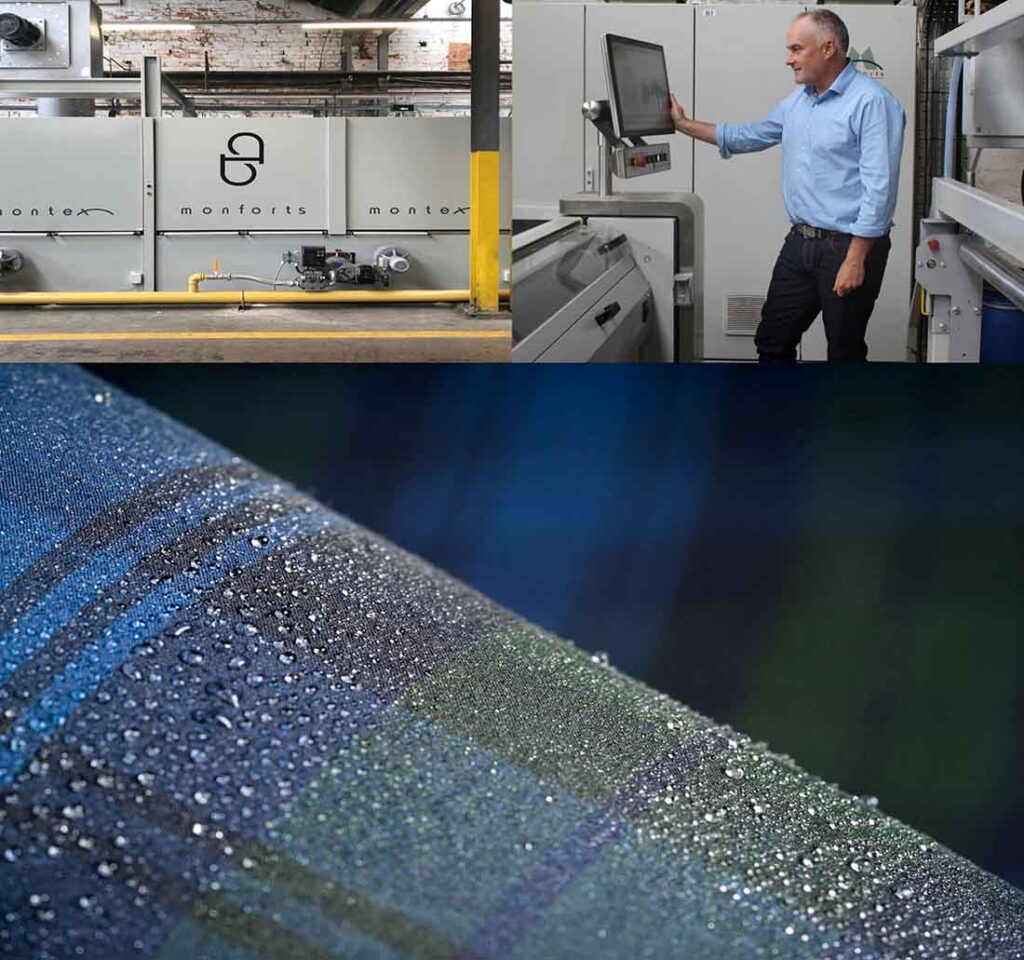
These technologies are no longer confined to greenfield sites or high-volume commodity producers. At Halley Stevensons in Dundee, Scotland, digital process control has been introduced into one of the industry’s most tradition-laden niches. Founded in 1864, the company specializes in waxed cotton fabrics, a technique with its roots in early maritime waterproofing practices developed by Scottish fishing communities centuries earlier.
To enhance flexibility and efficiency, Halley Stevensons has installed a modern Monforts Montex coating and finishing range equipped with advanced automation and process control. According to managing director James Campbell, the system — engineered by Germany-based A. Monforts Textilmaschinen GmbH & Co. KG — gives technicians greater confidence to develop new products while also fine-tuning the energy profile of existing ones. Energy consumption can be recorded at batch level, creating a feedback loop for continual improvement. The touchscreen interface allows operators to move easily between parameters, combining visual clarity with technical precision.
What is notable is not the replacement of skill, but its amplification. The accumulated craft knowledge of generations remains central, but it is now supported by systems that make processes more predictable and resource use more transparent. Tradition, in this context, is not being displaced by digitalization but reinforced by it.
Juggling Variables
In apparel manufacturing, the gains from AI are often less visible but equally significant. Planning and line balancing have long been bottlenecks, particularly in environments with high product variety and short lead times. AI-driven scheduling tools can juggle far more variables than manual planning, from changeover penalties and skill matrices to real-time work-in-progress. When orders shift, schedules can be recalculated quickly, reducing disruption and waste. Used thoughtfully, such systems support smoother workflows rather than treating labor as an abstract input.
The greatest untapped potential for AI, however, lies beyond the factory gate, in distribution and inventory management. Many of the industry’s structural inefficiencies stem from chronic mismatches between supply and demand. Overproduction, followed by discounting and complex logistics, remains a defining feature of fashion economics.
AI-based forecasting models that combine historical sales data with pricing, promotions, weather and digital signals can generate more adaptive demand projections. This, in turn, supports more stable replenishment and reduces the need for reactive transport. Even brands with deep roots in craftsmanship are now investing heavily in these capabilities.
Tailoring And Digital Twins
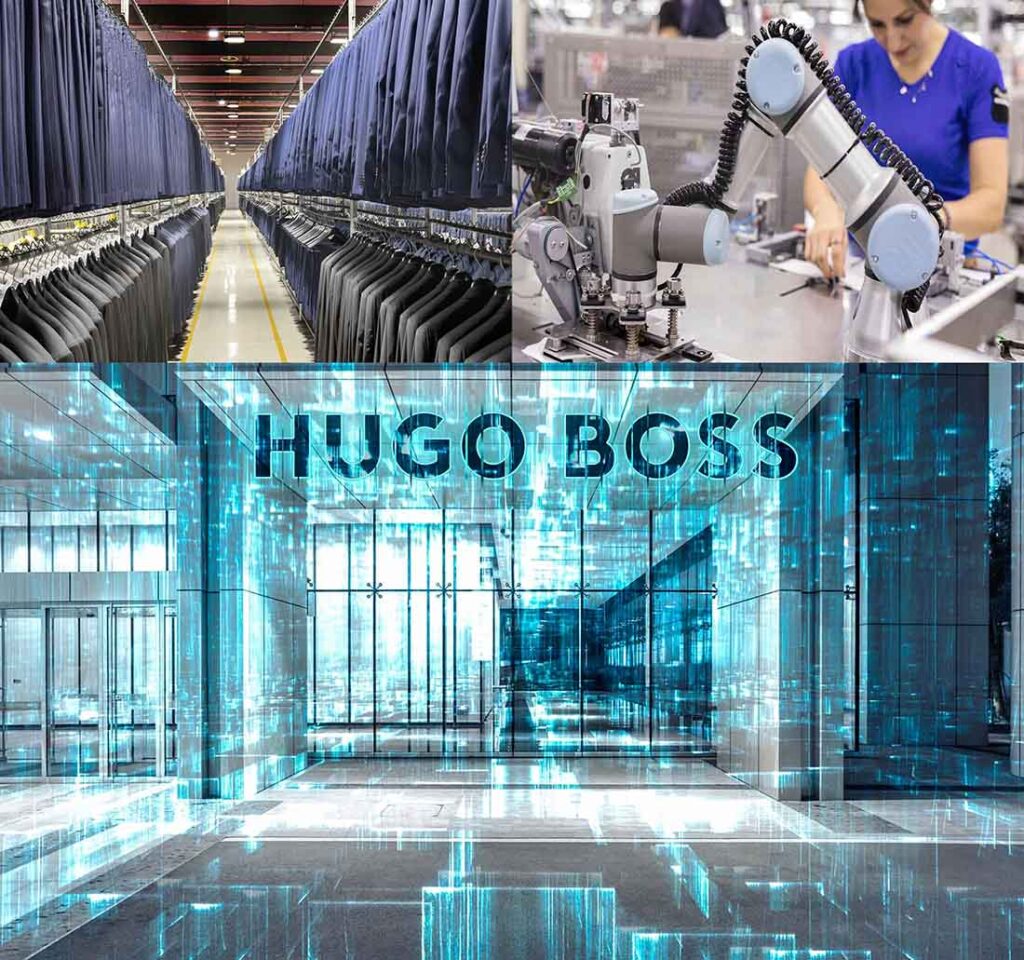
Hugo Boss offers a clear illustration. Founded in 1924 as a family-run tailoring business in southern Germany, the brand’s identity has long been anchored in precision, restraint and fit. Today, with annual sales exceeding $4 billion and a global supply network spanning owned facilities and external partners, the company sees digitalization as a primary growth engine.
By creating a digital twin of its supply chain, Hugo Boss aims to align demand planning, procurement and logistics more closely. Real-time data and AI-supported decision-making are intended to improve the timing and quantity of fabric and garment orders, while smarter inventory allocation helps ensure that customer demand is met more effectively. The language is technical, but the objective is simple — to reduce friction between what is made, where it sits and when it is needed.
Connected Capability
Across design, manufacturing and distribution, the most meaningful efficiencies emerge when AI is treated as a connected capability rather than a collection of isolated tools. Fully integrated systems remain the exception rather than the rule. As previously mentioned, however, progress more commonly takes the form of connected islands, linked by data lakes and interfaces rather than unified platforms. Structural fragmentation across the value chain, differing economic incentives and persistent issues around data quality and governance all slow integration.
The direction of travel, however, is clear. Cloud platforms, standardized data models and application programming interface-driven architectures are steadily lowering the barriers to connection. At the same time, commercial pressures around speed, sustainability and capital efficiency are forcing closer coordination between once-discrete functions.
As these islands begin to merge, AI is likely to fade as a headline concept and simply become the invisible infrastructure. Its real significance will lie not in bold claims of disruption, but in quietly ensuring that decisions made at one end of the textiles and apparel value chain are grounded in operational reality at the other.