



From CSRD-ESRS Data Foundations to Circularity Pathways, Signals for the Nonwovens Value Chain in 2026 and Beyond.
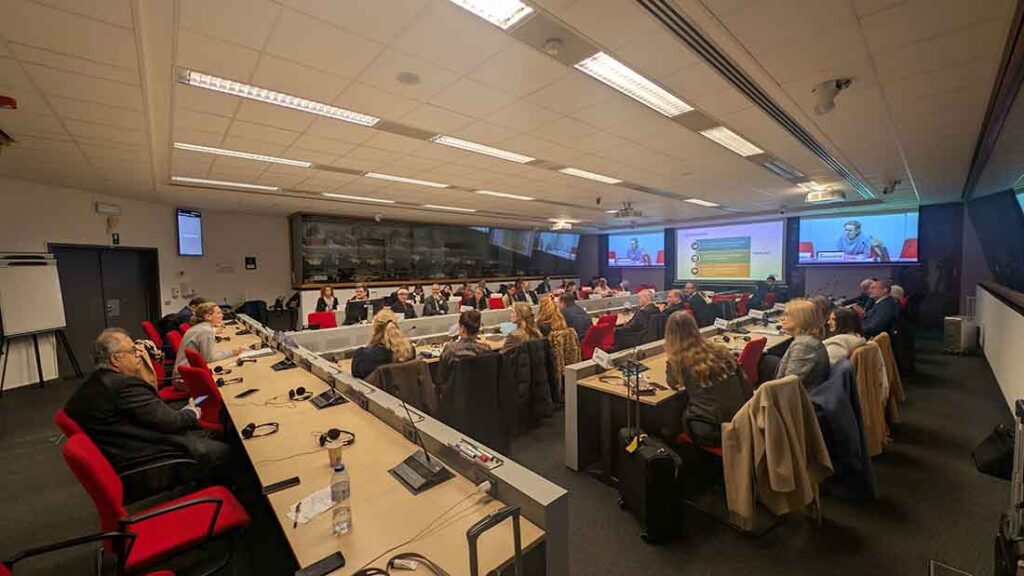
EDANA’s Sustainability and Policy Forum in Brussels DANA held its Sustainability & Policy Forum in Brussels last week (December 9–10, 2025) at the Residence Palace, combining plenary sessions with an EU advocacy workshop and a visit to the European Commission. The agenda ranged from the strategic: sustainability priorities in the age of simplification and competitiveness, to the operational: sustainability disclosure and transparency, CSRD as a management tool, and product-level metrics such as product carbon footprint and life cycle assessment for durable applications. Circularity served as the other key theme. A panel emphasized that “Circularity in Europe will not be achieved in silos” and questioned how textiles and nonwovens can collaborate as regulations, technologies, and recycling infrastructure develop.
Day one then focused on enabling routes, chemical recycling and mass balance, explicitly exploring whether policy supports or hinders progress. On the second day, the discussion focused on the formulation of EU policy within the EU Toolbox framework. An interactive advocacy workshop was introduced to examine how circularity objectives can be translated into practical regulations without compromising processes, safety, or performance. The closing exchange at the European Commission covered the Commission’s operations, the Waste Framework Directive, and “Environment Policy and Simplification.”
A central focus was the practical challenge of advancing circularity amid ongoing regulatory implification. In particular, the advocacy workshop moved the discussion beyond debating whether circularity matters and toward the more consequential question of how product policy can operationalize circularity objectives in a way that is workable for nonwovens manufacturers.
Throughout the Forum, EDANA stressed the importance of creating space for meaningful dialogue that goes beyond compliance and routine regulatory updates, fostering strategic collaboration across the nonwovens value chain. The sessions underscored the need for collective action, rather than isolated efforts, to tackle sustainability challenges, with stakeholders encouraged to anticipate future trends and coordinate solutions that balance regulatory demands with practical realities in safety and performance. This approach indicates a broader industry shift: from merely reporting sustainability data to actively managing it, ensuring that evolving EU policies yield credible, actionable outcomes for nonwovens manufacturers and their partners.
What EDANA Aimed to Achieve
EDANA describes the Forum as a space where industry, policymakers, experts, and stakeholders can step back from daily regulatory pressures and engage in strategic, forward-looking discussions. Its purpose extends beyond sharing information: It is designed to foster dialogue across the value chain, identify emerging trends early, and support a more coordinated and credible industry response to sustainability and policy challenges.
In EDANA’s view, the format was effective: participation, diversity of viewpoints, and the quality of exchanges, particularly on regulation and circularity during the advocacy workshops, confirmed the Forum’s relevance. The real test, EDANA notes, is translating this into action: turning the exchanges into tangible follow-up work in the months ahead.

Common Themes Across Presentations and Discussions
- Practical implementation within regulatory simplification
A central focus was the practical challenge of advancing circularity amid ongoing regulatory simplification. In particular, the advocacy workshop moved the discussion beyond debating whether circularity matters and toward the more consequential question of how product policy can operationalize circularity objectives in a way that is workable for nonwovens manufacturers. Participants consistently emphasized that performance requirements are non-negotiable and must be embedded in any regulatory approach. This reinforces the case for proportionate, application-specific regulation that integrates essential performance criteria, especially for hygiene, medical and technical products, into the regulatory architecture, rather than treating them as secondary considerations to be addressed after the fact.
- Advancing from reporting to strategic sustainability management
Another key theme was the move from sustainability reporting to integrating sustainability management into core business practices. The Corporate Sustainability Reporting Directive (CSRD) could become a valuable strategic tool for organizations that invest in strong data systems and prepare to meet changing EU standards.
The increasing overlap and interaction between regulatory instruments were repeatedly cited as a source of complexity, strengthening the need for internal alignment across frameworks and functions. Operationally, this transition implies that sustainability teams must increasingly adopt approaches comparable to those of finance functions: rigorous data governance, strong internal controls, clear accountability, and outputs that are decision-useful, supporting prioritization, investment decisions, and performance management, rather than relying predominantly on narrative disclosures and claims. VSME—which stands for the Voluntary Sustainability Reporting Standard for non-listed SMEs—was briefly discussed.
- Driving systems-level circularity through collaboration
Systems-level circularity emerged as a further priority, with a strong call for deeper collaboration across the textiles and nonwovens value chains. Panel discussions highlighted the importance of reducing structural barriers, identifying shared opportunities, and converting ambition into practical actions that can be implemented at scale.
Conversations on chemical recycling and mass balance reinforced that, while innovative technical pathways are progressing, their uptake will be constrained without policy recognition and regulatory clarity. In this context, precise definitions, consistent interpretation, and legal validation were framed as prerequisites for investment confidence and wider market deployment.
- Emphasizing credibility and transparency
Throughout the sessions, credibility and trust served as unifying themes. Speakers consistently emphasized that credible communication requires transparency, traceable evidence, and data-driven commitments that withstand scrutiny from regulators, customers, and other stakeholders. The discussions aligned with the industry’s pragmatic, science-based approach, emphasizing informed decision-making and reliable data as fundamental to progress.
Ultimately, the Forum reinforced that credibility is not just a communications exercise; it is a performance outcome driven by governance, evidence, and transparency, crucial for maintaining trust and advancing the industry’s sustainability journey.
Focus Topics as Repeated Themes
- Circularity: The discussion centred on practical steps for cross-sector cooperation, chemical recycling technology, policy frameworks, and the legal recognition of circularity methods.
- Reporting: CSRD, ESRS and related disclosures were presented as strategic business tools, emphasizing data-driven commitments and solid data foundations.
- Program Sustainability & Policy: For durable nonwovens, sessions highlighted a push toward product-level evidence and customer-focused metrics, including PCF/LCA/EPD.
- Supply Security: Supply security was noted as a constraint in transformation, with companies needing to balance adaptation, innovation, competitiveness, and supply stability. Reporting also linked sustainability to operational and supply chain resilience.
- Greenwashing and Claims: While “greenwashing” wasn’t directly addressed, the emphasis was on credibility, transparency, and evidence-based claims.
- Single-Use Plastics Directive: Details on timing and dedicated coverage were not provided, but the Directive was referenced as a policy tool promoting reuse, collection, and recycling systems.
The Outlook
Two main trajectories emerge: Near term (6–18 months): Reporting and policy have to be streamlined, with companies evaluated on their ability to provide credible, comparable sustainability data for reports, customers, and partners. Regulatory focus will shift from ambition to execution quality.
Medium term (2–5 years): Circularity will shift from messaging to infrastructure, fostering collaboration across sectors such as textiles and nonwovens. Progress in recycling and mass balance will depend on effective policies, sound methodologies (including chemical recycling), and reliable chain-of-custody systems.
Forum Takeaways
The materials do not describe any formal communiqué or new commitment from the Forum. The primary outcome is EDANA’s positioning of the event as a platform for constructive debate, with success measured by follow-up actions. Workshop questions remain how to make circularity goals into practical policy without sacrificing, how industry can influence Commission drafting, and how inter-departmental dynamics affect decisions.
For nonwovens, these issues impact compliance and innovation. EDANA notes the difficulty of keeping up with evolving regulations and ensuring innovation and supply security, particularly after DG ENV’s (Directorate-General for Environment of the European Commission) recent releases. It stresses that one-size-fits-all rules risk overlooking technical and societal differences across nonwoven applications, underscoring the need for segmentation for both advocacy and strategy.
Rawaa Ammar, Sustainability Director from EDANA, said: “This year’s Sustainability & Policy Forum brought together an exceptional mix of insights, exchanges and forward-looking discussions. The sessions were rich and thought-provoking, exactly the kind of space we aim to create to network and co-develop ideas, stay up to date with the latest regulatory and market developments, and spark new reflections for the industry.
The true impact of the event will unfold in the months ahead, and I am keen to channel the valuable conversations we had into tangible projects that can strengthen the industry’s sustainability journey. As the new Sustainability Director, my focus is on building on this strong foundation and helping our sector accelerate credible, science-based action on climate, circularity and responsible value chains.”
Author’s Conclusions and Perspectives
From my perspective, the Forum reinforced a simple reality: Sustainability is becoming a contest of capabilities. In ESG strategy, CSRD/VSME and other reporting tools, sustainable finance, and value chain execution, I increasingly see that “good” performance is defined by transparency, repeatable methods, data flows, and decision processes within enterprises and across the industry.
For the nonwovens value chain, that implies three priorities.
- First, invest in data discipline (including PCF/LCA/EPD competence where it is commercially relevant) so that reporting becomes decision-useful and claims become defensible.
- Second, segment the sustainability strategy by application: consumer/hygiene, medical, filtration, and durable nonwovens will not share identical circularity routes or acceptable trade-offs.
- Third, get involved early and help shape policies using evidence specific to each application. Since workable sustainability rules aren’t just beneficial, they’re essential for making sustainability scalable in industry.
The next phase will reward the companies and associations that can connect policy intent, customer requirements, and technical realities into a single, credible story backed by evidence.
If credibility is the new license to operate, are we treating data and cooperation as strategic investments or still as compliance costs?