



Advanced textiles are entering a new phase of strategic importance as they address economic, environmental and security challenges.
Protective wear emerged as the defining theme of the Techtextil 2026 exhibition held recently in Frankfurt, driven in part by the rapid expansion of defense and security investments being made across Germany and Europe.
Over the past year, European governments have accelerated military spending programs in response to geopolitical instability, NATO commitments and an increasing emphasis on strategic resilience.
Germany has become Europe’s largest military spender, committing billions of euros toward modernizing equipment, infrastructure and personal protection systems for military and emergency personnel.
This renewed focus on preparedness is driving significant demand for advanced technical textiles capable of delivering protection, durability and comfort in increasingly challenging environments.
Growing Demand
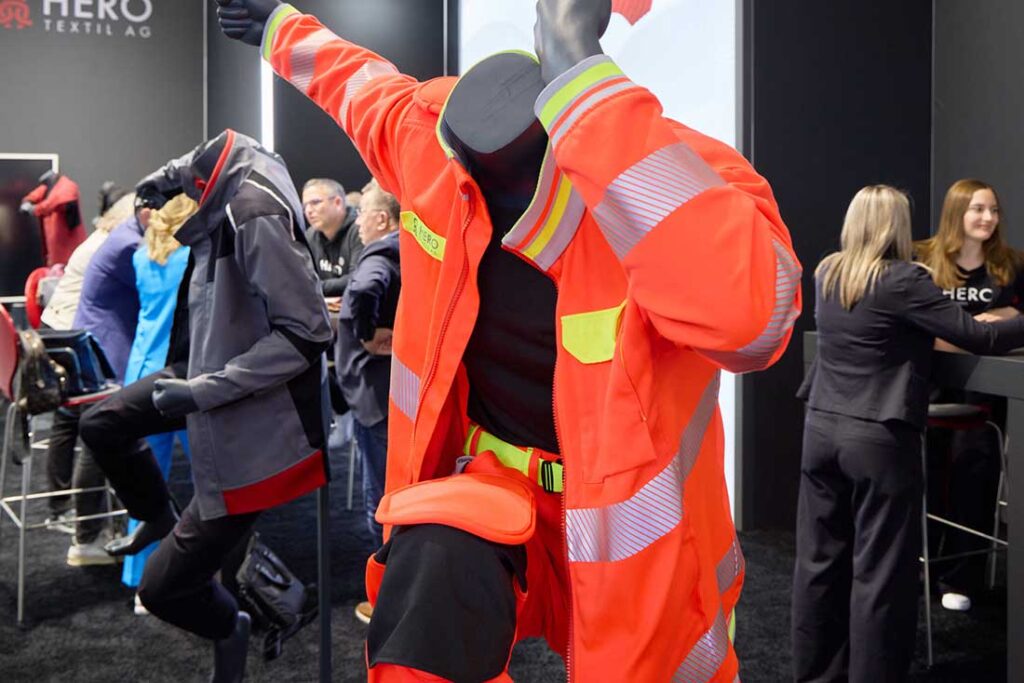
Against this backdrop, protective wear was very visible throughout the exhibition halls at this year’s Techtextil, with manufacturers showcasing the latest developments in flame resistance, ballistic protection, chemical protection, thermoregulation and lightweight performance. More than 130 exhibitors in the Performance Apparel Textiles section alone presented materials for workwear, military garments, emergency response clothing and specialist outdoor applications.
Among key German participants was Rudolf Group, which specializes in textile chemistry and functional finishes, including water repellency, chemical protection, durability enhancement and per- and polyfluoroalkyl substances (PFAS)-free performance technologies for protective garments.
Hero Textil exhibited fastening and belt systems designed for PPE, tactical gear and workwear applications, while Covestro also featured strongly with its polyurethane coating technologies for laminated protective fabrics.
Sandler represented the German nonwovens sector with materials particularly relevant for disposable medical personal protective equipment (PPE) and lightweight technical protective apparel.
Catwalk Presentations
Live “Performance Apparels on Stage” catwalk presentations also took place several times daily to put new developments in front of international buyers, original equipment manufacturers, sourcing teams and product developers.
Among German innovations here were many lightweight protective systems engineered for extreme operational conditions. RWTH Aachen, for example, introduced the Molotov Cocktail Protective Suit featuring breathable yarn structures for enhanced comfort under severe conditions. BASF and Fulgar presented a jacket based on loopamid nylon regenerated from textile waste and tires, and Karl Mayer showcased a warp-knitted ultraviolet (UV) protection jacket capable of achieving UV 50+ performance without chemical finishing. In addition, a 3D-knitted backpack with integrated functional polymer optical fibers for active lighting, marketed by Bache GmbH, was showcased.
Natural Ingredients
Modern protective garments must increasingly fulfill multiple functions simultaneously, combining safety, ergonomics, durability, wash resistance and circularity within a single textile solution. Natural and biobased fibers were another major focus, and more than 110 exhibitors taking part in the Performance Apparel Textiles section displayed products designed to reduce reliance on fossil-based materials while maintaining high-performance characteristics.
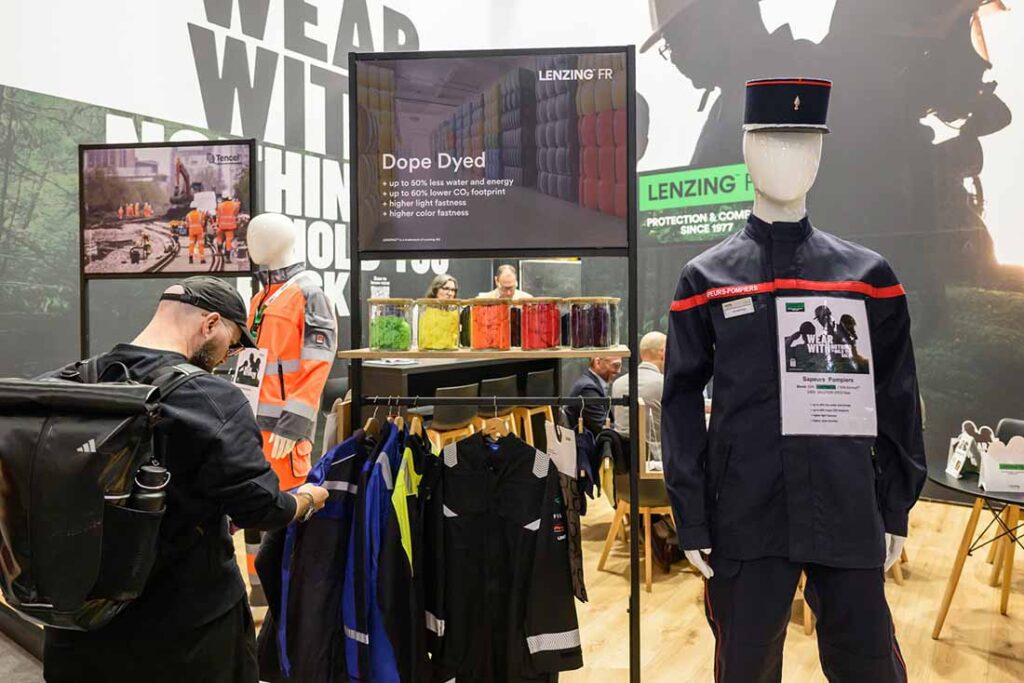
Austria-headquartered fiber producer Lenzing, for example, unveiled its new Solutions for Protective Wear portfolio, anchored by Lenzing FR fibers, providing the highest protection tier for inherent flame resistance and complementary solutions, including Tencel lyocell fibers for the first time. The launch marks the most significant expansion of Lenzing’s protective wear business since the company pioneered inherently flame-resistant (FR) cellulosic fibers in 1977, and comes as the global PPE market accelerates toward an estimated value of $130 billion by 2033.
Infrared And Thermal Shielding
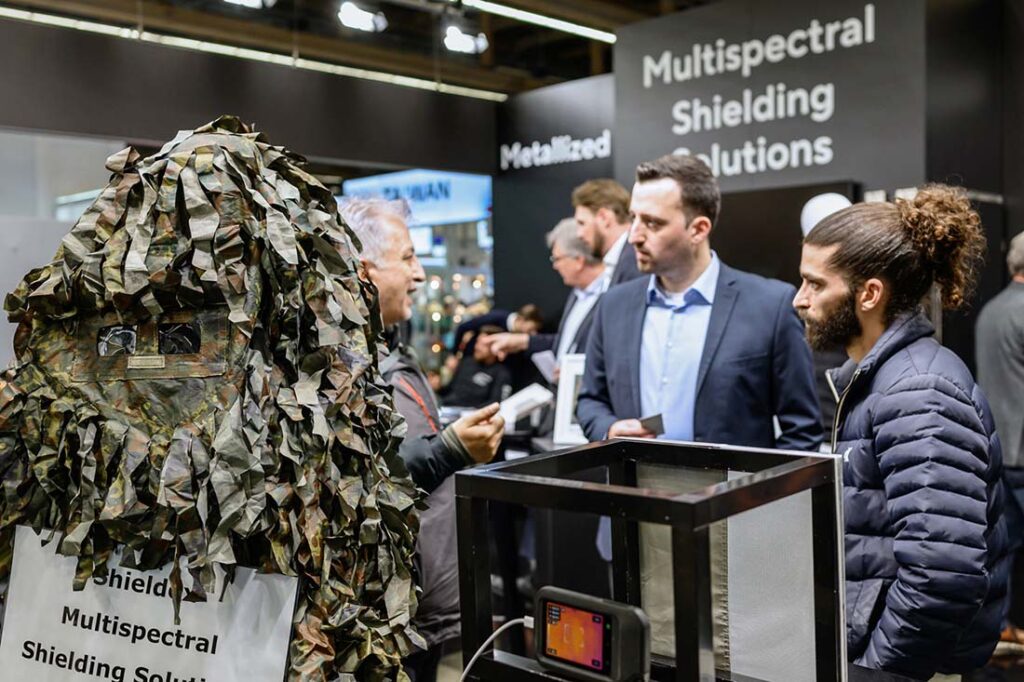
The increasing threat of modern infrared sensors and thermal imaging cameras also requires effective solutions to protect troop movements and equipment from enemy detection. In response to this, Germany-based Shieldex offers metallized textiles that provide effective shielding due to their high reflectivity.
Protecting against electromagnetic interference and preventing signal interception attempts also are critical to modern military operations, and Shieldex also supplies products specifically designed to suppress electromagnetic interference and prevent the detection of communications equipment or command posts.
Smart Stitch
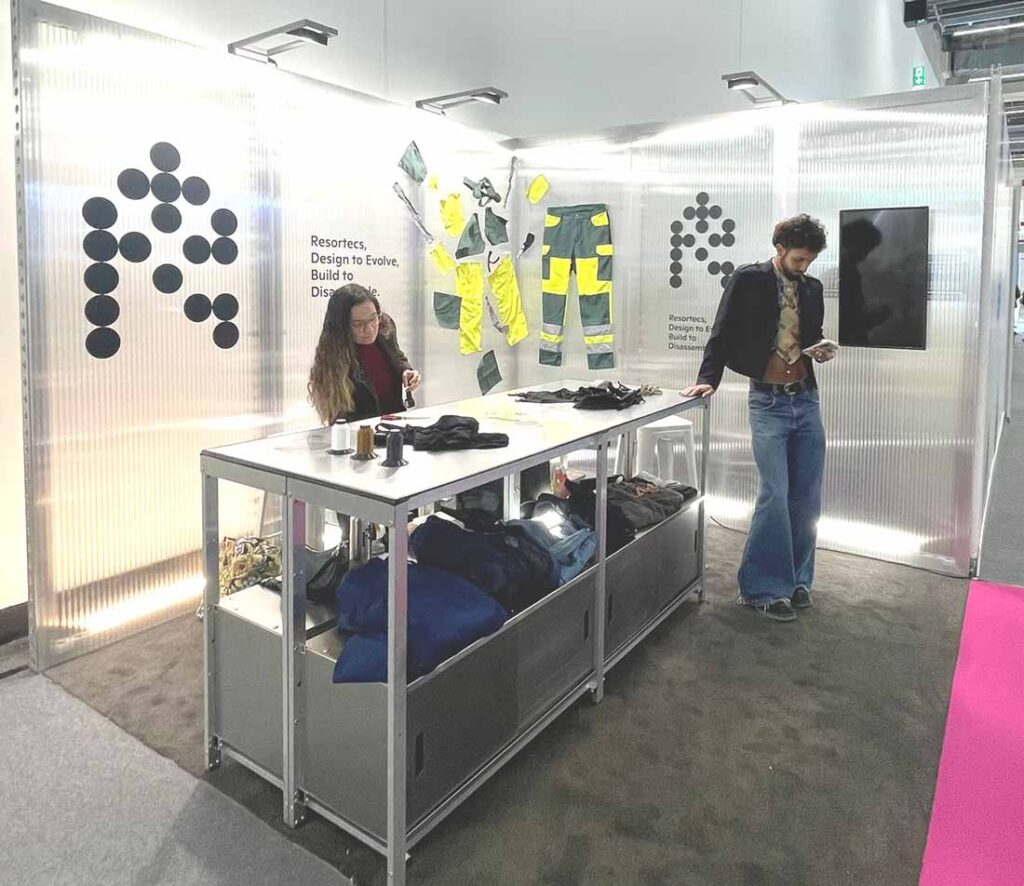
While seemingly no longer center stage, recycling still remains a high priority and in Frankfurt, Belgium-based Resortecs — the developer of Smart Stitch, a heat-dissolvable range of industrial sewing threads — announced a new partnership with the Germany-headquartered Amann Group, one of the world’s top three manufacturers of sewing thread.
The new partnership will see Smart Stitch actively developed via Amann’s industrial expertise and global distribution and allow brands and manufacturers to incorporate disassembly capability directly into garments without changing the design, production or performance of the item.
Smart Stitch is already being used by partners including leading Belgium-based protective wear manufacturer Sioen
Industries, paving the way for the establishment of the first Smart Disassembly line, with an initial annual processing
capacity of 3,000 tons, that will be located and operated in Belgium by Resortecs, hopefully by the end of 2026.
Smart Disassembly is a patented industrial-scale thermal disassembly system with a flexible capacity of 1 to 13 tons per day and a processing speed five times faster than manual disassembly. It is based on low-oxygen chambers with no risk of oxidation damage, in a closed-loop heating system that maximizes energy recovery and minimizes carbon dioxide emissions. The Smart Disassembly pre-processing line will integrate with existing sorting and collection infrastructure, as well as current and upcoming recycling technologies.
Renaissance
Italy-based Klopman, in partnership with sister companies TDV Industries and 4F Knits, has already established the Renaissance Textile recycling plant in France, which aims to regenerate 12,000 tons of polyester uniform waste to produce 42 million new garments this year.
In Frankfurt, in addition to its established range of flame-retardant woven and knitted fabric solutions, Klopman introduced Megaflex R-PES, a new workwear fabric developed with a recycled polyester blend and a PFAS-free water-repellent finish, reflecting a continued focus on sustainable textiles.
Klopman’s marketing manager Thomas Sieber explained that when it comes to recycling, 98 percent of the company’s business is workwear for the global workwear rental industry and the laundry industry for this is in itself operating in a circular way, which is a concrete advantage in terms of logistics.
UK Involvement
Growing security concerns across Europe are also helping to strengthen cooperation between the United Kingdom and the European Union following Brexit. As defense spending rises and governments focus increasingly on military readiness and supply chain resilience, the United Kingdom’s advanced manufacturing and technical textiles sectors are once again becoming closely aligned with European priorities. Collaboration on defense procurement, aerospace programs and protective technologies has intensified over the past year, with both sides recognizing the strategic importance of shared industrial expertise.
Incentivized by these developments, the UK Fashion and Textile Association (UKFT) network supported a group of 42 UK exhibitors at Techtextil 2026.
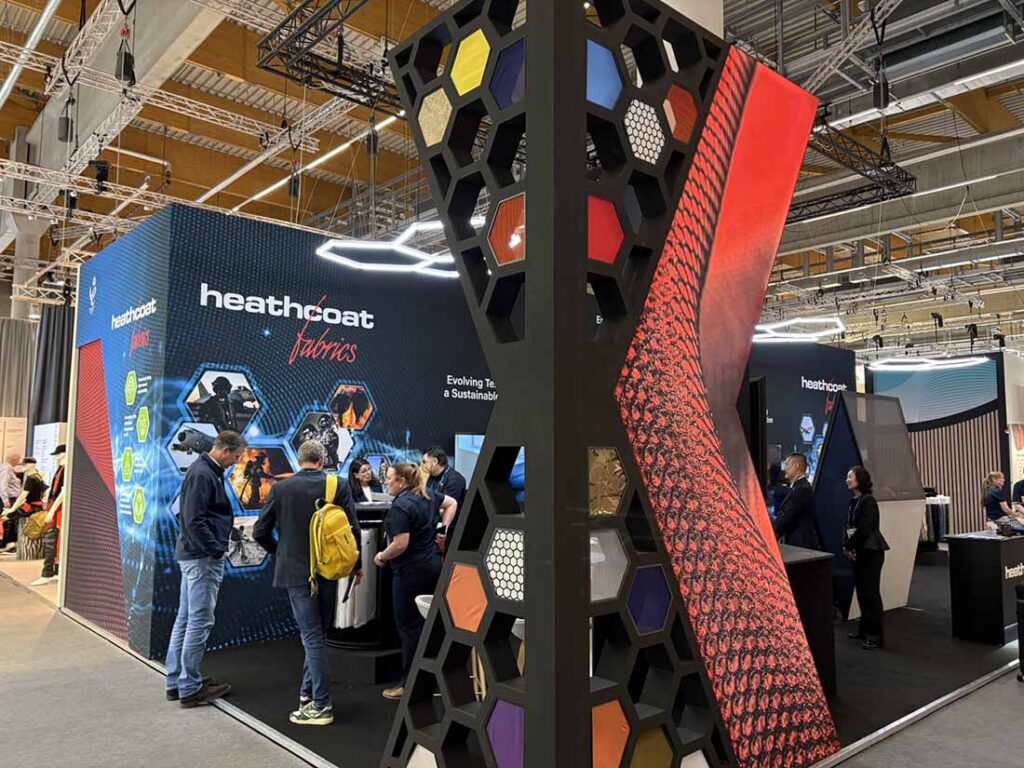
Among them, Heathcoat Fabrics presented a new generation of engineered materials designed to meet increasingly complex operational requirements, produced at its fully integrated in-house production plant. The latest developments include PFAS-free materials for chemical, biological, radiological and nuclear (CBRN) protection, Ember-X technology for wildfire environments, and EVO-FR flame-retardant spacer textiles for transport and aircraft interiors.
EVO-FR, produced using polyetherimide (PEI) yarn, offers a high-performance alternative to conventional foams, degrading and carbonizing under heat to reduce smoke and eliminate molten drip, and has been developed to meet stringent flammability standards.
Alliance
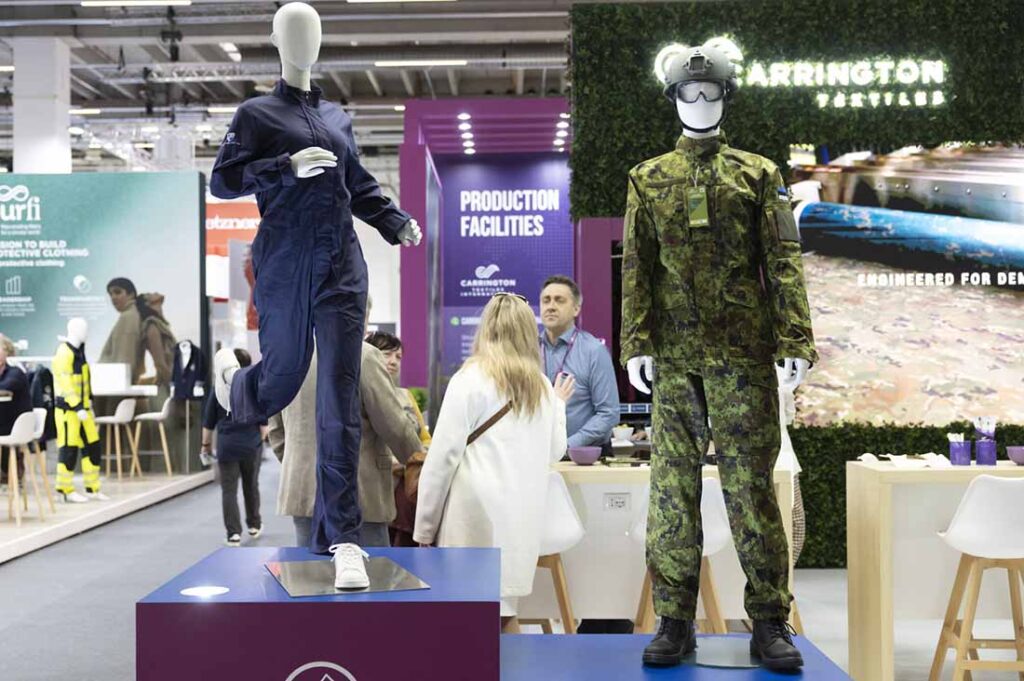
Meanwhile, Pincroft Dyeing and Printing and Toray Textiles Europe — both established suppliers to NATO military programs — announced a new alliance specifically aimed at supplying printed woven technical textiles for the UK defense sector.
“The UK already sells to major forces across the world, from the Netherlands, Germany and France, across to Australia and New Zealand, so why not to the UK itself?” asked UKFT CEO Adam Mansell in Frankfurt. “The UK MOD [Ministry of Defence] and other UK procurement agencies need to be incentivized — or required — to source more of their products from reliable UK sources and see the bigger UK industrial picture.”
Pincroft’s sister company Carrington meanwhile introduced an entirely new generation of inherent flame-retardant fabrics, developed by integrating technologies including Lenzing FR and Xlance, a UK-developed polyolefin-based elastic yarn.
“Our latest collection of fabrics introduces proprietary blends that have not previously existed in the global textiles market and are engineered from the fiber stage to deliver durability, wearer comfort and long-term protective performance,” said Carrington Sales Director Paul Farrell. “These fabrics represent a genuine step change in inherent FR development. Each construction has been created to answer evolving garment engineering demands while maintaining permanent FR integrity throughout the full life cycle of the garment.”
Pressing Challenges
All in all, Techtextil 2026 served to illustrate how the technical textiles sector in Europe is being increasingly reshaped by changing geopolitical realities, evolving environmental priorities and rapidly advancing material technologies. Protective wear is becoming a strategically important industrial capability closely linked to national resilience, defense readiness and critical infrastructure protection.
At the same time, performance and sustainability are now advancing in parallel rather than in opposition. From biobased flame-resistant fibers and PFAS-free chemical protection systems to scalable textile recycling infrastructure, manufacturers continue to deliver solutions that satisfy both operational and environmental demands. The ability to combine durability, comfort, protection and recyclability within the same product is rapidly becoming a defining competitive advantage.
Techtextil 2026 showcased an industry entering a new phase of strategic importance. Whether addressing battlefield survival, industrial safety, wildfire protection or textile circularity, advanced textiles are now at the center of some of the most pressing economic, environmental and security challenges facing Europe, as well as the rest of the world, today.