



Programming at FEDTEX highlighted federal procurement needs, Berry Amendment compliance, textile innovation and the role of domestic manufacturing in supply chain resilience.
The Federal and Defense Textile and Tactical Equipment Summit (FEDTEX), an annual event held recently in Raleigh, N.C., provides a venue for manufacturers of textile-based apparel and tactical equipment to engage with U.S. Department of Defense (DoD) and federal agency clothing and equipment buyers. The event, hosted by the North Carolina Military Business Center (NCMBC) in conjunction with the offices of U.S. Senators Thom Tillis and Ted Budd, combines a tabletop exhibition with three tracks of programming. With more than 60 tabletop exhibits, FEDTEX showcased a range of innovations including fibers and yarns, tactical and medical apparel, fabric coatings and treatments, cut-and-sew technologies, and textile fasteners, as well as the latest from textile laboratories, certification groups and academic researchers.
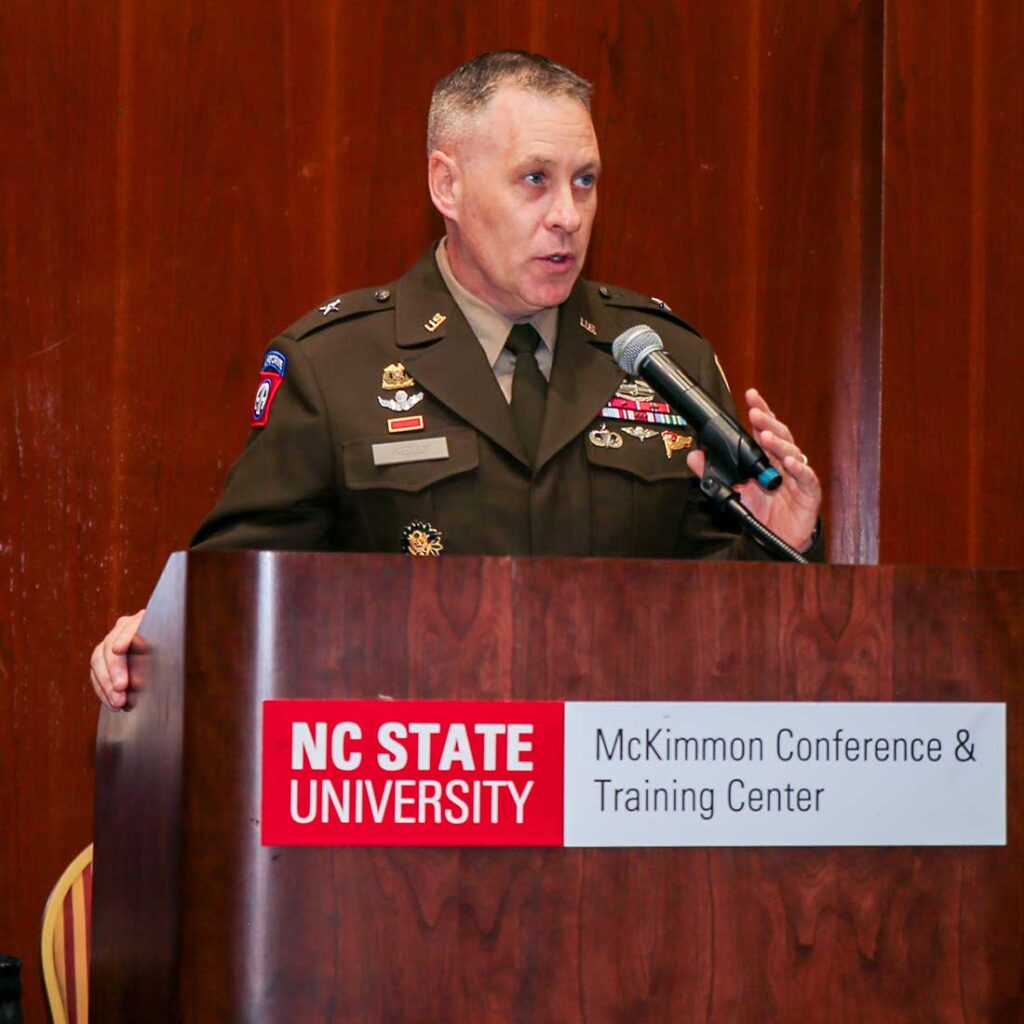
The breakfast plenary session provided insight into reorganization of the DoD procurement process and priorities from Brig. Gen. Sean P. Kelly, commander of Defense Logistics Agency Troop Support, and the current landscape for doing business in a Berry-compliant industry. It was especially interesting to hear that Berry Amendment compliance is considered beyond the DoD to other government agencies such as the Department of the Interior and Customs and Border Protection. The lunchtime plenary included remarks from North Carolina Secretary of State Elaine Marshall who covered the state’s efforts to strengthen and grow North Carolina’s presence in the federal textile product supply chain. David Hinks, dean of the Wilson College of Textiles at NC State University, followed Marshall with a detailed review of the statewide alignment of North Carolina’s higher education programs to support the entire textile industry.
The three tracks of programming were generally split into three major topic areas: instructional presentations on how to do business with the federal government; the current needs of the various branches of the military and government agencies; and technical innovations. First-time attendees reported that the how to do business with the government sessions were exceptionally useful. One attendee noted that prior to attending these sessions they had not fully appreciated how different the federal request for proposals (RFP) process was in contrast with the business-to-business world. Another FEDTEX attendee shared that with the information gained, their organization would be better prepared with respect to needed pre-work such as Cybersecurity Maturity Model Certification (CMMC). One attendee even noted, half jokingly, that attendance at FEDTEX helped decipher the dozens of government and DoD acronyms!

Technical Innovation And Supply Chain Resilience
Technical topics covered during FEDTEX included smart textiles in the military, advances in robotics for textile manufacturing, sustainability in textiles, per- and polyfluoroalkyl substances (PFAS), and workforce resources. The robotics discussion emphasized the potential for driving quality and consistency of textile-based product fabrication and assembly. These technologies can help improve reliability in the field and reduce waste of critical textile resources. Speakers noted that recent simulated war games identified the global interconnected textile supply chain as a potential point of strategic vulnerability. Reducing waste is one component of addressing this risk.
The session on sustainability highlighted the strategic need for textile recycling to maximize resource utilization along with advances supporting these endeavors. The PFAS session presented an overview of PFAS replacement technologies including cost, effectiveness and durability considerations. This was coupled with a discussion of how to revise military specifications away from a “de facto requirement of PFAS as a one-shot chemistry that does everything” and instead consider which attributes were being specifically addressed by PFAS and which attributes are not critical to performance. This shift in thinking allows manufacturers and specifiers to prioritize those attributes, potentially allowing manufacturing to adopt a systems approach rather than relying upon PFAS as a one-shot solution.
Overall, FEDTEX provided an actionable combination of insight into how to do business with the U.S. federal government, the current needs of various departments, agencies and branches, and the current state of technology. The event also pointed to continued growth for FEDTEX as federal textile procurement, domestic supply chain resilience and technical innovation remain priorities.